People talk and my ears bleed...and now my hands. I've been typing. I've been coding. There's a new version of TBE in the production facilities--more of an extreme makeover.
Please go to trietstest.blogspot.com and take a look. Remember it's a work in progress. Tell me what you think. I desperately want feedback.
And no, I haven't graduated to the big time of paid servers and snazzy webpages--it's still a blogspot blog (but I like it).
Sunday, April 30, 2006


Sunday, April 23, 2006
Caesarean Sections (HCMC) Part 3
Alright, so I was wrong. I think. In my first post on caesarean sections in Vietnam, I said
"So what is?" you ask. Glad you asked.
After reading my post a couple nights ago, my wife looked at me and said very bluntly:
"It's not the money, it's the government. It's the two-baby rule."
You see, Vietnam cannot openly enforce the "suggestion" that couples should have no more than one or two children. If it did, it would be violating children's rights (according to my wife and Save the Children UK ... my view of rights is different and deserves another post). Such violations would keep Vietnam out of organizations like the World Trade Organization, which it desperately wants to enter, so Vietnam doesn't enforce the rules, per se. What my wife saw at SCUK was a government that enforced the rule on government employees (such as people who worked for the Committee on Population, Family, and children [CPFC]) by writing it in their contract. Otherwise, the government must revert to convincing the population through lots of propaganda.
What is the best form of propaganda for birthing that the government has? It's cult of doctors. The government has successfully turned the profession of physician into a profession tantamount to godhood. There is a doctor's day. Only the smartest test takers can study medicine. At least 40% of all my English students want to be doctors because they are seen as morally above the people, the most intelligent, and very wealthy.
The doctors at hospitals also happen to be under the pay of the government.
So, the government has waged a very successful propaganda campaign against birthing. It has done this in a few ways:
1. It tells women they will get fat. No woman wants to hear this. The doctors tell all newly expecting mothers that they must gain at least 15kg during the course of pregnancy. If you have travelled around Ho Chi Minh City lately, you've seen the prevalence of fat pregnant women. If you do not reach the requisite weight, they will use drugs to keep you from giving birth until you do (I have never heard of this actually happening, but its a threat I have heard uttered)
2. In order to fight the fat, mothers should get a caesarean section. This surgery will make them less fat than giving birth vaginally. Never mind that the fat is already there from the previous 9 months, or the scar across the abdomen.
3. Births, vaginally or via c-section, are painful. Obviously, no woman in her right mind would want to go through surgery more than once or twice.
Now, this information doesn't explain why the doctors FORCE some women, like my friends, to have c-sections, but it does explain more realistically the probable leading driving force in pushing c-sections. Most hospital doctors make pittance from the hospital and get most of their money from private practice--but its the government that holds the key to promotions, prestige, and power. Also, I'm sure many believe what they practice. The doctors hear all through medical school about the wisdom and benefits of having only one or two children--and so they preach this to their patients.
I know this happens with breastmilk vs. formula. Doctors reinforce the incorrect stereotype that formula is better than breastmilk by teaching it to their patients and promoting certain types for fees.
The end result is a country of women who hear bad things about having more than two children (you'll be poor, it'll hurt, you'll be fat, etc.) and revere doctors giving birth in hospitals where doctors willingly push the doctrine either for personal gain or actual belief. The end result is a lot of c-sections and small families.
Now, underneath this discussion on c-sections, has been the discussion about it's legality. Is it legal? Could someone sue? Here's what I found out from my lawyer here in Vietnam. This conversation is paraphrased, but quoted to the best of my knowledge (it only happened yesterday, but it won't be exactly word for word).
[+/-] read/hide the rest of this post
"Doctors force women to wait until late in gestation and to have c-sections so they can schedule in the birth and make more money."I still think this might be true in some cases, since so many people feel that way, but I do not think it is the ultimate reason.
"So what is?" you ask. Glad you asked.
After reading my post a couple nights ago, my wife looked at me and said very bluntly:
"It's not the money, it's the government. It's the two-baby rule."
You see, Vietnam cannot openly enforce the "suggestion" that couples should have no more than one or two children. If it did, it would be violating children's rights (according to my wife and Save the Children UK ... my view of rights is different and deserves another post). Such violations would keep Vietnam out of organizations like the World Trade Organization, which it desperately wants to enter, so Vietnam doesn't enforce the rules, per se. What my wife saw at SCUK was a government that enforced the rule on government employees (such as people who worked for the Committee on Population, Family, and children [CPFC]) by writing it in their contract. Otherwise, the government must revert to convincing the population through lots of propaganda.
What is the best form of propaganda for birthing that the government has? It's cult of doctors. The government has successfully turned the profession of physician into a profession tantamount to godhood. There is a doctor's day. Only the smartest test takers can study medicine. At least 40% of all my English students want to be doctors because they are seen as morally above the people, the most intelligent, and very wealthy.
The doctors at hospitals also happen to be under the pay of the government.
So, the government has waged a very successful propaganda campaign against birthing. It has done this in a few ways:
1. It tells women they will get fat. No woman wants to hear this. The doctors tell all newly expecting mothers that they must gain at least 15kg during the course of pregnancy. If you have travelled around Ho Chi Minh City lately, you've seen the prevalence of fat pregnant women. If you do not reach the requisite weight, they will use drugs to keep you from giving birth until you do (I have never heard of this actually happening, but its a threat I have heard uttered)
2. In order to fight the fat, mothers should get a caesarean section. This surgery will make them less fat than giving birth vaginally. Never mind that the fat is already there from the previous 9 months, or the scar across the abdomen.
3. Births, vaginally or via c-section, are painful. Obviously, no woman in her right mind would want to go through surgery more than once or twice.
Now, this information doesn't explain why the doctors FORCE some women, like my friends, to have c-sections, but it does explain more realistically the probable leading driving force in pushing c-sections. Most hospital doctors make pittance from the hospital and get most of their money from private practice--but its the government that holds the key to promotions, prestige, and power. Also, I'm sure many believe what they practice. The doctors hear all through medical school about the wisdom and benefits of having only one or two children--and so they preach this to their patients.
I know this happens with breastmilk vs. formula. Doctors reinforce the incorrect stereotype that formula is better than breastmilk by teaching it to their patients and promoting certain types for fees.
The end result is a country of women who hear bad things about having more than two children (you'll be poor, it'll hurt, you'll be fat, etc.) and revere doctors giving birth in hospitals where doctors willingly push the doctrine either for personal gain or actual belief. The end result is a lot of c-sections and small families.
Now, underneath this discussion on c-sections, has been the discussion about it's legality. Is it legal? Could someone sue? Here's what I found out from my lawyer here in Vietnam. This conversation is paraphrased, but quoted to the best of my knowledge (it only happened yesterday, but it won't be exactly word for word).
The Bleeding Ear (TBE): "Are their lawsuits in Vietnam?"So, ultimately, Vietnam has tort law, but the society doesn't use it to the excess (or probably over-excess in my opinion) that American society does. It also has successfully used propaganda to convince women of the benefits of few children and c-sections, so the quote by Le Anh Tuan, in my first post, seems to be more accurate now. He said:
Lawyer: "Yes, of course! Lawsuits are very much protected underneath Vietnamese law."
TBE: "If a doctor did something wrong, could he or she be sued?"
Lawyer: "Most definitely."
TBE: "...by a regular person? Do they have the money? How much does it cost?"
Lawyer: "Yes, normal people can sue. Typically the lawyer will take 5% of the award. A couple days ago I closed a lawsuit worth over 2 billion VND, which gave me about 100 million VND. Lawyers will definitely take the cases."
TBE: "But I don't see a lot of lawsuits in Vietnam like in America."
Lawyer: "No, that's the difference--the culture. The Vietnamese culture hasn't embraced the concept of the lawsuit yet, so very few people do it or even think about it."
"..many mothers opt for a caesarian as a way of avoiding the average ten hours of labour pain caused by natural child birth.Still sounds like a pretty unethical thing to do, a trend that needs to be reversed for the benefit of Vietnamese family structure and the health of the women, and widespread. I am interested in comparing Vietnamese tort law to China (and it's one child system). Any takers?
...[and] some women prefer this unnatural method as they don’t want to lose their beauty after giving birth, while others want their children to be born on a chosen day.
...[and] it [is] very difficult for the hospital to deny any request for a caesarean. If they were to refuse the request and the mother was to have problems giving birth, the hospital could be sued."
[+/-] read/hide the rest of this post
Caesarean Section Births in HCMC, Part II
I tried to respond to the comments to my last post on caesarean sections, but the blog is acting up. My comment doesn't register on my blog, but if you click on the post comment link, it shows up in the pop-up box....strange. Especially since I haven't changed anything to my code recently.
I wonder if it was the length of my comment.
So, here's my response (comment) to the comments.
****
"Tort Law" exists in Vietnam, but like most law in Vietnam (and I assume China) is severly dictated by the communist party. In English speak, that means they enforce what they want to enforce and make everything else far too hard to do.
Suing someone doesn't involve the government in the USA, but in Vietnam, everything is the government. Even "private" companies are only partially private. The government holds a stake in everything. In my post, I am talking about births in Ho Chi Minh City, which almost exclusively happen at hospitals. Hospitals are government funded and ran, the doctors at hospitals are known to be members of the party--not necessarily the best doctors around.
So, to the best of my knowledge, it is possible to sue in Vietnam (I will find out more). However, in this case, you will be suing, basically, the government. Therefore, the government makes it very expensive, impractical, and scary to try that tactic. Much easier to just get a c-section. You must remember that many Viets (most?) in HCMC make between 600k VND and 1.5 mil VND a month ($37 USD to $93 USD) and suing a doctor/hospital would cost FAR more than that. Normal people just can't do it.
Also, interesting observation about China. I don't know if that's the reason for reticence in the actions of Vietnamese police, but it makes some sense.
About the numbers--I was shocked too. I didn't believe the numbers until I asked other people. I'm not talking about all of Vietnam here. The 40% number is a government figure for all of Vietnam, but the 80% is my straw poll about only HCMC. I expect that most women outside HCMC have vaginal births.
That said, even 40% is sickeningly high.
I have, unfortunately, also heard about giving money to get adequate care. When I heard (and read) about the prevalence of c-sections in Vietnam, I couldn't understand why. I thought that maybe it's part of the Vietnamese obsession to be western, modern, like giving children formula instead of breastmilk. The theory about making money stemmed from the comments I heard people make (it kept popping up) and I included it. It's the only reason I can think of that explains why so many totally healthy women/babies were denied vaginal births/inducement AND adequate hospital time. However, I would like to get my hands on something more and explore this further...maybe someone can help??
Finally, one of the small points I made in my post which I think is worth highlighting is the % of post-partum problems. Reasons why aside, 40% of Viet women are having c-sections and 9% of them are having serious complications afterwards. Two things jump out at me: the government study (not to be publicised) claimed only 0.16% and the independent study found 9%. That's a huge difference. I know people doctor numbers in the government to look better, but you'd think the incentive would be less if the numbers were not to be publicised. It would make the government look bad. It makes me wonder if the 40% number is doctored too.
Second, 9% of 40% is still almost 4%. 4% of all births in Vietnam have serious complications DUE TO c-sections. Vietnam has some brave mothers.[+/-] read/hide the rest of this post
I wonder if it was the length of my comment.
So, here's my response (comment) to the comments.
****
"Tort Law" exists in Vietnam, but like most law in Vietnam (and I assume China) is severly dictated by the communist party. In English speak, that means they enforce what they want to enforce and make everything else far too hard to do.
Suing someone doesn't involve the government in the USA, but in Vietnam, everything is the government. Even "private" companies are only partially private. The government holds a stake in everything. In my post, I am talking about births in Ho Chi Minh City, which almost exclusively happen at hospitals. Hospitals are government funded and ran, the doctors at hospitals are known to be members of the party--not necessarily the best doctors around.
So, to the best of my knowledge, it is possible to sue in Vietnam (I will find out more). However, in this case, you will be suing, basically, the government. Therefore, the government makes it very expensive, impractical, and scary to try that tactic. Much easier to just get a c-section. You must remember that many Viets (most?) in HCMC make between 600k VND and 1.5 mil VND a month ($37 USD to $93 USD) and suing a doctor/hospital would cost FAR more than that. Normal people just can't do it.
Also, interesting observation about China. I don't know if that's the reason for reticence in the actions of Vietnamese police, but it makes some sense.
About the numbers--I was shocked too. I didn't believe the numbers until I asked other people. I'm not talking about all of Vietnam here. The 40% number is a government figure for all of Vietnam, but the 80% is my straw poll about only HCMC. I expect that most women outside HCMC have vaginal births.
That said, even 40% is sickeningly high.
I have, unfortunately, also heard about giving money to get adequate care. When I heard (and read) about the prevalence of c-sections in Vietnam, I couldn't understand why. I thought that maybe it's part of the Vietnamese obsession to be western, modern, like giving children formula instead of breastmilk. The theory about making money stemmed from the comments I heard people make (it kept popping up) and I included it. It's the only reason I can think of that explains why so many totally healthy women/babies were denied vaginal births/inducement AND adequate hospital time. However, I would like to get my hands on something more and explore this further...maybe someone can help??
Finally, one of the small points I made in my post which I think is worth highlighting is the % of post-partum problems. Reasons why aside, 40% of Viet women are having c-sections and 9% of them are having serious complications afterwards. Two things jump out at me: the government study (not to be publicised) claimed only 0.16% and the independent study found 9%. That's a huge difference. I know people doctor numbers in the government to look better, but you'd think the incentive would be less if the numbers were not to be publicised. It would make the government look bad. It makes me wonder if the 40% number is doctored too.
Second, 9% of 40% is still almost 4%. 4% of all births in Vietnam have serious complications DUE TO c-sections. Vietnam has some brave mothers.[+/-] read/hide the rest of this post
Thursday, April 20, 2006
Caesarean Section Births in Ho Chi Minh City
(Caveat lector: This post is very long.)
Many of you know someone who has given birth via caesarean section--probably all of you. Unlike its portrayal in Robin Hood: Prince of Thieves (where a Moor Morgan Freeman performs the surgery on Little John's wife), it is not just an emergency procedure anymore. For various personal reasons that can be debated another time, some women opt for caesarean section rather than vaginal birth (i.e. drug free) or epidurals.
Why? Some of the leading doctors in America asked this question, along with, "Should we advise or patients to opt for not-medically necessary c-sections?"
Evidence comparing vaginal births to c-sections is scarce, they say. So,
The caveat:
So, experts from the United States of America and Australia have found that caesarean sections produce extra risks on the mother and child in subsequent births, these risks increase more if the subsequent births are vaginal, they increase still if you have more than two children, and the pros are reduced chances of the child suffering already extremely rare complications.
Now, these are results from two industrialized, wealthy countries with good health care programs--one with lots of caesarean sections and one with few. How does Vietnam stack up??
Although Vietnam's economy is growing by around 7.5% a year, it is not industrialized like America or Australia. Doctors are the upper crust in Vietnam--every child wants to be one--but the health system does not have the expertise or equipment that the other two do. The always horribly written and taken-with-a-grain-of-salt newspaper, the Vietnam News, wrote last year that in Vietnam
"40%?" one lady said. "Whatever. The percentage isn't lower than 80%"
That preceeded a flow of caesarean stories that proved the impetus for this research.
Le Anh Tuan, deputy director of the Central OB hospital in Hanoi, openly admitted reasons why women get c-sections in Hanoi saying,
Now, if women just want a baby on a certain day, why would they opt for c-section over inducing labor?
"Because the doctors want money," a Viet kieu friend told me. "When I went to have my last son, about a year ago, they would not let me have him vaginal. I told a doctor, 'This is my fifth child. I know what it's like. My labors are quick (30 minutes) and I want to be induced now.' My bags were packed and I was ready to go. The doctors flat out refused. They made me have it caesarean."
"It's 'cause they want money," chimed in her expat husband. "With c-sections they can charge more, and schedule the deliveries, so they can just have one right after the other, and make more money in a day. Plus they don't keep you in the hospital as long as they should so they can pump you in and out faster."
Then another friend--native Vietnamese with an expat husband--chimed in and said, "me too! I just had my son only two months ago. I wanted to have it vaginal, but they would not let me. I said, 'induce me!' and they said no. Finally, I packed up my bags, and went to the hospital at 39 weeks. I said, 'I'm not leaving until I have my baby.' Their response was, 'go home and come back in two weeks.' I was forced to wait until 41 weeks and then forced to have a c-section."
People ask me why I don't have any children yet. This is my answer. I don't want to deal with this crap. It's insanity. To force a woman into surgery, in a country with health care like this, because you want more money, and then hide behind the assertion that "the hospital could be sued." My father-in-law's a lawyer in Ho Chi Minh City and I'm telling you, the LAST thing a hospital in the city is worried about is some woman suing them. 99% of people don't have the resources to sue, and the current laws aren't strong enough to ever win a lawsuit against a government hospital, especially in Hanoi.
So, 5.5% of America, 25% of Australia, and probably 80% of Vietnam has babies via caesarean section. Caesarean sections provide some benefits to the baby, but are outweighed by increased complications to the mother in the second and subsequent births. These are multiplied if the mother has her other births vaginally or has more than two births total. Post-partum infections in Vietnam are at 9% of c-sections, almost twice as high as the most liberal % of vaginal births. Doctors force women to wait until late in gestation and to have c-sections so they can schedule in the birth and make more money.
I'm sick of this. I'm sick of the lack of morals. Forget PMU18, get me an investigation into widespread hospital corruption and hypocracy. Vietnamese ob/gyns at hospitals cause increased health problems in women by doing an unnecessary surgical technique with documented risks on at the least 40% of people in Vietnam (double in HCMC). They are everything I never want to be when I am a doctor.
[+/-] read/hide the rest of this post
Many of you know someone who has given birth via caesarean section--probably all of you. Unlike its portrayal in Robin Hood: Prince of Thieves (where a Moor Morgan Freeman performs the surgery on Little John's wife), it is not just an emergency procedure anymore. For various personal reasons that can be debated another time, some women opt for caesarean section rather than vaginal birth (i.e. drug free) or epidurals.
Why? Some of the leading doctors in America asked this question, along with, "Should we advise or patients to opt for not-medically necessary c-sections?"
Evidence comparing vaginal births to c-sections is scarce, they say. So,
"Based on indirect evidence," the report continued, "there appear to be relatively similar degrees of risk from both pathways in women intending to limit their childbearing to one or two children."The report than summarizes the pros and cons to caesarean sections.
"Potential benefits of a requested Caesarean delivery, compared with vaginal delivery, include decreased risk of hemorrhage for the mother and a reduced risk of certain complications for the baby ... Possible risks of a requested Caesarean include respiratory problems for the baby [and] hospital stays tend to be longer for the mother with Caesarean deliveries." (Emphasis is my own).That is pretty straight forward, and ho hum, but the docs did make a few firm recommendations. One of which is,
"Given that the risks of placenta previa and accreta rise with each Caesarean delivery, Caesarean delivery on maternal request is not recommended for women desiring several children."This alarm over caesarean sections comes because
"One published study found that this type of delivery increased from 3.3% of all live births in 1991 to 5.5% in 2001."Other reports have also found problems with caesarean sections. An Australian study found that
"women faced a higher risk of hemorrhage and hysterectomy in their next pregnancy, and there was a higher risk of stillbirth and maternal death.Anecdotal evidence suggested that women who had caesarean sections were at greater risk of infection and illness which impacted on breastfeeding, bonding between mother and baby, and postnatal depression."
This is important information because Australians have more experience in caesareans than Americans--with almost 25% of births now by c-section.
"[Dr Tracy] said a caesarean section cost on average $1000 more than a natural birth, and women were spending twice as long in hospital - an average of five days compared with two to three days for natural births."Hey, I wouldn't be a microbiologist without at least one scientific study to throw at you. Here's some hard data from the Medical Journal of Australia. (MJA 2005;183(10): 515-519)
The caveat:
"Of the 136 101 women with data on both first and second births, 25 596 (18.8%) had a caesarean section in their first pregnancy. Compared with mothers with primary vaginal birth, mothers who had primary caesarean section tended to be older, more socially advantaged and more likely to have medical and obstetric complications."Now the results:
"We found primary caesarean section (compared with primary vaginal birth) conferred additional risk of complications in the second pregnancy for both mother (primarily if she underwent labour) and baby, and that a substantial proportion of serious complications were attributable to primary caesarean section. However, the complications we examined were uncommon, regardless of whether the mother had a primary caesarean section.
...Among mothers who underwent labour, we found higher rates of PPH, hysterectomy, and manual removal of placenta in those who had had a primary caesarean section than in those who had not.
...Primary caesarean section conferred a higher risk of postpartum infection, which is not surprising given the substantially higher caesarean section rate in the second pregnancy in these mothers (18% v 4%). Primary caesarean section also conferred a higher risk of admission to ICU for women who undergo labour, consistent with higher rates of complications overall.
...Our results lead us to conclude that, if a mother has had a primary caesarean section, she will only reduce her risks of complications in her second pregnancy to the level commensurate with a mother who had a primary vaginal delivery if she also has a caesarean section in her second pregnancy."
So, experts from the United States of America and Australia have found that caesarean sections produce extra risks on the mother and child in subsequent births, these risks increase more if the subsequent births are vaginal, they increase still if you have more than two children, and the pros are reduced chances of the child suffering already extremely rare complications.
Now, these are results from two industrialized, wealthy countries with good health care programs--one with lots of caesarean sections and one with few. How does Vietnam stack up??
Although Vietnam's economy is growing by around 7.5% a year, it is not industrialized like America or Australia. Doctors are the upper crust in Vietnam--every child wants to be one--but the health system does not have the expertise or equipment that the other two do. The always horribly written and taken-with-a-grain-of-salt newspaper, the Vietnam News, wrote last year that in Vietnam
"In 2001, 36.9 per cent of mothers undertook the operation, whereas in the first six months of this year alone the figure is nearer 40 per cent."I dropped this by a few of my friends that have had children recently and was immediately laughed at.
"40%?" one lady said. "Whatever. The percentage isn't lower than 80%"
That preceeded a flow of caesarean stories that proved the impetus for this research.
Le Anh Tuan, deputy director of the Central OB hospital in Hanoi, openly admitted reasons why women get c-sections in Hanoi saying,
"Usually caesarean births are only carried out if there are pregnancy complications, or if the mother is ill, either reason posing serious risks to the health of the mother or child.And the kicker is that he finishes it with this:
...that doctors would also decide to operate if the embryo was over grown, or if the mother was too old or too young. The doctor also said mothers who had received embryo transplants resulting from in vitro fertilisation should also undertake the operation.
...many mothers opt for a caesarian as a way of avoiding the average ten hours of labour pain caused by natural child birth.
...[and] some women prefer this unnatural method as they don’t want to lose their beauty after giving birth, while others want their children to be born on a chosen day."
"it [is] very difficult for the hospital to deny any request for a caesarean. If they were to refuse the request and the mother was to have problems giving birth, the hospital could be sued."What are the statistics from c-sections in Vietnam? A report in the Journal of Health, Population, and Nutrition gives some clues.
"Results of a longitudinal study showed that the incidence of post-caesarean infection was 9% with 3-4% severe infection ... Yet, these rates are likely underestimates as routine laboratory analysis of post-caesarean patients was not conducted."(This is interesting because the government found only 0.16% post-partum infections in its own unpublished study.) The estimates of post-partum infections after vaginal births range from 1.7% to about 5%. Even the most conservative estimate of vaginal births gives an infection rate 10 times higher than what the government recorded only one year earlier in a private report.
Now, if women just want a baby on a certain day, why would they opt for c-section over inducing labor?
"Because the doctors want money," a Viet kieu friend told me. "When I went to have my last son, about a year ago, they would not let me have him vaginal. I told a doctor, 'This is my fifth child. I know what it's like. My labors are quick (30 minutes) and I want to be induced now.' My bags were packed and I was ready to go. The doctors flat out refused. They made me have it caesarean."
"It's 'cause they want money," chimed in her expat husband. "With c-sections they can charge more, and schedule the deliveries, so they can just have one right after the other, and make more money in a day. Plus they don't keep you in the hospital as long as they should so they can pump you in and out faster."
Then another friend--native Vietnamese with an expat husband--chimed in and said, "me too! I just had my son only two months ago. I wanted to have it vaginal, but they would not let me. I said, 'induce me!' and they said no. Finally, I packed up my bags, and went to the hospital at 39 weeks. I said, 'I'm not leaving until I have my baby.' Their response was, 'go home and come back in two weeks.' I was forced to wait until 41 weeks and then forced to have a c-section."
People ask me why I don't have any children yet. This is my answer. I don't want to deal with this crap. It's insanity. To force a woman into surgery, in a country with health care like this, because you want more money, and then hide behind the assertion that "the hospital could be sued." My father-in-law's a lawyer in Ho Chi Minh City and I'm telling you, the LAST thing a hospital in the city is worried about is some woman suing them. 99% of people don't have the resources to sue, and the current laws aren't strong enough to ever win a lawsuit against a government hospital, especially in Hanoi.
So, 5.5% of America, 25% of Australia, and probably 80% of Vietnam has babies via caesarean section. Caesarean sections provide some benefits to the baby, but are outweighed by increased complications to the mother in the second and subsequent births. These are multiplied if the mother has her other births vaginally or has more than two births total. Post-partum infections in Vietnam are at 9% of c-sections, almost twice as high as the most liberal % of vaginal births. Doctors force women to wait until late in gestation and to have c-sections so they can schedule in the birth and make more money.
I'm sick of this. I'm sick of the lack of morals. Forget PMU18, get me an investigation into widespread hospital corruption and hypocracy. Vietnamese ob/gyns at hospitals cause increased health problems in women by doing an unnecessary surgical technique with documented risks on at the least 40% of people in Vietnam (double in HCMC). They are everything I never want to be when I am a doctor.
[+/-] read/hide the rest of this post
Tuesday, April 18, 2006
The Gospel of Judas
First, a disclaimer: I am Christian. I do not, however, consider myself part of the "religious right" as my libertarian political philosophy often puts me at odds with what they say.
That being said, I watched the Gospel of Judas show the other night on the National Geographic Channel, and wanted to hurl--hurl something at the tv. I think it's the scientist in me. I kept saying (outloud and much to the chagrin of my wife),
"Where's the evidence? ...That doesn't prove that ... how can they make that assertion? Their evidence doesn't back up that."
Et. cetera.
You must understand--I grew up on National Geographic. I remember sitting for hours in the hot garage in Houston, Texas, reading through NG magazines from the '70s and '80s. I remember how much i treasured the issue where the cover was totally holographic with an eagle in the middle--the cover story celebrated the new technology of holograms. In school, as I grew older and fell in love with biology, I always held NG as a pinnacle of science journalism--to bring amazing photographs together with hard science to help explain the mysteries of the world.
There was NO hard science in the Gospel of Judas. It ... how do I say ... betrayed my faith in National Geographic. The first hour was spent trying to debunk the image of Judas that modern Christianity believes in. Carefully spliced interviews of leading Christian theologians I've never heard of and have never influenced my belief painted Judas as a misunderstood character. He was a character painted in an evil light as post-crucifixion Christians tried to distance themselves from Jews. They tried to blame a Roman execution on Jews to assuage their own guilt. They looked down on Jews for stubbornly fighting the Romans in 70 AD.
All of this conjecture might have gone forgiven had it stopped, but no, then they connected the character of Judas to anti-semitism in Europe and as a cause for the holocaust.
Aside: Why does everything bad have to somehow lead back to the holocaust? Can't we just accept that people can be evil, and maybe commit evil acts NOT connected to an obviously horrific act of genocide that has garnered Hitler a special place in Hell??
I don't know about you, but I've never thought of Judas as a Jew, and my acceptance of his betrayal of Jesus hasn't turned me into an anti-semite. Judas was an apostle of Christ, and his betrayal is a tale of tragedy.
The second hour of the show showed how the 85% of the manuscript recovered revealed a document that purports Judas was asked by Christ to betray him. It glossed quickly over the fact that the gospel was written about 100-150 years after the other gospels, was not considered authentic in its own time, nor adequately explains the influence of gnosticism on the manuscript.
That, could have been an interesting show. Two hours of explaining Gnosticism and how the Gospel of Judas helps shed light on this obscure early sect of Christianity. Ah, but history is full of "could have beens."
Dave Kopel, of The Volokh Conspiracy, has a good post on Gnosticism and the Gospel's place in science.
"If modern people believe in the Gospel of Judas, and start a religion around it, would it be called Judaism too?"
Which brings me to my concluding thoughts. I don't read conservative christian blogs much, but I ran across this post to American Digest from Instapundit. Read it. Superbly written, even if you don't agree with what he says. Here's one of my favorite quotes (On professional intellectuals including the editors of NG):
That being said, I watched the Gospel of Judas show the other night on the National Geographic Channel, and wanted to hurl--hurl something at the tv. I think it's the scientist in me. I kept saying (outloud and much to the chagrin of my wife),
"Where's the evidence? ...That doesn't prove that ... how can they make that assertion? Their evidence doesn't back up that."
Et. cetera.
You must understand--I grew up on National Geographic. I remember sitting for hours in the hot garage in Houston, Texas, reading through NG magazines from the '70s and '80s. I remember how much i treasured the issue where the cover was totally holographic with an eagle in the middle--the cover story celebrated the new technology of holograms. In school, as I grew older and fell in love with biology, I always held NG as a pinnacle of science journalism--to bring amazing photographs together with hard science to help explain the mysteries of the world.
There was NO hard science in the Gospel of Judas. It ... how do I say ... betrayed my faith in National Geographic. The first hour was spent trying to debunk the image of Judas that modern Christianity believes in. Carefully spliced interviews of leading Christian theologians I've never heard of and have never influenced my belief painted Judas as a misunderstood character. He was a character painted in an evil light as post-crucifixion Christians tried to distance themselves from Jews. They tried to blame a Roman execution on Jews to assuage their own guilt. They looked down on Jews for stubbornly fighting the Romans in 70 AD.
All of this conjecture might have gone forgiven had it stopped, but no, then they connected the character of Judas to anti-semitism in Europe and as a cause for the holocaust.
Aside: Why does everything bad have to somehow lead back to the holocaust? Can't we just accept that people can be evil, and maybe commit evil acts NOT connected to an obviously horrific act of genocide that has garnered Hitler a special place in Hell??
I don't know about you, but I've never thought of Judas as a Jew, and my acceptance of his betrayal of Jesus hasn't turned me into an anti-semite. Judas was an apostle of Christ, and his betrayal is a tale of tragedy.
The second hour of the show showed how the 85% of the manuscript recovered revealed a document that purports Judas was asked by Christ to betray him. It glossed quickly over the fact that the gospel was written about 100-150 years after the other gospels, was not considered authentic in its own time, nor adequately explains the influence of gnosticism on the manuscript.
That, could have been an interesting show. Two hours of explaining Gnosticism and how the Gospel of Judas helps shed light on this obscure early sect of Christianity. Ah, but history is full of "could have beens."
Dave Kopel, of The Volokh Conspiracy, has a good post on Gnosticism and the Gospel's place in science.
The roots of the Gospel of Judas and of gnosticism go back to Marcion (approx. 100-160 a.d.). After he was excommunicated for heresy, he founded his own sect, the Marcionites.It's a good post, which led a coworker to speculate,
...The Marcionites believed that the physical world was created by the angry god of the Old Testament, and that Jesus had been sent by a different god, who had nothing to do with the created world. Marcionites strove to avoid all contact with the created world. They were celibate, and ultra-ascetic.
"If modern people believe in the Gospel of Judas, and start a religion around it, would it be called Judaism too?"
Which brings me to my concluding thoughts. I don't read conservative christian blogs much, but I ran across this post to American Digest from Instapundit. Read it. Superbly written, even if you don't agree with what he says. Here's one of my favorite quotes (On professional intellectuals including the editors of NG):
"Addicts of auto-erotic spiritual asphyxiation, their onanistic pleasure in these deeds is only enhanced if they [critizing and denegrating Christianity] can be performed during the most holy days of the Christian calendar. Only then can maximum profit and pleasure be assured.In the words of the modern American teenage Generation Why-er: "Ohhh! Snap!"
This dark thrill of denigration has the immediate benefit of pleasingly confirming them in their own Church of Zero ..."
Thursday, April 13, 2006
The Girl in the Library
[Like The Face at the Restaurant, "the purpose of relating the story is to highlight life's many fork-in-the-road situations." It is a moment in time, a person, a "what if" situation, and an indelible part of me.]
Slowly the bead of sweat dripped down my forehead. Winding it's way amid the unseen nooks and ravines of my skin, it brushed my right eyebrow, dipped down toward my eye, and caused an insatiable itch rewarded by a quick flick of the wrist and a wipe.
"Man, this wasn't what I had in mind," I thought.
Sick. Fever. And I was stuck wiping my sweat with my starched white cuff. Clearing my throat I adjusted my tuxedo once again.
"I don't know how much longer I can do this, feeling light-headed and all," I mused. My eyes drifted down to the new ring on my finger and locked onto a reflection of black hair.
All at once I found myself at a desk on the bottom floor of the library, trying to separate my life from the muck. So many distractions.
Like an underwater dance, moving oh so slowly, words sounding hollow, deep, and distorted, my life of the last two years swirled around me. Heck, the last fifteen minute walk to the library swirled around me. Swirling, swirling ... and BAM!. Snapped back to reality, seeing clearly, maybe too much so, I saw her.
Why hadn't I noticed her earlier? I had sat right next to her. Black hair, the soft kind with a sheen that speaks to you. Eyes, wide, in that European way, contrasting the delicate asian features of her face like a heroine's eyes in Japanese anime. Simple shirt, simple clothes, but that smile ... that smile ... almost tangible like the sweet taste of strawberry in the summer.
Her lips moved, and then I saw her eyes. They darted at me, then away into space, then back again.
"Are you speaking to me?" I thought, as her eyes moved again.
"What? Don't you think I'm pretty?" She asked.
Did the words come from her moving lips or riveting eyes?
"Of course. You're amazing." I replied, entranced with the woman before me. How could someone like this be found on the bottom floor of a library. Truly the best things in life are unheralded.
"Then kiss me, you fool," said those beautiful black eyes. "What are you waiting for?"
"You're kidding me," I thought. "I don't know you. We've only just met."
"Kiss her, you moron," said a voice. "Obviously she wants it--just look at her eyes."
"Don't be stupid. You don't even know her," came my mind's reply.
Back and forth they went, the voices in my head, arguing "to do or not to do" and the world started spinning again. Those eyes, all I knew were those eyes were speaking to me. I had sat next to an amazingly beautiful girl, her eyes were speaking to me, and both sides of my conscionce were duking it out on my shoulder.
And then ... kiss. The world focused instantly on our lips, lightly locked in the library. A second, a blink, and it was over.
What had I done? What had I done? Why did I do it? It was her eyes! They made me do it! They called to me, asked me, pleaded, even.
My hand quivered and the reflection in my ring was gone.
"How long was I gone?" I asked. "A minute? No, only seconds."
Slowly, I exhaled.
Looking to my right, I saw her again, that same girl from the library, even more beautiful than in my memory. Succulent red lips, braided black hair, a stunning white wedding dress...
Boy am I glad I kissed her.
[+/-] read/hide the rest of this post
Slowly the bead of sweat dripped down my forehead. Winding it's way amid the unseen nooks and ravines of my skin, it brushed my right eyebrow, dipped down toward my eye, and caused an insatiable itch rewarded by a quick flick of the wrist and a wipe.
"Man, this wasn't what I had in mind," I thought.
Sick. Fever. And I was stuck wiping my sweat with my starched white cuff. Clearing my throat I adjusted my tuxedo once again.
"I don't know how much longer I can do this, feeling light-headed and all," I mused. My eyes drifted down to the new ring on my finger and locked onto a reflection of black hair.
All at once I found myself at a desk on the bottom floor of the library, trying to separate my life from the muck. So many distractions.
Like an underwater dance, moving oh so slowly, words sounding hollow, deep, and distorted, my life of the last two years swirled around me. Heck, the last fifteen minute walk to the library swirled around me. Swirling, swirling ... and BAM!. Snapped back to reality, seeing clearly, maybe too much so, I saw her.
Why hadn't I noticed her earlier? I had sat right next to her. Black hair, the soft kind with a sheen that speaks to you. Eyes, wide, in that European way, contrasting the delicate asian features of her face like a heroine's eyes in Japanese anime. Simple shirt, simple clothes, but that smile ... that smile ... almost tangible like the sweet taste of strawberry in the summer.
Her lips moved, and then I saw her eyes. They darted at me, then away into space, then back again.
"Are you speaking to me?" I thought, as her eyes moved again.
"What? Don't you think I'm pretty?" She asked.
Did the words come from her moving lips or riveting eyes?
"Of course. You're amazing." I replied, entranced with the woman before me. How could someone like this be found on the bottom floor of a library. Truly the best things in life are unheralded.
"Then kiss me, you fool," said those beautiful black eyes. "What are you waiting for?"
"You're kidding me," I thought. "I don't know you. We've only just met."
"Kiss her, you moron," said a voice. "Obviously she wants it--just look at her eyes."
"Don't be stupid. You don't even know her," came my mind's reply.
Back and forth they went, the voices in my head, arguing "to do or not to do" and the world started spinning again. Those eyes, all I knew were those eyes were speaking to me. I had sat next to an amazingly beautiful girl, her eyes were speaking to me, and both sides of my conscionce were duking it out on my shoulder.
And then ... kiss. The world focused instantly on our lips, lightly locked in the library. A second, a blink, and it was over.
What had I done? What had I done? Why did I do it? It was her eyes! They made me do it! They called to me, asked me, pleaded, even.
My hand quivered and the reflection in my ring was gone.
"How long was I gone?" I asked. "A minute? No, only seconds."
Slowly, I exhaled.
Looking to my right, I saw her again, that same girl from the library, even more beautiful than in my memory. Succulent red lips, braided black hair, a stunning white wedding dress...
Boy am I glad I kissed her.
[+/-] read/hide the rest of this post
Tuesday, April 11, 2006
Wanna head a Vietnamese Government Agency? Only $1 Mil. USD
Today the Người Lao Động printed an interview with Đỗ Quang Trung, head of the Interior Ministry. Interesting article. The best part is this question (all translation is my own):
"Có dư luận nói rằng chức thứ trưởng “chạy” hết 8 tỉ đồng, chức bộ trưởng hết 15 tỉ đồng, Bộ trưởng có nghe thông tin này?"Answer:
(Minister, have you heard the public assertions that to be a deputy minister requires over 8 billion VND, and becoming a minister needs over 15 billion VND?)
"Việc chạy chức chạy quyền có dư luận lâu rồi chứ không riêng ở Bộ GTVT. Công tác cán bộ không một cá nhân nào quyết định mà phải là tập thể. Ngay việc Thủ tướng quyết định không phải qua Ban Bí thư thì cũng phải lấy ý kiến các ban Đảng, các cơ quan tham gia. Đây cũng là một cách khắc phục việc chạy chức chạy quyền. Nếu giao cho một cá nhân nào quyết định thì cực kỳ nguy hiểm."Way to beat around the bush, Mr. Đỗ. So I'm supposed to understand that the $500k USD or $1 mil. USD needed to be a deputy minister or minister must be shared with many people instead of given to just one person, right? Ah, I see...
(This opinion has been around for anyone in office for awhile, not just for the Ministry of Transportation & Traffic. An officer's work is not the decision of one person but a group of people. The choice of a deputy minister is not just the committee of the Secretary's decision, but they also get the opinions of other party committees, and other organizations participate too. This is only one way to check abuses of position and power. It is extremely dangerous to entrust one person with all decision-making power.)
Sunday, April 09, 2006
Comments Bug
This is a note to readers:
Recently I instituted a new tagging system using del.icio.us tags to make pseudo-categories. (I love it by the way). However, since then, the comments I've made (only on this blog) have not been preview-able. Is this only me, or do you other readers have problems previewing comments also?
The del.icio.us system required FreshTags and Greasemonkey for Firefox. So, if it's only me, maybe it has something to do with my Greasemonkey addition. If it's everyone, maybe it's the FreshTags.
Recently I instituted a new tagging system using del.icio.us tags to make pseudo-categories. (I love it by the way). However, since then, the comments I've made (only on this blog) have not been preview-able. Is this only me, or do you other readers have problems previewing comments also?
The del.icio.us system required FreshTags and Greasemonkey for Firefox. So, if it's only me, maybe it has something to do with my Greasemonkey addition. If it's everyone, maybe it's the FreshTags.
Friday, April 07, 2006
Nosy Viets
Yesterday was one of those days...sometimes I love the people here in Vietnam and sometimes I hate them. Right now, I feel much more of the latter than the former.
Yesterday I left the house about three o'clock to pick up the wife from work (Save the Children UK) and biked to the corner of Đỗ Ngọc Thạch and 3 Tháng 2. At the intersection I must turn left onto "3/2" and take that a long ways to District 1. However, the intersection was packed. Gridlock. Absolutely packed. Not uncommon in Vietnam, but never exciting either.
In great Vietnamese fashion, the light turned green and I took off, jutting into the middle of the intersection, weaving in between bikes, and making it almost to the end when I became lodged in the mass of flesh and steel, shouts and horns. To my right was a group of people standing outside a house and two green-clad policemen with their traffic batons out.
"Ah hah!" I thought. "The typical police coming to a house and everyone wants to see it mess. Why are people here so nosy?"
Then I looked closer and saw a man kneeling on the ground, his arm covered in blood as he desperately tried to stop the red geyeser erupting from another man's neck. At that moment I realized the situation was bad. A traffic accident. Dunno why. Dunno how. But I know the results.
Everything suddenly came into focus: two policemen, trying their hardest to get people to move, but nobody was moving; one man lying on the ground, dying; another man desperately trying to save his life, irregardless of AIDS or other possibilities; and maybe a hundred people on motorbikes disobeying the police, blocking any hope of an ambulance, and gawking.
At that moment I lost it...I blew up. I compared the scene to America, where people are required by law (and follow it) to help or get out of the way. This just seemed so wrong, so evil. Worse than tò mò (nosy), worse than mất lịch sự (rude), worse than ... worse.
So I did what I could do--scream. I started yelling at the top of my lungs at everyone around me. The only way for the situation to get better is for people to leave. So I started pushing people to leave.
"Đi nhé!" I yelled. "Đi mày đi! Mày ngư quá à!"
("Go!" I yelled. "Go you moron! You're freaking retarded!")
My invectives were at anyone I could point a finger at and get eye contact. Slowly, people woke up and some took off, even if only for 20 meters before stopping and watching from afar. The lane opened up for me, and I took it too, doing my part to let a dying man have his peace, his chance for life, and his dignity.
Later that night, driving home from dinner, I saw six teenagers in a fist fight, two with boards, and some men stopping to try and break it up. I thought to call the cops, but my wife stopped me. "That's not how it's done in Vietnam," she said.
Well, if this is how it's done, then I'm glad to be headed back to the states in two months.
Yesterday I left the house about three o'clock to pick up the wife from work (Save the Children UK) and biked to the corner of Đỗ Ngọc Thạch and 3 Tháng 2. At the intersection I must turn left onto "3/2" and take that a long ways to District 1. However, the intersection was packed. Gridlock. Absolutely packed. Not uncommon in Vietnam, but never exciting either.
In great Vietnamese fashion, the light turned green and I took off, jutting into the middle of the intersection, weaving in between bikes, and making it almost to the end when I became lodged in the mass of flesh and steel, shouts and horns. To my right was a group of people standing outside a house and two green-clad policemen with their traffic batons out.
"Ah hah!" I thought. "The typical police coming to a house and everyone wants to see it mess. Why are people here so nosy?"
Then I looked closer and saw a man kneeling on the ground, his arm covered in blood as he desperately tried to stop the red geyeser erupting from another man's neck. At that moment I realized the situation was bad. A traffic accident. Dunno why. Dunno how. But I know the results.
Everything suddenly came into focus: two policemen, trying their hardest to get people to move, but nobody was moving; one man lying on the ground, dying; another man desperately trying to save his life, irregardless of AIDS or other possibilities; and maybe a hundred people on motorbikes disobeying the police, blocking any hope of an ambulance, and gawking.
At that moment I lost it...I blew up. I compared the scene to America, where people are required by law (and follow it) to help or get out of the way. This just seemed so wrong, so evil. Worse than tò mò (nosy), worse than mất lịch sự (rude), worse than ... worse.
So I did what I could do--scream. I started yelling at the top of my lungs at everyone around me. The only way for the situation to get better is for people to leave. So I started pushing people to leave.
"Đi nhé!" I yelled. "Đi mày đi! Mày ngư quá à!"
("Go!" I yelled. "Go you moron! You're freaking retarded!")
My invectives were at anyone I could point a finger at and get eye contact. Slowly, people woke up and some took off, even if only for 20 meters before stopping and watching from afar. The lane opened up for me, and I took it too, doing my part to let a dying man have his peace, his chance for life, and his dignity.
Later that night, driving home from dinner, I saw six teenagers in a fist fight, two with boards, and some men stopping to try and break it up. I thought to call the cops, but my wife stopped me. "That's not how it's done in Vietnam," she said.
Well, if this is how it's done, then I'm glad to be headed back to the states in two months.
Tuesday, April 04, 2006
Tags and Categories
Well, I've added some new blogs to the blogroll. Look to the side and you'll see blogger hacks, ecmanaut, freshblog, and the last word. All are blogs dealing with blogger hacks, coding, and making life easier for a starving blogger using blogspot.
Hopefully, this post will be the first of many to be tagged with del.icio.us tags and eventually that will be used to form categories...that's the hope at least. Until then, enjoy my new drop down menus for archives and recent posts.
Hopefully, this post will be the first of many to be tagged with del.icio.us tags and eventually that will be used to form categories...that's the hope at least. Until then, enjoy my new drop down menus for archives and recent posts.
Friday, March 31, 2006
John Locke and My Wife
Currently, my wife is taking American Heritage by independent study. For those of you who have never heard of "American Heritage," it is the made up class at BYU that supposedly mixes history, political science, and economics into one general education class for non-polysci, history, or econ majors.
I never took this class, for I looked on it with disdain--choosing instead to take real history classes and econ classes.
My wife had a hard time with the first essay, so I helped explain John Locke's theory to her and formulate her ideas into a coherent essay. She got an A, so I must have done a good job. In her essay she compares America's protection of Locke's "inalienable rights" to Vietnam's version:
You can read the whole essay on John Locke's theory and how it influenced the founding fathers by clicking the read/expand link below (warning, in MS Word it is 3 single-spaced pages).
*****Essay 1 by My Wife (quotes may be used with proper annotation. This work may not be reproduced in full without the expressed written consent of the author. A reminder, everything on this blog is under copyright)*****
The American experience is a unique phenomenon in the history of the world. Not since man first spread out over the globe and settled ancient civilizations was there a situation amicable to the development of a free society. One of the major factors in shaping such an environment was John Locke. His essays, like the Second Treatise, helped steer intellectual debate and human thought to build a situation that incubated individual liberties and changed the citizen-government relationship. His Second Treatise focused on five points that apply directly to the American experience: humanity’s natural state, the social contract, the purpose of government, derivation of governmental power, and reciprocity for governmental dereliction of duties.
The five points explained by John Locke in his treatise stem ultimately from his view of human nature. Locke worked as personal secretary to the Earl of Shaftsbury, which gave him experience seeing how public policy influences the nation. However, he also saw that money drove these people to work in government. The mercantilist era saw huge monopolies develop in order to corner markets like sugar, slaves, and tea. These mega-companies allowed goods to be shipped in bulk—thereby achieving an economy of scale, reducing costs and increasing profits.
From his experience, Locke believed that man is inherently driven by self-interest. The driving force for mercantilism was money, not philanthropies nor God. One example was slavery. English mercantilists organized their companies in order to make more money selling slaves, not because they felt any desire to help Africans. The paternalistic view of slavery in the United States arose during the late 1700s and early 1800s to help the South gain a moral upper hand over the North’s economic arguments against the institution.
Therefore, two things become evident. First, if there is no higher power—no relevant higher power dictating man’s actions—then man, himself, is supreme. Second, mercantilism shows that this paramount man is driven by, and treasures most, his personal ability to follow his interests. If he wants to own slaves, he can work towards that. In summary, individual liberty is the inborn gift of a supreme person to achieve his or her life goals.
Locke built on this assumption in his Second Treatise by listing five points between this paramount man and government. He describes the original state of man as the hypothetical “state of nature.” He speculates that a person based on his view of human nature, would live peacefully in a world where “all had rights to live their lives, to enjoy their liberty, and to own and improve their property” (Fox, 43). These three tenants exist for all, unable to be taken away, given to man by Nature herself. However, Locke’s view is profoundly idealistic. A man with perfect freedom could walk around, eat apples off of any tree he liked, play in any stream he chose, and slept in any dale he found. But what happens when another person crosses his path, wants to eat the same apple, or bathe in the same stream? Two people cannot eat one apple.
This problem is solved by the “social contract.” Humanity, Locke postulates, has two conflicting desires: harmony and freedom. In order to live in harmony, individual freedoms must be conquered. Since only one person can eat the apple, others must be convinced to choose other apples, or other trees. Locke’s social contract is the unspoken arrangement between people to promote the greatest individual liberty while maintaining a peaceful society.
In this contract, the populace contracts to set up laws governing society and in return, is guaranteed protection of its most basic “inalienable” rights—to live, to enjoy liberty, and to own and improve property. This guarantee is the third of Locke’s five points. Because life, liberty, and the right to own and improve property are the only three inalienable rights man has—endowed from Nature, the only purpose of Government is to protect those rights. Any government that oversteps these bounds, and conquers these rights, has broken its mandate. Since the foundation of government springs from the people, it necessarily requires the consent of the people to function. The social contract of rules and laws that promote order and personal freedom in a society, exist only as long as the people desire them to exist. When a time comes that people feel government is irrelevant or needs to be changed, their inalienable right of personal freedom entitles them to withdraw the mandate given to government. Without the people’s consent, government does not exist.
The principle of “social contract” is illustrated effectively by traffic laws and patterns in the United States and Vietnam. In America, the government, by consent of the people, has set lanes, speed limits, and traffic police to punish offenders. In this manner, the people have their right to life (not being killed in an accident), liberty (a driver may drive in whichever lane he or she chooses, and at what speed), and owning and improving property (the driver owns his or her car, plus the taxes pay for road upkeep). In this manner, by outwardly sacrificing freedom of movement or speed, traffic moves in an orderly way, the basic rights of people are promoted, and people get to their respective destinations quickly and safely.
Contrast this with Vietnam. Traffic in Vietnam shows the problems of both a government that restricts personal freedoms, and one that does not support personal liberties enough. Because Communism plays the role of caregiver, people lose responsibility for their actions (owning and improving property). They become disconnected from the effects and therefore have no incentive to act in a manner that does not benefit them in the short term. Hence, drivers in Vietnam routinely cut others off, have hit-and-runs, or transport goods in vehicles that are not fit to drive—too polluting or destroy the roads.
On the other hand, Communism also suffers from a lack of supporting personal liberties enough (the right to life). Roads in Ho Chi Minh City have lanes, traffic lights, speed limits, and police, however they are rarely followed. People stop at red lights just long enough to inch out into the intersection and block the perpendicular flow of traffic from moving efficiently. Eventually they find an opening in the traffic and dart to the other side of the intersection. This impediment induces the other cars to do the same when the lights change. The net result is that the number of traffic accidents increase tremendously and people reach their destinations very slowly.
What happens to a government that breaks its mandate? Is there recourse for the people who gave it life? Locke argues that it is the responsibility of the people to abolish a government that acts outside its mandate, even by violent revolution if necessary. Because the liberty of the people is paramount, Locke argues that a tyrannical or inept government, which does not achieve its purpose of securing harmony and personal freedoms for its people, may become oppressive and strive to control those freedoms in order to benefit a few. Such a government breaks its mandate and loses its right to govern. However, although the consent of the people has been withdrawn, and the government effectively ceases to exist, it remains a group of highly powerful people that control and restrict the personal rights of others. In order to secure freedom, and establish a new government capable of promoting the greatest possible individual freedom, war and revolution are often necessary. In this instance, the people are taking away one of the three main rights of other people—the right to life—in order to secure all three rights for the populace.
Locke’s five points profoundly influenced the leaders of the American colonies. The wide expanse of the American frontier effectively set up an environment similar to Locke’s ideal Nature. Those who emigrated from Europe found a country where there were no laws and so much land they could basically settle anywhere. They had nearly infinite freedom to go and do as they pleased. Obviously, this assumes the racial superiority colonists felt and their desire to kill Native Americans and take the land. So, although in truth natural rights were being violated, in effect the Europeans had nearly unlimited personal liberties.
As the population of colonists grew, cities became larger and more interconnected. As a result, the colonists started making laws to regulate society. Since companies organized most colonies, these companies acted like Nature, securing the most basic rights for individuals through the colony charters. Although enfranchisement did not extend to all people (women, indentured servants, African slaves), it promoted the feeling among colonists that the parliaments they set up, the “social contracts” they enacted with each other, the laws established by them for the governing of the colonies, derived power from the people, and ultimately the colony itself instead of Mother England.
This subtle change in allegiance is vitally important. Colonists saw their laws and governments as established via the consent of the governed, and that put them on par with the parliament in England, not beholden to it. Because the laws came from the people, it begot a feeling of importance that was shown during the Stamp Act Riots. Britain, feeling the need to recoup losses from defending the colonists during the French-Indian War, enacted a small tax on stamps. A typical colony with allegiance to England would have paid the tax, as tribute to the motherland; however, American colonists did not. Because they felt they were on par with England, that parliament had no right to enact taxes in the colonies because it had no representatives from the colonies. No representatives meant no power derived from the people in the colonies, and therefore no consent.
Without the consent of the colonists, the colonists felt parliament had no power. Since Locke stated that government existed only as long as it had the consent of the governed, in effect, English parliament did not exist in the Americas. Obviously this was a “pick and choose” situation. Most colonists didn’t care who governed them, or protected them, as long as they could make a living. However, more and more of the influential and rich colonists did care. America made a perfect environment for freedom of life, liberty and owning property. Like Locke envisioned, American colonists established social contracts to regulate society as population increased. Because populations were still small, and the main outside threat was Indian attack, the purpose of these colonist-derived and colonist-run governments was protection of life, liberty, and their property. Due to the nature of colonial parliaments, colonists felt allegiance to the people and on par with the English Parliament in London. Since they received no representation in that parliament, they also gave no consent to its edicts and felt it had no power over them. Almost unwittingly, the American experience predetermined the colonists for Locke’s fifth point—revolution.
After the stamp acts and other acts of civil disobedience (Boston Tea Party, Boston Massacre) it became more easily seen how the English parliament had not protected colonists’ life, liberty, or property. Therefore, it had lost its mandate. Since Britain was quickly becoming the most powerful country in the world at this time, America responded by its only course of action—violent rebellion with the help of the other world superpower, France.
After the revolution, America’s unique balanced democratic system insured that the environment of freedom would continue. Ultimately, officials are elected, thereby giving the people the power and the consent. Without consent, the official is not reelected. Also, by enumerating the basic freedoms in the constitution and bill of rights, Americans were ensured that the purpose of the government was to protect those rights. Any action of the government could only be sanctioned by the people and if the people felt that the action would help protect one of those three basic rights: life, liberty, and the pursuit of happiness.
[+/-] read/hide the rest of this post
I never took this class, for I looked on it with disdain--choosing instead to take real history classes and econ classes.
My wife had a hard time with the first essay, so I helped explain John Locke's theory to her and formulate her ideas into a coherent essay. She got an A, so I must have done a good job. In her essay she compares America's protection of Locke's "inalienable rights" to Vietnam's version:
The principle of “social contract” is illustrated effectively by traffic laws and patterns in the United States and Vietnam. In America, the government, by consent of the people, has set lanes, speed limits, and traffic police to punish offenders. In this manner, the people have their right to life (not being killed in an accident), liberty (a driver may drive in whichever lane he or she chooses, and at what speed), and owning and improving property (the driver owns his or her car, plus the taxes pay for road upkeep). In this manner, by outwardly sacrificing freedom of movement or speed, traffic moves in an orderly way, the basic rights of people are promoted, and people get to their respective destinations quickly and safely.
Contrast this with Vietnam. Traffic in Vietnam shows the problems of both a government that restricts personal freedoms, and one that does not support personal liberties enough. Because Communism plays the role of caregiver, people lose responsibility for their actions (owning and improving property). They become disconnected from the effects and therefore have no incentive to act in a manner that does not benefit them in the short term. Hence, drivers in Vietnam routinely cut others off, have hit-and-runs, or transport goods in vehicles that are not fit to drive—too polluting or destroy the roads.
You can read the whole essay on John Locke's theory and how it influenced the founding fathers by clicking the read/expand link below (warning, in MS Word it is 3 single-spaced pages).
*****Essay 1 by My Wife (quotes may be used with proper annotation. This work may not be reproduced in full without the expressed written consent of the author. A reminder, everything on this blog is under copyright)*****
The American experience is a unique phenomenon in the history of the world. Not since man first spread out over the globe and settled ancient civilizations was there a situation amicable to the development of a free society. One of the major factors in shaping such an environment was John Locke. His essays, like the Second Treatise, helped steer intellectual debate and human thought to build a situation that incubated individual liberties and changed the citizen-government relationship. His Second Treatise focused on five points that apply directly to the American experience: humanity’s natural state, the social contract, the purpose of government, derivation of governmental power, and reciprocity for governmental dereliction of duties.
The five points explained by John Locke in his treatise stem ultimately from his view of human nature. Locke worked as personal secretary to the Earl of Shaftsbury, which gave him experience seeing how public policy influences the nation. However, he also saw that money drove these people to work in government. The mercantilist era saw huge monopolies develop in order to corner markets like sugar, slaves, and tea. These mega-companies allowed goods to be shipped in bulk—thereby achieving an economy of scale, reducing costs and increasing profits.
From his experience, Locke believed that man is inherently driven by self-interest. The driving force for mercantilism was money, not philanthropies nor God. One example was slavery. English mercantilists organized their companies in order to make more money selling slaves, not because they felt any desire to help Africans. The paternalistic view of slavery in the United States arose during the late 1700s and early 1800s to help the South gain a moral upper hand over the North’s economic arguments against the institution.
Therefore, two things become evident. First, if there is no higher power—no relevant higher power dictating man’s actions—then man, himself, is supreme. Second, mercantilism shows that this paramount man is driven by, and treasures most, his personal ability to follow his interests. If he wants to own slaves, he can work towards that. In summary, individual liberty is the inborn gift of a supreme person to achieve his or her life goals.
Locke built on this assumption in his Second Treatise by listing five points between this paramount man and government. He describes the original state of man as the hypothetical “state of nature.” He speculates that a person based on his view of human nature, would live peacefully in a world where “all had rights to live their lives, to enjoy their liberty, and to own and improve their property” (Fox, 43). These three tenants exist for all, unable to be taken away, given to man by Nature herself. However, Locke’s view is profoundly idealistic. A man with perfect freedom could walk around, eat apples off of any tree he liked, play in any stream he chose, and slept in any dale he found. But what happens when another person crosses his path, wants to eat the same apple, or bathe in the same stream? Two people cannot eat one apple.
This problem is solved by the “social contract.” Humanity, Locke postulates, has two conflicting desires: harmony and freedom. In order to live in harmony, individual freedoms must be conquered. Since only one person can eat the apple, others must be convinced to choose other apples, or other trees. Locke’s social contract is the unspoken arrangement between people to promote the greatest individual liberty while maintaining a peaceful society.
In this contract, the populace contracts to set up laws governing society and in return, is guaranteed protection of its most basic “inalienable” rights—to live, to enjoy liberty, and to own and improve property. This guarantee is the third of Locke’s five points. Because life, liberty, and the right to own and improve property are the only three inalienable rights man has—endowed from Nature, the only purpose of Government is to protect those rights. Any government that oversteps these bounds, and conquers these rights, has broken its mandate. Since the foundation of government springs from the people, it necessarily requires the consent of the people to function. The social contract of rules and laws that promote order and personal freedom in a society, exist only as long as the people desire them to exist. When a time comes that people feel government is irrelevant or needs to be changed, their inalienable right of personal freedom entitles them to withdraw the mandate given to government. Without the people’s consent, government does not exist.
The principle of “social contract” is illustrated effectively by traffic laws and patterns in the United States and Vietnam. In America, the government, by consent of the people, has set lanes, speed limits, and traffic police to punish offenders. In this manner, the people have their right to life (not being killed in an accident), liberty (a driver may drive in whichever lane he or she chooses, and at what speed), and owning and improving property (the driver owns his or her car, plus the taxes pay for road upkeep). In this manner, by outwardly sacrificing freedom of movement or speed, traffic moves in an orderly way, the basic rights of people are promoted, and people get to their respective destinations quickly and safely.
Contrast this with Vietnam. Traffic in Vietnam shows the problems of both a government that restricts personal freedoms, and one that does not support personal liberties enough. Because Communism plays the role of caregiver, people lose responsibility for their actions (owning and improving property). They become disconnected from the effects and therefore have no incentive to act in a manner that does not benefit them in the short term. Hence, drivers in Vietnam routinely cut others off, have hit-and-runs, or transport goods in vehicles that are not fit to drive—too polluting or destroy the roads.
On the other hand, Communism also suffers from a lack of supporting personal liberties enough (the right to life). Roads in Ho Chi Minh City have lanes, traffic lights, speed limits, and police, however they are rarely followed. People stop at red lights just long enough to inch out into the intersection and block the perpendicular flow of traffic from moving efficiently. Eventually they find an opening in the traffic and dart to the other side of the intersection. This impediment induces the other cars to do the same when the lights change. The net result is that the number of traffic accidents increase tremendously and people reach their destinations very slowly.
What happens to a government that breaks its mandate? Is there recourse for the people who gave it life? Locke argues that it is the responsibility of the people to abolish a government that acts outside its mandate, even by violent revolution if necessary. Because the liberty of the people is paramount, Locke argues that a tyrannical or inept government, which does not achieve its purpose of securing harmony and personal freedoms for its people, may become oppressive and strive to control those freedoms in order to benefit a few. Such a government breaks its mandate and loses its right to govern. However, although the consent of the people has been withdrawn, and the government effectively ceases to exist, it remains a group of highly powerful people that control and restrict the personal rights of others. In order to secure freedom, and establish a new government capable of promoting the greatest possible individual freedom, war and revolution are often necessary. In this instance, the people are taking away one of the three main rights of other people—the right to life—in order to secure all three rights for the populace.
Locke’s five points profoundly influenced the leaders of the American colonies. The wide expanse of the American frontier effectively set up an environment similar to Locke’s ideal Nature. Those who emigrated from Europe found a country where there were no laws and so much land they could basically settle anywhere. They had nearly infinite freedom to go and do as they pleased. Obviously, this assumes the racial superiority colonists felt and their desire to kill Native Americans and take the land. So, although in truth natural rights were being violated, in effect the Europeans had nearly unlimited personal liberties.
As the population of colonists grew, cities became larger and more interconnected. As a result, the colonists started making laws to regulate society. Since companies organized most colonies, these companies acted like Nature, securing the most basic rights for individuals through the colony charters. Although enfranchisement did not extend to all people (women, indentured servants, African slaves), it promoted the feeling among colonists that the parliaments they set up, the “social contracts” they enacted with each other, the laws established by them for the governing of the colonies, derived power from the people, and ultimately the colony itself instead of Mother England.
This subtle change in allegiance is vitally important. Colonists saw their laws and governments as established via the consent of the governed, and that put them on par with the parliament in England, not beholden to it. Because the laws came from the people, it begot a feeling of importance that was shown during the Stamp Act Riots. Britain, feeling the need to recoup losses from defending the colonists during the French-Indian War, enacted a small tax on stamps. A typical colony with allegiance to England would have paid the tax, as tribute to the motherland; however, American colonists did not. Because they felt they were on par with England, that parliament had no right to enact taxes in the colonies because it had no representatives from the colonies. No representatives meant no power derived from the people in the colonies, and therefore no consent.
Without the consent of the colonists, the colonists felt parliament had no power. Since Locke stated that government existed only as long as it had the consent of the governed, in effect, English parliament did not exist in the Americas. Obviously this was a “pick and choose” situation. Most colonists didn’t care who governed them, or protected them, as long as they could make a living. However, more and more of the influential and rich colonists did care. America made a perfect environment for freedom of life, liberty and owning property. Like Locke envisioned, American colonists established social contracts to regulate society as population increased. Because populations were still small, and the main outside threat was Indian attack, the purpose of these colonist-derived and colonist-run governments was protection of life, liberty, and their property. Due to the nature of colonial parliaments, colonists felt allegiance to the people and on par with the English Parliament in London. Since they received no representation in that parliament, they also gave no consent to its edicts and felt it had no power over them. Almost unwittingly, the American experience predetermined the colonists for Locke’s fifth point—revolution.
After the stamp acts and other acts of civil disobedience (Boston Tea Party, Boston Massacre) it became more easily seen how the English parliament had not protected colonists’ life, liberty, or property. Therefore, it had lost its mandate. Since Britain was quickly becoming the most powerful country in the world at this time, America responded by its only course of action—violent rebellion with the help of the other world superpower, France.
After the revolution, America’s unique balanced democratic system insured that the environment of freedom would continue. Ultimately, officials are elected, thereby giving the people the power and the consent. Without consent, the official is not reelected. Also, by enumerating the basic freedoms in the constitution and bill of rights, Americans were ensured that the purpose of the government was to protect those rights. Any action of the government could only be sanctioned by the people and if the people felt that the action would help protect one of those three basic rights: life, liberty, and the pursuit of happiness.
[+/-] read/hide the rest of this post
Wednesday, March 29, 2006
"Marriage is for White People"
That is the view of a student of Joy Jones, who wrote an article on the culture of marriage in America for the Washington Post. She relates,
This does not shock me. Ms. Jones' statistics reveal what many people have said openly and at the dinner table for years: the day of the family with a married father-mother raising children is a day gone by.
Here's the statistics: 1960, 67% of Black families were headed by husband & wife. White families, 90.9%
Between 1970 and 2001, overall marriage rates in the USA fell 17% and marriage rates among Blacks fell 34%.
Now, around 42% of Black adults and 25% of White adults have never been married (2001 census).
For years, religious leaders have cautioned us about the perils of pride, the assault on the family, sexual promiscuity, etc. Now we see these prophecies realized.
Where's the harm, you say? So we don't get married--we don't need marriage anymore, right? People can be free today to earn a living, women do not need men to support them, and transportation allows people to keep in touch from longer distances. So go out and have some fun, have a kid if you want, get married if you want the ceremony, and then join the 30% of married couples that cheat on their spouses. The world is getting along just fine.
Or is it? Ms. Jones shows that the decrease in marriage rates corresponds with an increase in children born to unwed mothers (2.3% in 1960 to 22.5% in 2001). Where do these children go? How many times do we hear about the smart kids from the ghetto that never made it to college because he (or she) had to drop out of high school to help support the family? We call this a failure of the system, a failure to get him or her the educational opportunities neccesary, a failure to support at-risk families to help children stay in school.
What it is really is a failure of two people to keep their pants on until they are in a position to competently handle the responsibilities of children, and a failure for those who screw up (no pun intended) to maturely handle the consequences of their actions.
The American culture is now a culture of shifting blame. What can I do to dodge the consequences of my actions. "It's not my fault the condom broke..."
Moreover, along with the breakdown in marriage and the increase in births to unwed mothers, comes an increase in children growing up without one or both role models. How can a child be expected to learn how to treat others, if mom is always working and dad only comes every other weekend to play ball? Such examples are no example at all.
Ms. Jones suggests the breakdown comes from the reality marriage is a contract, and men do not bring much to the table anymore. Men want to play while women are looking for marriage, and women are successful and stable when men, weakly and with little to their name, decide to settle down.
She is partly right. Men are playing when women want to get married. However, this stems not from the ability of women to get a good job and thereby not need many anymore. The drop in marriage stems from the pride and "eat, drink, and be merry" attitude glorified in today's music, movies, and sports heros. How many crunk videos have you seen without promiscuity, drunkeness, and a general disinterest in their repercussions? How many movies glorify the torrid love affair, the witty criminals looking for a million dollars? How many athletes personify the "forget school and focus on sports? Somebody will pay you and your ego millions to catch balls" (*cough* Terrell Owens *cough*)?
Now Dale Carpenter from the Volokh Conspiracy opines that new reports support gay adoptions. I do not disagree that having two loving parents, even two men or two women, can be a better family life than living at an orphanage until you're 18 (although I still suspect the methodology of the study). But everyone, even the study's authors, allow that a family with a mother and father is the IDEAL. So we sit around arguing legislation on whether gays should adopt, when in reality, we are giving up on the ideal. A Native American proverb says, "if you shoot for the sun you will hit the eagle, but if you shoot for the eagle your arrow will hit the ground."
We are shooting at the eagle.
The correct response is to work on the social aspects that make marriage appealing. Not just marriage, but faithfulness in marriage. We need to buoy them up, show positive role models, so that Ms. Jones' children don't see fatherhood as the end all, but husbandhood with fatherhood as the highest calling they can attain in life. Then, and only then, will the other problems start to fall into place.
Finally, my position can be summed up in this response to Ms. Jones, who said about her own chance to get married,
I married my wife not just "until death do us part" like you hear in the movies, but I swore "for all eternity." That promise sticks with me every second of every day. It tells me to get up when I'm tired and take her to work. It tells me to rub her back when I really just want to watch the soccer game. It tells me to put off my worldly desires in order to cultivate a good example she and my future children will be proud of. And although I thought, like you Ms. Jones, that marriage would be just a continuation of our growing bond together, it is not. Marriage is the exponential growth of our relationship born out of sacrifice and humility and love. Any drama is a small price for something so amazing.[+/-] read/hide the rest of this post
I was pleasantly surprised when the boys in the class stated that being a good father was a very important goal to them, more meaningful than making money or having a fancy title."That's wonderful!" I told my class. "I think I'll invite some couples in to talk about being married and rearing children."
"Oh, no," objected one student. "We're not interested in the part about marriage. Only about how to be good fathers."
And that's when the other boy chimed in, speaking as if the words left a nasty taste in his mouth: "Marriage is for white people."
This does not shock me. Ms. Jones' statistics reveal what many people have said openly and at the dinner table for years: the day of the family with a married father-mother raising children is a day gone by.
Here's the statistics: 1960, 67% of Black families were headed by husband & wife. White families, 90.9%
Between 1970 and 2001, overall marriage rates in the USA fell 17% and marriage rates among Blacks fell 34%.
Now, around 42% of Black adults and 25% of White adults have never been married (2001 census).
For years, religious leaders have cautioned us about the perils of pride, the assault on the family, sexual promiscuity, etc. Now we see these prophecies realized.
Where's the harm, you say? So we don't get married--we don't need marriage anymore, right? People can be free today to earn a living, women do not need men to support them, and transportation allows people to keep in touch from longer distances. So go out and have some fun, have a kid if you want, get married if you want the ceremony, and then join the 30% of married couples that cheat on their spouses. The world is getting along just fine.
Or is it? Ms. Jones shows that the decrease in marriage rates corresponds with an increase in children born to unwed mothers (2.3% in 1960 to 22.5% in 2001). Where do these children go? How many times do we hear about the smart kids from the ghetto that never made it to college because he (or she) had to drop out of high school to help support the family? We call this a failure of the system, a failure to get him or her the educational opportunities neccesary, a failure to support at-risk families to help children stay in school.
What it is really is a failure of two people to keep their pants on until they are in a position to competently handle the responsibilities of children, and a failure for those who screw up (no pun intended) to maturely handle the consequences of their actions.
The American culture is now a culture of shifting blame. What can I do to dodge the consequences of my actions. "It's not my fault the condom broke..."
Moreover, along with the breakdown in marriage and the increase in births to unwed mothers, comes an increase in children growing up without one or both role models. How can a child be expected to learn how to treat others, if mom is always working and dad only comes every other weekend to play ball? Such examples are no example at all.
Ms. Jones suggests the breakdown comes from the reality marriage is a contract, and men do not bring much to the table anymore. Men want to play while women are looking for marriage, and women are successful and stable when men, weakly and with little to their name, decide to settle down.
She is partly right. Men are playing when women want to get married. However, this stems not from the ability of women to get a good job and thereby not need many anymore. The drop in marriage stems from the pride and "eat, drink, and be merry" attitude glorified in today's music, movies, and sports heros. How many crunk videos have you seen without promiscuity, drunkeness, and a general disinterest in their repercussions? How many movies glorify the torrid love affair, the witty criminals looking for a million dollars? How many athletes personify the "forget school and focus on sports? Somebody will pay you and your ego millions to catch balls" (*cough* Terrell Owens *cough*)?
Now Dale Carpenter from the Volokh Conspiracy opines that new reports support gay adoptions. I do not disagree that having two loving parents, even two men or two women, can be a better family life than living at an orphanage until you're 18 (although I still suspect the methodology of the study). But everyone, even the study's authors, allow that a family with a mother and father is the IDEAL. So we sit around arguing legislation on whether gays should adopt, when in reality, we are giving up on the ideal. A Native American proverb says, "if you shoot for the sun you will hit the eagle, but if you shoot for the eagle your arrow will hit the ground."
We are shooting at the eagle.
The correct response is to work on the social aspects that make marriage appealing. Not just marriage, but faithfulness in marriage. We need to buoy them up, show positive role models, so that Ms. Jones' children don't see fatherhood as the end all, but husbandhood with fatherhood as the highest calling they can attain in life. Then, and only then, will the other problems start to fall into place.
Finally, my position can be summed up in this response to Ms. Jones, who said about her own chance to get married,
"As I reviewed the situation, I realized that all the things I expected marriage to confer -- male companionship, close family ties, a house -- I already had, or were within reach, and with exponentially less drama."Marriage is not about companionship, family ties, and a house--it is so much more. A true marriage is where a man and a woman's lives become one, their goals become one, their hopes, dreams, fears, tears, smiles, laughs, sighs, and cries become one. No matter how loving two people are, how intimate physically and emotionally they are before marriage, there is something that heightens and deepens the feelings when you are married.
I married my wife not just "until death do us part" like you hear in the movies, but I swore "for all eternity." That promise sticks with me every second of every day. It tells me to get up when I'm tired and take her to work. It tells me to rub her back when I really just want to watch the soccer game. It tells me to put off my worldly desires in order to cultivate a good example she and my future children will be proud of. And although I thought, like you Ms. Jones, that marriage would be just a continuation of our growing bond together, it is not. Marriage is the exponential growth of our relationship born out of sacrifice and humility and love. Any drama is a small price for something so amazing.[+/-] read/hide the rest of this post
Monday, March 27, 2006
Ah the joy

One of my favorite pasttimes is watching the cartoons at www.homestarrunner.com. So, for all of you uninitiated, this last week's email was good. Or maybe I've just missed them over the last two weeks...
Anyway, watch Strongbad email 149: Candy Product.
You can thank me later.
Imperialism versus Isolationism
Tony Blair recently called on the world to start a global alliance to defend the universal values of justice, fairness, and freedom from fear. He is correct.
People in the United States argue for isolationism. It is the trendy view. The progressive view. But I do not think it is the right view. I will couch my opinion in a couple differing reasons.
First, the status of the United States gives it the ability to do things no other country can do. The United States is often called the lone superpower. I disagree, I think China is a semi-superpower, but symantics are beside the point. America has the cultural power to export everything from MTV to videogames to English to jeans, and the military might to clear the earth of every living thing. Not many people truly realize that--nothing, not even China's huge standing army, has the firepower to fight the USA right now. Our technology, even without a draft, would leave everything in ruins.
So, we are the older brother. Like the older brother, we obtained our position through chance (to be born first or to wade through WW2 realitively unscathed) and through hard work (obeying parents and studying at school or obtaining freedom and developing industry). Like the older brother, when asked by a younger sibling to help pick up toys or make dinner, we can do one of two things: help or walk away. If we walk away, what have we done, but left someone without the ability to accomplish the task working futily at it, possibly to be burned as they try to make the mac&cheese? Or do we use our power and position to help them learn to make mac&cheese by themselves, even if it means putting down whatever we were doing first, getting our hands dirty, and leading our younger sibling through the motions, maybe many times, until he or she finally can do it on his or her own.
No one of you would argue for the sibling to be left on his or her own, and the same logic applies. We know democracy. We know human rights. We know economic liberalization. We are the only country others can turn to for help in teaching how to mix these volatile ingredients together into a good-tasting and healthy meal.
Second, we have the moral responsibility to do so. The older boy down the street has no responsibility to help anyone with his or her mac&cheese if he vocally says often how he hates mac&cheese, how he hates little kids, and how he hates others with little kids. You don't expect him to help. You won't ask him to help. If he does help you our surprised and if not, you don't care. But the older brother that says often, how he was born making mac&cheese, and how his family raised him to always help others, gives a different impression. If that boy, who is known through the neighborhood for championing the ability of kids to make their own mac&cheese, for teaching others how to do it, and for preaching the importance of eating mac&cheese--if that brother does not help, you stand shocked, shake your head, and whisper about how wrong it is. He is a hypocrite. He said he would help and had helped before but this time did nothing when much was expected.
The USA preaches freedom, democracy, and human rights. To not advance those causes to the world in every opportunity is to play the hypocrite.
Finally, we have the self-interested reason. The phrase "he who strikes first, laughs last" applies. As we get older, we get more responsibilities. Time becomes precious. Mac&cheese, once the favorite meal, becomes harder and harder to make--we need time. Making it for ourselves, ok, but to have to feed the whole family? Gee wiz. Taking the time over one week to teach the siblings how to make mac&cheese allows them to make the dish for the whole family in the future thereby freeing up the older brother to do something else. Once the siblings know how to make mac&cheese they can be taught how to set the table, and then how to clean the dishes, and finally how to do something altogether different--like laundry. But the point is, the older brother doesn't have to do it for them anymore. He has time to focus on his own laundry, or he gets them to do it as practice while he has an extra 30 minutes to study for his med school exams, etc.
People forget that the USA taught these issues to Germany, Japan, and South Korea. Like teaching how to make mac&cheese, it's taken a long time. We still have a significant military presence in each of these three countries. But does anyone worry about democracy, human rights, or economic liberalization working in these countries? No. Rarely, if at all. Because of it, we have better electronic goods, and mobile phones. We have Hondas and Sandisk, and Siemens. We have anchors of stability in North Asia and Europe. And we have more time to focus on the new chores, the "table settings" and "dishwashers," as well as teaching the new siblings (Iraq & Afghanistan) what their older siblings learned 50 years before. And we have incredibly low unemployment, rising graduation rates, a steadily increasing GDP, and an incredible lifestyle because of it.
So don't knock Iraq. Don't knock Afghanistan. Don't knock Imperialism. We aren't lashing people with whips and chaining them together to build a sphinx. We are teaching correct principles and eventually, eventually, they will be able to govern themselves.[+/-] read/hide the rest of this post
People in the United States argue for isolationism. It is the trendy view. The progressive view. But I do not think it is the right view. I will couch my opinion in a couple differing reasons.
First, the status of the United States gives it the ability to do things no other country can do. The United States is often called the lone superpower. I disagree, I think China is a semi-superpower, but symantics are beside the point. America has the cultural power to export everything from MTV to videogames to English to jeans, and the military might to clear the earth of every living thing. Not many people truly realize that--nothing, not even China's huge standing army, has the firepower to fight the USA right now. Our technology, even without a draft, would leave everything in ruins.
So, we are the older brother. Like the older brother, we obtained our position through chance (to be born first or to wade through WW2 realitively unscathed) and through hard work (obeying parents and studying at school or obtaining freedom and developing industry). Like the older brother, when asked by a younger sibling to help pick up toys or make dinner, we can do one of two things: help or walk away. If we walk away, what have we done, but left someone without the ability to accomplish the task working futily at it, possibly to be burned as they try to make the mac&cheese? Or do we use our power and position to help them learn to make mac&cheese by themselves, even if it means putting down whatever we were doing first, getting our hands dirty, and leading our younger sibling through the motions, maybe many times, until he or she finally can do it on his or her own.
No one of you would argue for the sibling to be left on his or her own, and the same logic applies. We know democracy. We know human rights. We know economic liberalization. We are the only country others can turn to for help in teaching how to mix these volatile ingredients together into a good-tasting and healthy meal.
Second, we have the moral responsibility to do so. The older boy down the street has no responsibility to help anyone with his or her mac&cheese if he vocally says often how he hates mac&cheese, how he hates little kids, and how he hates others with little kids. You don't expect him to help. You won't ask him to help. If he does help you our surprised and if not, you don't care. But the older brother that says often, how he was born making mac&cheese, and how his family raised him to always help others, gives a different impression. If that boy, who is known through the neighborhood for championing the ability of kids to make their own mac&cheese, for teaching others how to do it, and for preaching the importance of eating mac&cheese--if that brother does not help, you stand shocked, shake your head, and whisper about how wrong it is. He is a hypocrite. He said he would help and had helped before but this time did nothing when much was expected.
The USA preaches freedom, democracy, and human rights. To not advance those causes to the world in every opportunity is to play the hypocrite.
Finally, we have the self-interested reason. The phrase "he who strikes first, laughs last" applies. As we get older, we get more responsibilities. Time becomes precious. Mac&cheese, once the favorite meal, becomes harder and harder to make--we need time. Making it for ourselves, ok, but to have to feed the whole family? Gee wiz. Taking the time over one week to teach the siblings how to make mac&cheese allows them to make the dish for the whole family in the future thereby freeing up the older brother to do something else. Once the siblings know how to make mac&cheese they can be taught how to set the table, and then how to clean the dishes, and finally how to do something altogether different--like laundry. But the point is, the older brother doesn't have to do it for them anymore. He has time to focus on his own laundry, or he gets them to do it as practice while he has an extra 30 minutes to study for his med school exams, etc.
People forget that the USA taught these issues to Germany, Japan, and South Korea. Like teaching how to make mac&cheese, it's taken a long time. We still have a significant military presence in each of these three countries. But does anyone worry about democracy, human rights, or economic liberalization working in these countries? No. Rarely, if at all. Because of it, we have better electronic goods, and mobile phones. We have Hondas and Sandisk, and Siemens. We have anchors of stability in North Asia and Europe. And we have more time to focus on the new chores, the "table settings" and "dishwashers," as well as teaching the new siblings (Iraq & Afghanistan) what their older siblings learned 50 years before. And we have incredibly low unemployment, rising graduation rates, a steadily increasing GDP, and an incredible lifestyle because of it.
So don't knock Iraq. Don't knock Afghanistan. Don't knock Imperialism. We aren't lashing people with whips and chaining them together to build a sphinx. We are teaching correct principles and eventually, eventually, they will be able to govern themselves.[+/-] read/hide the rest of this post
Thursday, March 23, 2006
"[+/-] Show/Hide this Post" Addition
Today, I have added another feature to the ever expanding Bleeding Ear. TBE is pleased to announce the ability to expand or close a post. If you see a link saying "[+/-] show/hide this post" or something similar to that, you can click on the link and get the rest of the post--in the same window--thanks to javascript.
As my rudementary knowledge of programming improves, I will bring you even more new and improved, or at least new to this blog and hopefully improved, additions. Comments and suggestions, even complaints are ok.
Hopefully this change will allow the mainpage of TBE to be less cluttered. Therefore, those of you who want to read my whole long post on the Cao Dai religion and watch the video can, and those who want to skip to my long post on how Microsoft Live search sucks, will not have to scroll down all the way through the Cao Dai post.
Here's to many more improvements in this world brought to you by or through The Bleeding Ear!
As my rudementary knowledge of programming improves, I will bring you even more new and improved, or at least new to this blog and hopefully improved, additions. Comments and suggestions, even complaints are ok.
Hopefully this change will allow the mainpage of TBE to be less cluttered. Therefore, those of you who want to read my whole long post on the Cao Dai religion and watch the video can, and those who want to skip to my long post on how Microsoft Live search sucks, will not have to scroll down all the way through the Cao Dai post.
Here's to many more improvements in this world brought to you by or through The Bleeding Ear!
Saturday, March 18, 2006
Bill Gates is a Moron
Ok, so I'm not a Microsoft fan. It's done some good things, but it's done a lot of bad too. Bill Gates, well, I think he stole everything for windows from Steve Jobs, but he deserves some kudos for at least marketing it correctly. Other than that, he's a moron. Here's why:
Recently, Gates mocked MIT's $100 computer project. Gates' has his own philanthropic endeavors, which account for 99% of any credit I give him, but this comment nearly wipes his slate clean. He said,
Helloooo, earth to Bill. You don't just get a broadband connection and IT support. I especially love the "geez" thrown in as if he was saying "geez, take off that yellow sweater, it's ugly." Most people in this world, Bill, live in abject poverty. They care about computers and Microsoft as much as going to the moon. They would spit in your face immediately if it meant getting food, or a decent living. They don't care about you and your computers.
The other part of the world not industrialized or in abject poverty, is wretchedly close. Even in Vietnam, ADSL lines are not cheap. Families cannot afford to have a computer or a broadband line. The thought of a laptop is out of the question. And I'm in Saigon, the most western of cities in Vietnam. Look out in the countryside, and there might be one internet cafe in the town.
So shut your cake-hole you stupid prick. Go back to your mansion with heated tile floors or your hide-a-way in Washington State where you "dream up" all of Microsoft's new adventures. Unless you're willing to spend hundreds of billions of dollars, maybe trillions, installing effective and reliable broadband lines, electricity, building and staffing IT colleges, building all the primary and secondary schools (and staffing them) to get people to a level to learn IT, and replacing all the governments that might send their countries into civil war so that politics can be peaceful enough to get it all done--unless you can do that on five continents--the shut your pie-hole and support the MIT people.
$100 is almost two months salary for a middle class worker in Vietnam, but at least it's doable. And with a handcrank, a student won't have to worry about all the rolling blackouts the government issues every WEEK because it doesn't have enough power for the country. I am proud of the people at MIT and those who work with them because this might actually help somebody move out of poverty. Or maybe, if you'd rather do this, we could just take all your money, Mr. Gates, and divy it up between everyone and put you on the street with a $100 computer. Would that work better??
Recently, Gates mocked MIT's $100 computer project. Gates' has his own philanthropic endeavors, which account for 99% of any credit I give him, but this comment nearly wipes his slate clean. He said,
"If you are going to go have people share the computer, get a broadband connection and have somebody there who can help support the user, geez, get a decent computer where you can actually read the text and you're not sitting there cranking the thing while you're trying to type."
Helloooo, earth to Bill. You don't just get a broadband connection and IT support. I especially love the "geez" thrown in as if he was saying "geez, take off that yellow sweater, it's ugly." Most people in this world, Bill, live in abject poverty. They care about computers and Microsoft as much as going to the moon. They would spit in your face immediately if it meant getting food, or a decent living. They don't care about you and your computers.
The other part of the world not industrialized or in abject poverty, is wretchedly close. Even in Vietnam, ADSL lines are not cheap. Families cannot afford to have a computer or a broadband line. The thought of a laptop is out of the question. And I'm in Saigon, the most western of cities in Vietnam. Look out in the countryside, and there might be one internet cafe in the town.
So shut your cake-hole you stupid prick. Go back to your mansion with heated tile floors or your hide-a-way in Washington State where you "dream up" all of Microsoft's new adventures. Unless you're willing to spend hundreds of billions of dollars, maybe trillions, installing effective and reliable broadband lines, electricity, building and staffing IT colleges, building all the primary and secondary schools (and staffing them) to get people to a level to learn IT, and replacing all the governments that might send their countries into civil war so that politics can be peaceful enough to get it all done--unless you can do that on five continents--the shut your pie-hole and support the MIT people.
$100 is almost two months salary for a middle class worker in Vietnam, but at least it's doable. And with a handcrank, a student won't have to worry about all the rolling blackouts the government issues every WEEK because it doesn't have enough power for the country. I am proud of the people at MIT and those who work with them because this might actually help somebody move out of poverty. Or maybe, if you'd rather do this, we could just take all your money, Mr. Gates, and divy it up between everyone and put you on the street with a $100 computer. Would that work better??
Tuesday, March 14, 2006
Cao Dai and Tay Ninh (Video Post)
About a month ago I went to Tay Ninh, a rural province to the northwest of Saigon, to see the Cao Dai Holy See Temple and learn about the religion. I uploaded a video at that time, but have not had time to describe the experience. It was very enlightening.
I love going out to the countryside, because my family has roots in the country, and wherever I am, whatever country I'm in, I seem to feel at home--even though I grew up in the big city. Along the road you can see rice, and animals, bamboo huts and rubber farms.




The Cao Dai Holy See Temple is really a large temple within a large religious complex in the Tay Ninh province. Traveling by motorbike, I entered the southern gate (not the main gate), and traveled up a road past a rubber tree grove, some temples, and some houses, to reach the main plaza and temple.


The main plaza looks like the circus maximus of ancient Rome. In the middle is a plaza with two large columns. People mill around, talking with each other, on the grass between the columns. Surrounding the middle, is the road, which conveniently forms an oval as it passes on all sides. Finally, on both of the long sides of the oval are two huge bleacher stands, covered, where people must watch some really large and special festivals. When I went a few families were sitting under its shade and talking. The smaller ends of the oval have the main gate, and the main temple.
The main temple, like all things Cao Dai, is extremely intricately detailed and colorful--almost to the point of gaudy. Everything has a meaning. The front door is painted like clouds to symbolize heaven, but nobody enters through them. Instead, during ceremonies, men enter through a side door on the right and women through a side door on the left. During normal hours men and women may enter either door and mingle freely, but during the ceremony the sexes are segregated.

The outside of the temple has mainy freezes. Some depict Ong Phat or Phat Ba (male and female versions of Buddha), but others are a single eye in a triangle. The eye represents Ong Troi, or God, who oversees all. A follower of Cao Dai believes in the relative truthfulness to all religions, overseen by a formless God which they depict as the eye.


Upon entering, the visitor or worshipper is treated to a view beyond gaudy and oppulent. Guarding the front door are statues of three people--Sun Yat-Sen, leader of the Chinese Revolution, Victor Hugo, the French writer, and Nguyen Binh Khiem, the mystic who started CaoDai-ism. These three people are revered as saints by the Cao Dai, because as the sign says,

Inside the temple is basically one huge room, with a balcony to look down upon the first floor. Columns with dragons wrapped around them span the whole length of the temple. The ceiling is painted like the sky--and reminded me of the Alladin in Las Vegas without the fake lightning and rain. On the outside of the columns is a walk area for people to move up the room to the huge eye at the end. The middle area is for people to kneel and worship.

The ground raises slowly by steps as you work your way towards the huge globe that contains the eye. Nine steps in all, representing the nine separations of man from God. This is highlighted right at the globe which is set upon nine steps around it. Also, between the worshipper and the globe (as you walk forward) is a group of chairs sitting empty. These chairs are for the Pope and Cardinals and signify the encompassing of Catholicism in the CaoDai doctrine.

Beyond the thrones are altars where food is given and incence burned to Buddha. Finally you reach the altar to God, in front of a huge sphere that signifies the universe. It has over 30,000 distinct constellations and stars--each representing a specific reincarnation of mankind. Unfortunately, I cannot remember the exact number, or I would better explain what the stars represent. As it is, I don't want to preach false doctrine.

All along the way are reliefs of angels and fairies, men and women, who depict the major deities or founders of the world's religions. You look above you and see Confucious, Buddha, Christ, and Moses, because the CaoDai doctrine is that all religions are good, and all teach truth. [on a personal note, this made teaching a CaoDai believer about Christianity very interesting and frustrating. Everything you taught them would be believed without question, but, as CaoDai, the importance of believing that Christ is "the way, the truth, and the life" is lost on them. A believer can pick and choose any truths or rules from any religion when he/she lives his/her life because they are all correct.]
During the noon ceremony, those people who have recently lost loved ones go up to the second floor balcony, and sing and pray in the traditional Vietnamese-Buddhist fashion. On the floor, worshipers are divided with men on the right and women on the left. They incrementally move up towards the eye and stop and kneel and pray at each level. The first time is for the people that have died, then they will return to the beginning and pray again to God for themselves and mankind. An observer can see the strong influence of Vietnamese ancestor worship in this ceremony--not the least of which is the preeminence given praying to ancestors first over God. As the worshippers move up towards the eye, the singers stay on the top balcony along with a boy who plays an instrument similar to a guitar, and move with them.



Everyone in the ceremony wears white to signify purity with the exception of a few leaders. these leaders where red to signify Catholicism and Confucianism, Yellow to signify Buddhism, and Blue to signify Deism.


The Cao Dai religion is "home grown" in Vietnam, and currently boasts a couple million members. During the Indochine Wars, the CaoDaists trusted no side and fielded their own standing army. This incurred the distaste of the eventual Communist government, which only recently has looked kindly on the religion. For anybody who travels to South Vietnam, the trip to Tay Ninh is well worth the time, and probably better than anything you can see in Saigon. Go take a look at this amazing religion for yourself, but if you can't, check out my video of part of the ceremony.
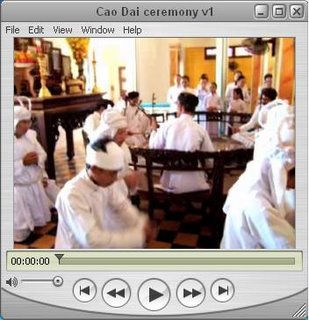 [+/-] read/hide the rest of the post
I love going out to the countryside, because my family has roots in the country, and wherever I am, whatever country I'm in, I seem to feel at home--even though I grew up in the big city. Along the road you can see rice, and animals, bamboo huts and rubber farms.
The main temple, like all things Cao Dai, is extremely intricately detailed and colorful--almost to the point of gaudy. Everything has a meaning. The front door is painted like clouds to symbolize heaven, but nobody enters through them. Instead, during ceremonies, men enter through a side door on the right and women through a side door on the left. During normal hours men and women may enter either door and mingle freely, but during the ceremony the sexes are segregated.
"Being entrusted with the mission of realizing the 3rd alliance between God and mankind (the first realized by Moses and the second by Jesus Christ) these saints give spiritual guidance and assist the CaoDaists in spreading the new holy doctrine."It's interesting--read the whole thing.
During the noon ceremony, those people who have recently lost loved ones go up to the second floor balcony, and sing and pray in the traditional Vietnamese-Buddhist fashion. On the floor, worshipers are divided with men on the right and women on the left. They incrementally move up towards the eye and stop and kneel and pray at each level. The first time is for the people that have died, then they will return to the beginning and pray again to God for themselves and mankind. An observer can see the strong influence of Vietnamese ancestor worship in this ceremony--not the least of which is the preeminence given praying to ancestors first over God. As the worshippers move up towards the eye, the singers stay on the top balcony along with a boy who plays an instrument similar to a guitar, and move with them.
[+/-] read/hide the rest of the post
Priorities
Today, after dropping off my wife at work, I was stopped for nearly 7 minutes at an intersection on Vo Thi Sau street. Now, traffic jams--gridlock--are common in Ho Chi Minh City because people stupidly inch their way into the intersections, blocking oncoming traffic. Then, when the lights change colors, nobody can go, because the other side is still stuck in the intersection, and it induces more people to do the same.
Today was different. In front of me was an ambulance, sirens blaring, stuck amid a sea of motorbikes, cars, and two busses, while a soldier on a motorbike stopped in the intersection and cleared it out. Then we all waited while some fancy cars and trucks carrying soldiers passed through the intersection with flags waving. The soldiers were laughing. All I could think about was the person in the ambulance in front of me, possibly dying, family members crying and holding his/her hand, as they waited 7 minutes for this motorcade to pass.
Seven minutes is an eternity in emergency care. Lives are saved or lost in seconds. Companies in the USA spend millions of dollars getting response times down from 8 minutes to 6 or 5 ... and this ambulance was forced to wait 7 minutes so some army big-wig could pass by unencumbered.
It just felt wrong...
Today was different. In front of me was an ambulance, sirens blaring, stuck amid a sea of motorbikes, cars, and two busses, while a soldier on a motorbike stopped in the intersection and cleared it out. Then we all waited while some fancy cars and trucks carrying soldiers passed through the intersection with flags waving. The soldiers were laughing. All I could think about was the person in the ambulance in front of me, possibly dying, family members crying and holding his/her hand, as they waited 7 minutes for this motorcade to pass.
Seven minutes is an eternity in emergency care. Lives are saved or lost in seconds. Companies in the USA spend millions of dollars getting response times down from 8 minutes to 6 or 5 ... and this ambulance was forced to wait 7 minutes so some army big-wig could pass by unencumbered.
It just felt wrong...
Monday, March 13, 2006
Congrats to BYU
My alma mater.
Well, it looks like they didn't make the dance, because Texas A&M was just a little better, but hey, a 20-8 season is great. Next year we'll add a little more strength to our schedule, and we'll be back dancing. Until then, here's to a 6 seed in the NIT and hopefully some more wins!

Well, it looks like they didn't make the dance, because Texas A&M was just a little better, but hey, a 20-8 season is great. Next year we'll add a little more strength to our schedule, and we'll be back dancing. Until then, here's to a 6 seed in the NIT and hopefully some more wins!
Thursday, March 09, 2006
The New "Microsoft Live" Search
Yesterday, Microsoft unveiled a couple things--its new Origami PC (Ultra Mobile PC or UMPC) and Microsoft Live, its answer to Google in the search engine world. Is it any good? Google, we all know, rules the roost. I dropped off the face of the earth from 2000-2002, and when I came back and found everyone using this weird "Google," I too became converted. However, I am an open-minded soul, and always willing to look for the better alternative. Could Microsoft finally have done it??
Now, Microsoft has only 11% of the search market right now. Everyone knows (or at least 9 of 10 people know) that it's current msn search engine is a waste of space and time. Yahoo ranks second, with around 25% of the search market, and I, for the most part, like the search engine itself. The page is too cluttered for my taste. Hence I join the almost 60% of searchers that use Google. It is fast, efficient, correct, uncluttered (if I want other stuff besides email, I'll go to those web pages). They have a dry sense of humor, and the best email service I've ever used.
But this is Microsoft LIVE. It's using the vaunted AJAX...the revolutionary tool that will make the internet come alive!! I've published before on what I think AJAX can do. Well, I thought, what better way to see if it is as good as it sounds.
The opening interface differs from google radically.


Here is Google's familiar minimalistic website. Here is Windows Live's website. You say, "Oh, that's minimalistic!" But no, that's it loading. I had to refresh the page twice before it loaded correctly. The correct page looks like this:
 Besides the wait, it isn't a bad webpage. The search bar stands out at the top, and the blue banner has three easy-to-click boxes (all of mine are checked) for what other things you want on the website. This is a great idea. Those of us who like the minimalist approach, can unclick all the boxes, and those who like the cluttered approach can keep them on. I left them on so you can see what extras LIVE offers.
You can see in the above screenshot that it has a few options. The Windows Live Gallery keeps you abreast of changes. The Gadget Gallery has small add-ons that function essentially like Widgets on a Mac. The Safety Center is an online version of your MS Windows XP security center. Then you get the list of happenings from MSNBC.com. As you scroll down, you notice a few more items:

You have E! News, an easy link to your live.com email account (which should use AJAX to compete against gmail but also offer drag & drop technology...I like that), the weather, and sports. All headings are expandable when clicked. Also, when you scroll over a news link, you get a summary bubble with three buttons: read, send to a friend, or blog this.

So I search...for "Vietnamese food." I figure, this is a very common search. Maybe not Vietnamese food specifically, but searching for food, restaurants, recipes, shopping makes up a large part of searches, and "Vietnamese food" both caters to those categories and is different enough to test the search engines.


This has pros and cons. The Pros are a link for feeds (now a must in the blogging world) and local. I was especially impressed with Local. It's search returns integrated well with the Virtual Earth map, giving me a quicker and more aesthetically pleasing search than Google (see below).
 My wife hates talking to me, because she says every sentence I say is "Yes...but..." or "Yes...however." Well, however, there are many downsides to Windows Live. One of the most glaring was the lack of pictures. When clicking on images, I got "there are no images for your search" in Windows Live, but I received this in Google:
 Not only am I now starving after seeing those pictures, but I find the total ABSENCE of pics in my Live search to be disturbing. That's a big error.
Second, the number of hits were drastically different. Live gave my 1,314,934 hits and Google 18,100,000. Now, I don't know anyone that will even visit one million sites, but it worries me that Google can find over 18 million sites that deal with my topic and Windows Live can't even manage one and a half. That result highlights a severe problem in the search engine that may be overlooked by my search, but would affect a more specific or obscure search.
Thirdly, and most important, what are the results of the search? I looked at the first 20 results because in Google a person rarely goes past the first 2-3 pages. Many of the results are different, but the differences aren't highlighted until you look at the first 10 of each News results.
Using the news link for windows live brought the first five search results:
1. san fran weekly listing restaurants,
2. boston online talks of vietnamese immigrants
3. college heights herald reminisces about a night on the town
4. knox pages talks of a cruise with a vietnamese-american
5. metro mix wants you to be a reviewer for foods
6. bangor daily talks about starch in rice
7. abc daily talks about gps units
8. reuters talks about the cruise with viet-americans
9. cattlenetwork.com talks about beef
10. kgw.com talks of ethnic food in vancouver
These news results have very little to do with Vietnamese food. Counter that with these results from Google:
1. Nhan Dan, Vietnam - Mar 7, 2006 Restaurateurs push Hanoi into the future with laquerware
2. Viet Nam News Agency, Vietnam - Feb 19, 2006 Vietnamese food and tourism arrive in India
3. Malaysia Star, Malaysia - Mar 6, 2006 interview with Ha Mai, celebrity vietnamese chef
4. VietNamNet Bridge, Vietnam - 16 hours ago price drops for rice sellers in vietnam
5. Long Beach Press-Telegram, CA - Mar 7, 2006 trying to find viet food in NYC
6. Bangor Daily News, ME - 13 hours ago exerpt focuses on viet fish sauce
7. Stars and Stripes, D.C. - Mar 7, 2006 asian bazaar in chech city
8. LA Weekly, CA - 7 hours ago restaurant listing
9. CattleNetwork.com, KS - 22 hours ago beef, but shows that someone has a viet wife (hence the search result)
10. Thanh Nien Daily, Vietnam - 22 hours ago viet scientists make safe alternative to borax for food
The results speak for themselves. For all the aesthetic pleasures that AJAX has offered Windows Live, it fails miserably compared to Google. The search engine is weak. No images returned, only about 7% of Google's hits returned in Live's search, and news results that are horribly off topic. Ladies and gentleman, take my advice--stick with Google. When it comes to finding things, it is still the best.[+/-] read/hide the rest of the post
Now, Microsoft has only 11% of the search market right now. Everyone knows (or at least 9 of 10 people know) that it's current msn search engine is a waste of space and time. Yahoo ranks second, with around 25% of the search market, and I, for the most part, like the search engine itself. The page is too cluttered for my taste. Hence I join the almost 60% of searchers that use Google. It is fast, efficient, correct, uncluttered (if I want other stuff besides email, I'll go to those web pages). They have a dry sense of humor, and the best email service I've ever used.
But this is Microsoft LIVE. It's using the vaunted AJAX...the revolutionary tool that will make the internet come alive!! I've published before on what I think AJAX can do. Well, I thought, what better way to see if it is as good as it sounds.
The opening interface differs from google radically.


 Besides the wait, it isn't a bad webpage. The search bar stands out at the top, and the blue banner has three easy-to-click boxes (all of mine are checked) for what other things you want on the website. This is a great idea. Those of us who like the minimalist approach, can unclick all the boxes, and those who like the cluttered approach can keep them on. I left them on so you can see what extras LIVE offers.
You can see in the above screenshot that it has a few options. The Windows Live Gallery keeps you abreast of changes. The Gadget Gallery has small add-ons that function essentially like Widgets on a Mac. The Safety Center is an online version of your MS Windows XP security center. Then you get the list of happenings from MSNBC.com. As you scroll down, you notice a few more items:


Beautiful. Absolutely great way to leave things uncluttered on the screen, and tie in email and blogging. The only downside is you are required to use a live.com email address and msnspaces.com blog. Hopefully, they will expand this, but I doubt it, since they want to keep people on their sites.
So I search...for "Vietnamese food." I figure, this is a very common search. Maybe not Vietnamese food specifically, but searching for food, restaurants, recipes, shopping makes up a large part of searches, and "Vietnamese food" both caters to those categories and is different enough to test the search engines.


You can see that the search results are pulled into one page. This allows for a couple differences. First, you can see that the results on these two pictures are the same, but one is more verbose. By using the cursor in the top right corner, you can choose between three settings: minimal (like you see on the left), normal (on the right), or verbose (which I found to be nothing more than usually a link to other similar pages). In contrast, what you see with Google is what you get.
 You get the standard title, pithy description, the address, and links to similar sites (offered in verbose Live) and cached images (not offered in Live, but helpful in areas of the world that may BLOCK a website, or if the website's server is having troubles).
Also useful to note is the number and types of returns. Windows Live returned 1,314,934 hits for my "Vietnamese food" search, and allows me to see about 2 at a time. I use the scrollbar on the right to move up and down. The scrollbar is kinda nice, esp. having the arrows on the bar, but it makes surfing difficult when all the pages are in one location.
When I surf, I usually visit sites in the first two google pages (first 20 sites) after that, i like to browse way in the back, by hitting one of the o's in "Gooooooogle." Browsing the smaller, peripheral sites is near impossible because you have to scroll down until you reach them. Google indexes 10 hits to a page, so you spend time loading pages every time you move on, but it's not any slower than Live, since Live doesn't allow you to jump around. I find that really annoying.
Another feature is the links to specific searches. Windows Live, as you see below, keeps them all in the AJAX feature on the main search site. Google (see above) has them as separate pages.
 You get the standard title, pithy description, the address, and links to similar sites (offered in verbose Live) and cached images (not offered in Live, but helpful in areas of the world that may BLOCK a website, or if the website's server is having troubles).
Also useful to note is the number and types of returns. Windows Live returned 1,314,934 hits for my "Vietnamese food" search, and allows me to see about 2 at a time. I use the scrollbar on the right to move up and down. The scrollbar is kinda nice, esp. having the arrows on the bar, but it makes surfing difficult when all the pages are in one location.
When I surf, I usually visit sites in the first two google pages (first 20 sites) after that, i like to browse way in the back, by hitting one of the o's in "Gooooooogle." Browsing the smaller, peripheral sites is near impossible because you have to scroll down until you reach them. Google indexes 10 hits to a page, so you spend time loading pages every time you move on, but it's not any slower than Live, since Live doesn't allow you to jump around. I find that really annoying.
Another feature is the links to specific searches. Windows Live, as you see below, keeps them all in the AJAX feature on the main search site. Google (see above) has them as separate pages.


 My wife hates talking to me, because she says every sentence I say is "Yes...but..." or "Yes...however." Well, however, there are many downsides to Windows Live. One of the most glaring was the lack of pictures. When clicking on images, I got "there are no images for your search" in Windows Live, but I received this in Google:
 Not only am I now starving after seeing those pictures, but I find the total ABSENCE of pics in my Live search to be disturbing. That's a big error.
Second, the number of hits were drastically different. Live gave my 1,314,934 hits and Google 18,100,000. Now, I don't know anyone that will even visit one million sites, but it worries me that Google can find over 18 million sites that deal with my topic and Windows Live can't even manage one and a half. That result highlights a severe problem in the search engine that may be overlooked by my search, but would affect a more specific or obscure search.
Thirdly, and most important, what are the results of the search? I looked at the first 20 results because in Google a person rarely goes past the first 2-3 pages. Many of the results are different, but the differences aren't highlighted until you look at the first 10 of each News results.
Using the news link for windows live brought the first five search results:
1. san fran weekly listing restaurants,
2. boston online talks of vietnamese immigrants
3. college heights herald reminisces about a night on the town
4. knox pages talks of a cruise with a vietnamese-american
5. metro mix wants you to be a reviewer for foods
6. bangor daily talks about starch in rice
7. abc daily talks about gps units
8. reuters talks about the cruise with viet-americans
9. cattlenetwork.com talks about beef
10. kgw.com talks of ethnic food in vancouver
These news results have very little to do with Vietnamese food. Counter that with these results from Google:
1. Nhan Dan, Vietnam - Mar 7, 2006 Restaurateurs push Hanoi into the future with laquerware
2. Viet Nam News Agency, Vietnam - Feb 19, 2006 Vietnamese food and tourism arrive in India
3. Malaysia Star, Malaysia - Mar 6, 2006 interview with Ha Mai, celebrity vietnamese chef
4. VietNamNet Bridge, Vietnam - 16 hours ago price drops for rice sellers in vietnam
5. Long Beach Press-Telegram, CA - Mar 7, 2006 trying to find viet food in NYC
6. Bangor Daily News, ME - 13 hours ago exerpt focuses on viet fish sauce
7. Stars and Stripes, D.C. - Mar 7, 2006 asian bazaar in chech city
8. LA Weekly, CA - 7 hours ago restaurant listing
9. CattleNetwork.com, KS - 22 hours ago beef, but shows that someone has a viet wife (hence the search result)
10. Thanh Nien Daily, Vietnam - 22 hours ago viet scientists make safe alternative to borax for food
The results speak for themselves. For all the aesthetic pleasures that AJAX has offered Windows Live, it fails miserably compared to Google. The search engine is weak. No images returned, only about 7% of Google's hits returned in Live's search, and news results that are horribly off topic. Ladies and gentleman, take my advice--stick with Google. When it comes to finding things, it is still the best.
Subscribe to:
Posts (Atom)