• People Talk and My Ear Bleeds

Thoughts

    from Twitter

    News

    Tuesday, July 10, 2007

    A Tale of Two Peoples 2: The "Việt Kiều" word

    "Emigrant, my friends! Do you not see me here, in France, of my own will?"

    "You are a cursed emigrant," cried a farrier, making at him in a furious manner through the press, hammer in hand; "and you are a cursed aristocrat!"

    ... Darnay said, as soon as he could make his voice heard:

    "Friends, you deceive yourselves, or you are deceived. I am not a traitor."

    "He lies!" cried the smith. "He is a traitor since the decree. His life is forfeit to the people. His cursed life is not his own!"

    ...

    "What is this decree that the smith spoke of?" Darnay asked the postmaster, when he had thanked him, and stood beside him in the yard. "Truly, a decree for selling the property of emigrants."

    "When passed?"

    "On the fourteenth."

    "The day I left England!"

    "Everybody says it is but one of several, and that there will be others- if there are not already- banishing all emigrants, and condemning all to death who return. That is what he meant when he said your life was not your own."

    "But there are no such decrees yet?"

    "What do I know!" said the postmaster, shrugging his shoulders; "there may be, or there will be. It is all the same. What would you have?"
    (Charles Dickens, Tale of Two Cities, Book 3 chapter 1)


    In "A Tale of Two Peoples," I set forth the view that the Vietnamese in Vietnam and the Vietnamese living oversees are quite totally two different peoples. Many people made good, cogent comments. Possibly stemming from our unconscious ethno-centricism, most points focused on the status of the Việt kiều.

    However, at least equally responsible for the gulf between the two peoples are the Vietnamese mới. To prove that two peoples exist, I must both show a feeling of community that defines a people, and show feelings of disconnection between the two groups.

    I alluded to this when I said,
    "I cannot count anymore the number of times I've heard "việt kiều" come out of someone's mouth as a derogatory comment."
    and this term's connotation shows the gulf of which I write.

    Of course, these are two peoples currently moving apart, and as such there will be exceptions to my theory, but I do feel they are the minority, not majority.

    The term "việt kiều" is used by the communists to include people of Vietnamese descent living oversees as Vietnamese--to establish jurisdiction over them in the government's mind. This concept is foreign to someone from the United States. We do not wake up each morning, grab the paper, and read on the front page about the awards or escapades of someone of American descent living in a foreign country--France for instance--especially if that person was born and raised in France.

    But that is what the Vietnamese do every morning. Example: Open up your Tuổi Trẻ newspaper in the morning and you'll likely find an article (conveniently located online in the "Người Việt xa quê" [Viets away from home] section) about someone of Vietnamese descent doing something in another country, often barely related to Vietnam at all.

    Yet all the newspaper articles cannot stop the divide between people. I spoke with an old student of mine the other night, and this is part of the conversation we had:

    Student (4/19/2007 9:55:43 PM): o viet nam
    Student (4/19/2007 9:55:50 PM): co nhiu nguoi tu nhan la viet kieu
    Student (4/19/2007 9:55:54 PM): nhung ho hok het di lam
    Student (4/19/2007 9:56:02 PM): ma chi la di wa my rui ve
    Student (4/19/2007 9:56:14 PM): chu hok he lam viec
    Student (4/19/2007 9:56:26 PM): va ho chi mang mac viet kieu ma thoi
    ...
    Student (4/19/2007 10:04:46 PM): theo thi co 2 loai viet kieu thay ah
    Student (4/19/2007 10:04:51 PM): mot la nhu em da noi
    Student (4/19/2007 10:04:58 PM): ho lam viec cuc kho de kiem tien
    Student (4/19/2007 10:05:12 PM): rui gui ve cho gia dinh dang kho khan o viet nam hay ba con
    Student (4/19/2007 10:05:20 PM): nhung con mot loai viet kieu nua la
    Student (4/19/2007 10:05:25 PM): ho chi co danh thoi
    Student (4/19/2007 10:05:32 PM): chu ho hok he di lam de kiem tien
    Student (4/19/2007 10:05:41 PM): nen ho chi bit huong thu thoi
    Student (4/19/2007 10:05:59 PM): doi khi con co nhung nguoi mang danh viet kieu de di lua dao nua
    Student (4/19/2007 10:06:01 PM): v.v
    Student (4/19/2007 10:06:04 PM): nhiu lam thay oi
    Student (4/19/2007 10:06:29 PM): nen o viet nam neu viet kieu ma ve thuong xuyen la nguoi ta biet viet kieu gia
    Student (4/19/2007 10:06:45 PM): boi vi ve thuong xuyen thi co dau co di lam udoc
    Student (4/19/2007 10:06:56 PM): ma hok di lam thi sao lam ra tien phai hok thay
    Student (4/19/2007 10:06:59 PM): :-)


    Another viewpoint stemmed from this conversation I had with my wife.

    Me: Dear, when you hear the word "việt kiều" how do you feel?
    Wife: I don't like it. I don't want to be one.
    Me: But in Vietnam, does it have a negative or positive connotation?
    Wife: Negative.
    Me: Why?
    Wife: Because we don't like them, the việt kiều, coming into our country and acting like they're all good. Last time we were in Vietnam, I went with my mom to Parkson, and she pointed them out. They walk around and flash all their money like they're better thank us.
    Me: How could you tell them from other rich Viets?
    Wife: Oh you can tell. They're so nhà quê. They look like they've never been in a department store before, wandering around, not knowing where to go, but then they pull out all the money and flaunt it around saying 'Hey, we're rich.' They go to America and work for nothing, living a poor life, and then they fly back to Vietnam and throw it around acting all rich and better.
    Me: Your family's been blessed lately, and are pretty well off. Is it just a case of envy, or do others feel this way?
    Wife: All my friends felt that way, and many of them have no money. I felt this way growing up--before my parents got money. I think it's pretty common.
    Me: What about my student, who said "việt kiều" was used for those who went to work in America and came back?
    Wife: I don't know how the young generation uses it, but it can have many meanings--
    Me: Didn't it start from the government in newspapers trying to take credit for things done by ex patriot Vietnamese?
    Wife: Yes, and if you read the newspaper and see it, then that's what it means--the dictionary definition. But it has more than that. Most people use it derogatorily.
    Me: About the newspapers...did you ever feel kinship with the việt kiều written about in the Tuổi Trẻ?
    Wife: No. I thought it was stupid. They're not Vietnamese. The government is just trying to take credit for things that they do. If I did something here in America, and they wrote about it in Vietnam, that doesn't make it Vietnamese. It was a product of me, here in America, with these opportunities, and skills, and will always be an American thing.
    Me: What about a Vietnamese person who -- well, let's say you have a Vietnamese person in America--a high school student--who wins an award in math, and then a white kid wins the same award, and both are reported in the newspapers in Vietnam. Would you feel more closely with one or the other?
    Wife: Well obviously the Viet ... I'd think 'that's our Vietnamese brain! Good at math!' But as far as taking credit for him, no, because he grew up in America. He's not Vietnamese.


    Both viewpoints highlight the heterogeneous feelings that the Vietnamese mới have for the Việt kiều, and mirror what I felt I saw while there. In Vietnam, like always, there is great respect for hard work. The Vietnamese are some of the hardest working people I have ever seen. Therefore, those Vietnamese who live in America are respected for their hard work by those who understand that not all streets in America are paved with gold.

    However, the very visceral feelings of hurt, anger, pride, jealousy, etc. are also evident when those same people return to Vietnam. The ties between Việt mới and Việt kiều are minimal--possibly hair color and height only--because of the radically different circumstances in which they grew up and lived. Look at my wife's answers to my last two questions. She feels more connected to the Viet math star than the white math star, yet truly doesn't feel close to any person of Vietnamese descent living in America ("They're not Vietnamese").

    A middle class Vietnamese person makes between 3 million and 10 million đồng a month in Saigon. Actually, that's almost upper middle class. It's a lot less outside Saigon and Hanoi. The income disparity is massive. The new educated youth that speak English are taking foreign money and living well, but that is not nearly the norm for most of the country.

    Picture 110


    So, a 24 year old mechanic sees a 24 year old Việt kiều walk out of Parkson with a shirt that cost 800,000 đồng and a tie that cost 300,000đ and he doesn't say, "hey bro." He says, "you just spent my monthly wage on a shirt and tie, and you say you're one of me? You don't know me. You haven't lived through what I do. You aren't anything like me. You're not me."

    This is not a hatred, but a dissociation. The Việt mới stick around those who share their experiences, can empathize, and identify as being true Vietnamese.

    Monday, July 02, 2007

    Where are my Pictures?

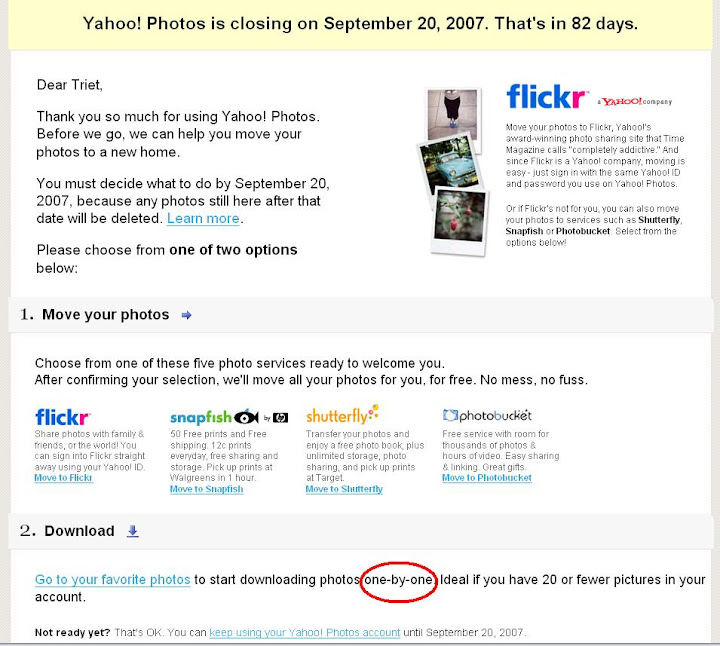
    The other day I checked my photos on Yahoo photos and was greeted with this sight:


    I'm not a fan of Yahoo!, to be honest, but I was bummed. I do like Yahoo! Photos. Among other things, it was the one free photo host I had that let me make as many albums as I wanted. As you can tell from the screenshot above, Yahoo wants me to move to Flickr (because it owns Flickr), and I almost did it reflexively, since I've had a Flickr account for years (at least 2 B.Y. -- before Yahoo). However, I stopped myself, since I had no clue what the other three suggested photo sites were, and this is my discovery.

    Looking always to do things my own way, I immediately jumped to #2 and was horrified that I would have to download each photo one by one... I don't know how most people only have 20 photos or less, but I can assure you, I am NOT downloading my hundreds of photos one ... by ... one ... I'm stupid, but not that stupid.

    So I moved to the automated services. I started with the least familiar -- Shutterfly.


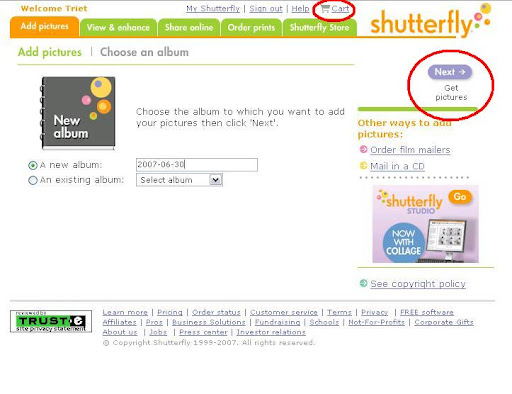
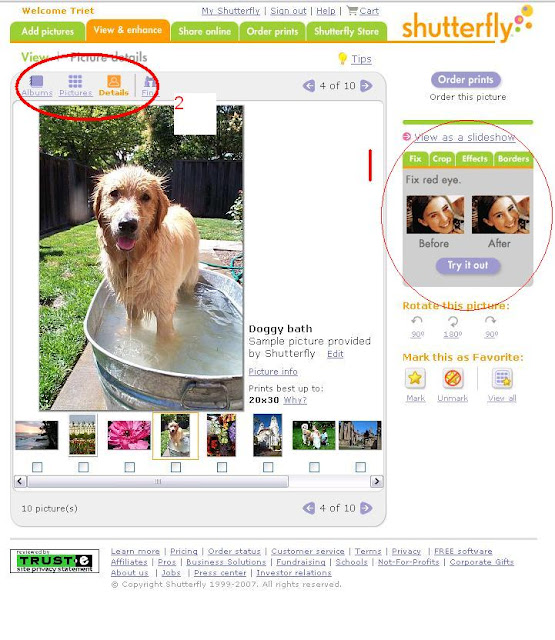
    The sign up was quick and painless. I was then greeted with the ability to start my own album or use Shutterfly's stock photos to make a demo album. They must understand that people like to test drive first. Already racking up the points. I picked the demo pictures, and was greeted with the first picture. Overall the layout is nice and crisp. Circle 1 shows your thumbnail options: small, medium, large. Large is the only option with names below. Small is REALLY small.

    Working in Shutterfly allows quick movement between albums and pictures. You can see in circle 2, that you can fix red-eye and make a slideshow. Making another album was as simple as pushing a button (picture 2), and should you be inclined to buy prints of your photos through Shutterfly (the real reason why it exists), the ubiquitous "Cart" button is always at the top. The ordering is pretty straight forward -- you just use drop-down boxes to select the # of each size photo you want. You can either have the prints mailed to you, or you can pick them up at the nearest Target.

    However, when looking at my photos, Shutterfly started to lose points. As you can see in the third picture, circle 1, Shutterfly has an easy to use system of doctoring photos. Good! But it doesn't allow you to look at your photos in any greater detail than you see the dog now. No zoom. No tagging of photos for searching. Limited metadata. Limited points in my book.

    I left Shutterfly unimpressed. It failed at the most important of all functions--letting me see my photos. If I just want to upload and print them, I'll just go straight to Target's photo page.

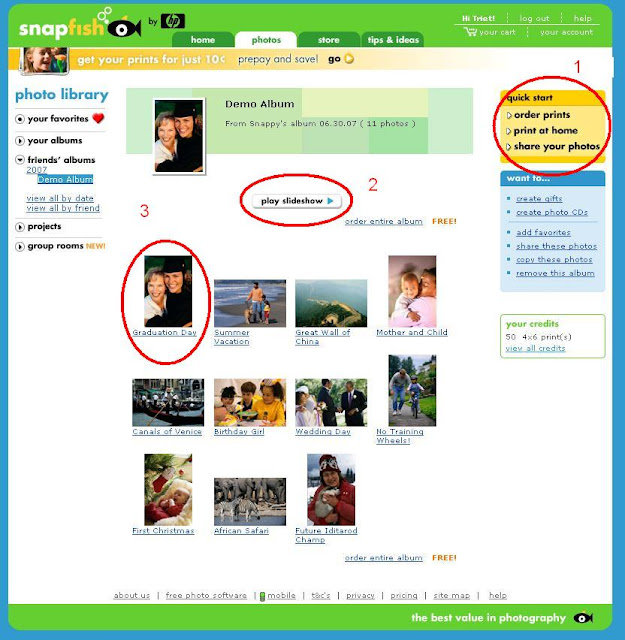
    Next on the list was Snapfish. Again, the sign up was easy, eerily similar to Shutterfly. In fact, almost everything was eerily similar.


    As you can see from circle 1, its main purpose is also to make you print your photos. They did, however, put the slideshow button central to the webpage, which I think is better, seeing how most people using this service will want their stuff simple, and that's as simple as it gets. However, you really can't do anything with the thumbnails (circle 3), and viewing the photos is exactly the same as Shutterfly. Overall, I'd go with Shutterfly, but in reality I think they are just twins separated at birth.

    Unimpressed with Snapfish, and compounded with previous experience of seeing Photobucket slideshows on Facebook pages, I entered Photobucket with very low expectations. Immediately I was hit with advertisements. Aaagghhh, busy webpage....my google-fied mindset cannot process such business. I like my webpages neat and uncluttered, definitely not filled with grinning faces and useless words that my eyes just skim over.

    This, however, is the theme of Photobucket. Advertise everything. If these photo hosting sites were cars, Photobucket would be in Nascar. Definitely geared to the mindless preteen/myspace generation.


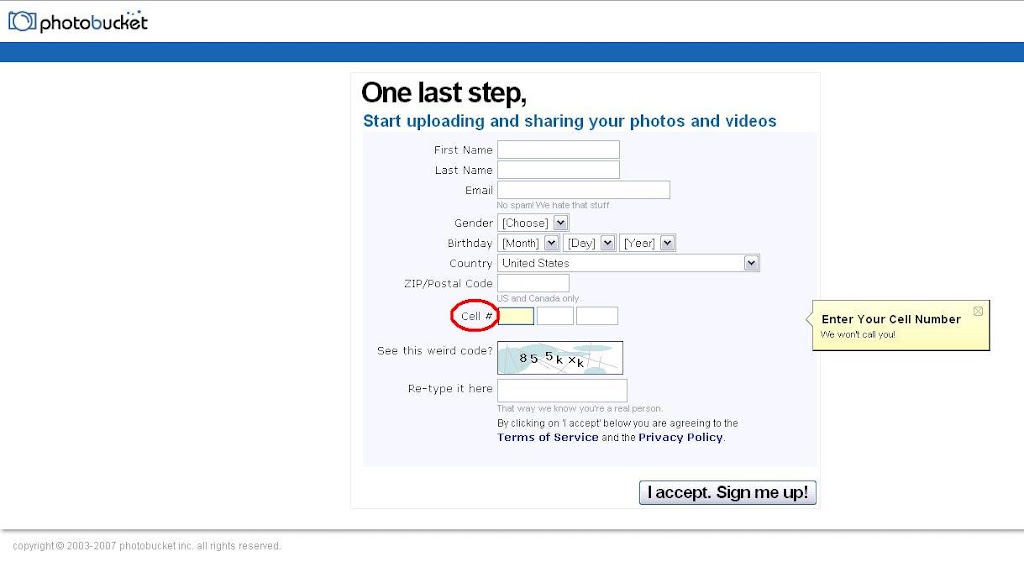
    Immediately Photobucket lost more points by asking me for my cell phone number.


    If I don't give this to every person I know, why would I give it to some random website? I seriously almost stopped there, and if it wasn't for my blogging mindset, I would have. However, I pressed on, and am happy to say, you can leave it blank (which I did).

    After clearing that major hurdle, I was actually impressed with its service. Although it started with negative points after the cell phone fiasco, it quickly racked them up. Photobucket is a true photo hosting site. It lets you mess with your photos, share your photos, turn them into soup if you want to. Because of this, it deals with bandwidth and storage issues (picture), so it allows you to choose how you store your photos. It is also the first site I encounter with tiered access: free and paid.

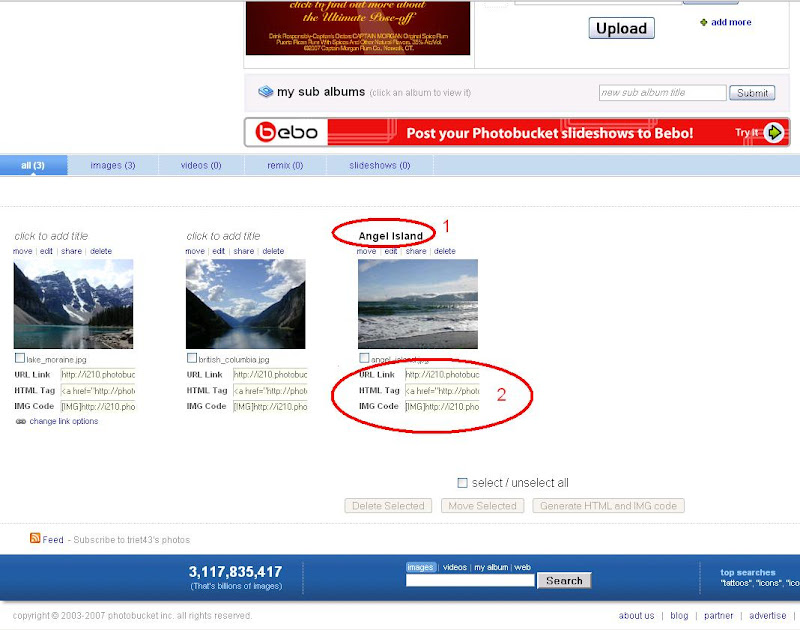
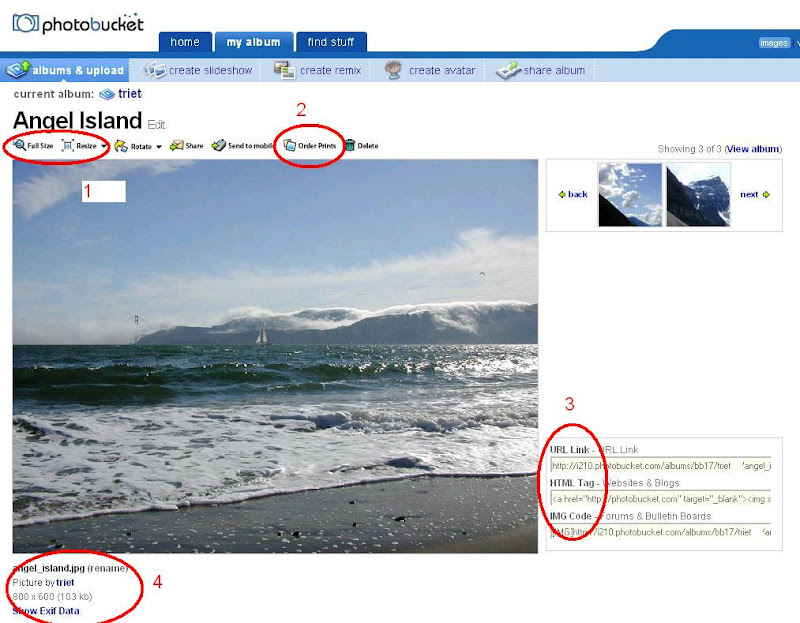
    I had to upload my own files (no gimme demos), so I used the demos that come with Windows XP. Immediately I noticed three things (picture):

    1. The photos show up somewhat unnaturally at the bottom of the page.
    2. It is quite easy to edit data (like titles) in the photos.
    3. It gives you the url, img code, and embed link right up front -- a great boon for bloggers.

    When you click on a photo, you have a nice clean desktop to work with (picture).

    1. Photobucket allows you to see the full size (that you chose to save on their server) photo with a click of the button.
    2. In addition to the REAL photo editing and hosting functionality, it still allows you to give them money by printing your photos.
    3. Conveniently, the url, img, and embed code is situated unobtrusively in the bottom corner of the page while editing.
    4. For true photography junkies, it gives you some metadata to work with.

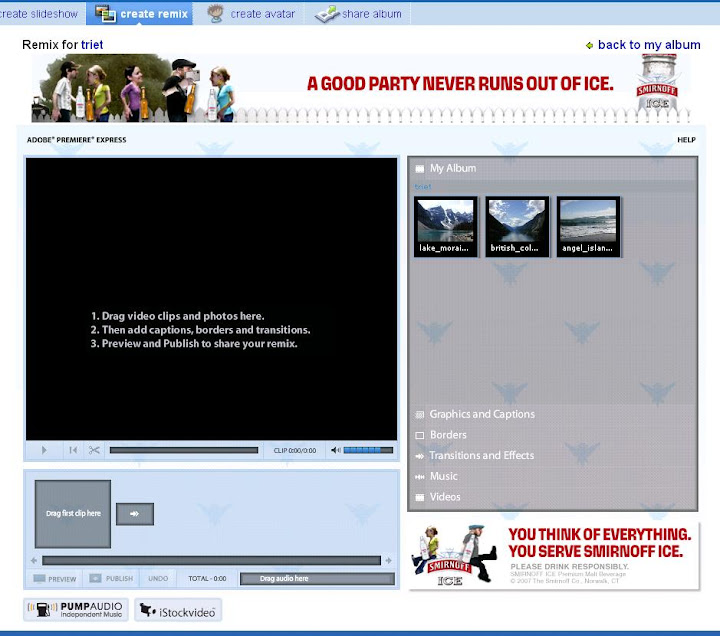
    Photobucket's coup de grace is it's ability to "Remix," or make a movie (picture). Partnering with Adobe, it allows users to drag video clips and photos to make a collage of sorts -- perfect for weddings where we all sigh at the pics and videos of the bride and groom when they're three. The system is easy to use (drag and drop), intuitive, and FREE. The only setback is the limited space given to movie hosting.

    Finally, you can upgrade to Pro for $25 (picture), but more on that later.

    Next came Flickr, the home team. Flickr's signup is doubly easy, because it's also Yahoo's sign up. If you have a Yahoo acct because of email, Yahoo360, etc., then you can use the same here. Upon entering, the front page is a little crowded, but not like Photobucket. It also has minimal advertising, while most of Photobucket's crowd was advertising.


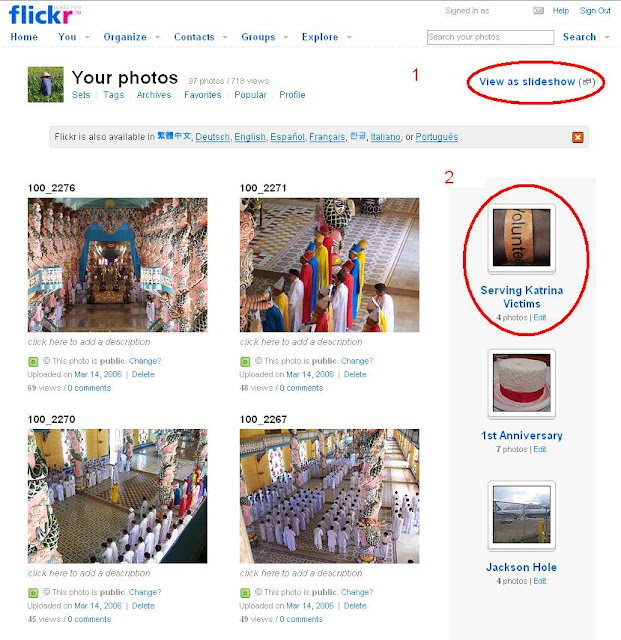
    Moving to my photos, you can see both the good and the bad right away. The good is the layout. Whereas Photobucket put the photos at the bottom of the page, Flickr has them right there for you to peruse. You can also change the layout if you want. The bad is that you only get three albums in the free version of Flickr. It too is a tiered service.

    1. The slideshow button is clearly but unobtrusively placed (but no Remix!).
    2. Albums are clearly labeled and easy to use, if you have enough.

    Flickr's photo editing/viewing setup is great, mostly due to it's photographer base that made it popular before Yahoo dumbed it down. Looking at your photo (this is one I took of a noonday ceremony at the Cao Dai temple in Tay Ninh) you can see, (picture)

    1. Flickr makes it easy to see all sizes, blog your photo, or order prints. If you order prints, you do it through a company called Qoop, which coincidentally, is the company used by Photobucket.
    2. Tags make Flickr. By tagging your photo, you determine how people find it through searches.
    3. Also due to its photographer background, Flickr gives you all the gory details of the pictures.

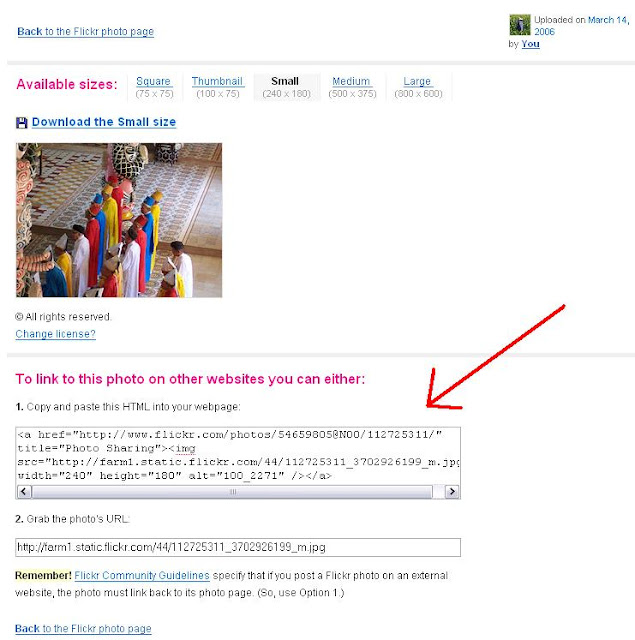
    When you look at the other sizes of a photo, Flickr takes you to another page. This is kinda frustrating. I'm so used to javascript functionality that I'd like to see the page think, and then deliver it to me, instead of loading a whole new webpage. What Flickr does right is give you options. You can easily select sizes, and if you pay for the upgraded service you can have the "original" size option available (picture).

    In addition, Flickr clearly gives you the url, img, and embed info necessary to be a good blogger. One issue I have with their "community guidelines" is that my use of lightbox 2.0 doesn't mesh perfectly with Flickr's rules. All of this is extra info I've gained over years of use.

    Finally, Flickr's pro account also costs $25 a year (picture 1, picture 2).

    With all this site hopping, I got thinking. Yahoo left off one other BIG photo hosting site, and coincidentally, it's biggest competitor: Picasaweb by Google.

    So, I thought, why not try it out too? How does it compare to Photobucket and Flickr, which clearly cleaned the clocks of Snapfish and Shutterfly?

    Like Flickr, Picasa's sign in is easy and linked. Everything in the google universe is accessible. Since I am blogging on Blogger, I already have an account with Picasa, because that is the default host for my blog's photos.


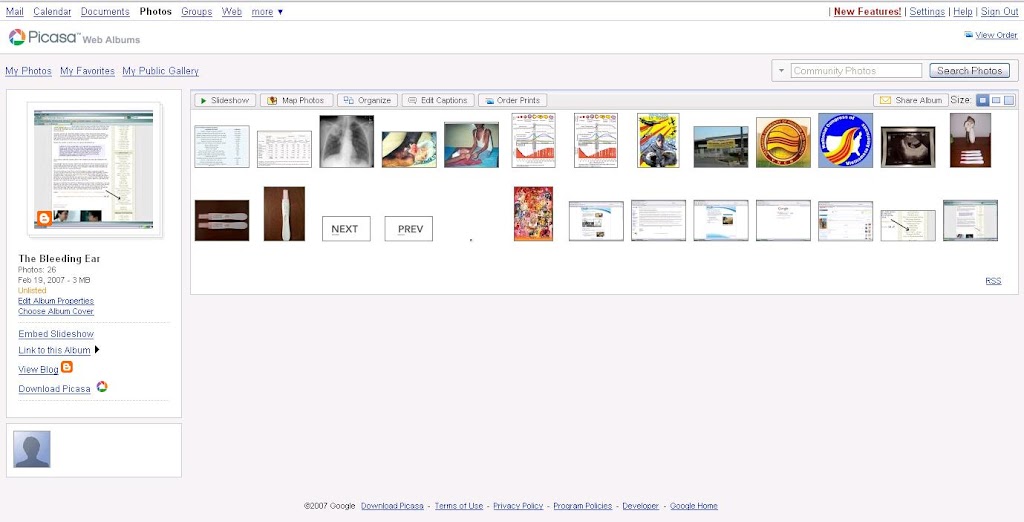
    Looking at my blog's album, it is immediately apparent that Picasa follows Google's lust for all things minimalistic and pastel. The thumbnails' sizes are easily changed and laid out for you in a simple manner. Picasa also offers photo mapping and organization that other services do not -- basically you put a pin on a map where the pic is from so people can look at the map and browse photos from that area.

    When looking at a photo, Picasa doesn't give you the size options that Flickr does, but it's pretty comparable to Photobucket. Even when you zoom, you might not always get the original size, if it's a big photo (picture).

    1. It does give you all the photo metadata like Flickr does.
    2. It also makes the url, img, and embed info easy to find and unobtrusive like both Flickr and Photobucket. In fact, maybe a little better, because you can change the size of the picture coded quickly through a drop down menu below the code.

    Interestingly, if you choose to print your photo, Picasa gives you the option of using Shutterfly...so we come full circle! (picture)

    Another thing Picasa offers is Picasa for your computer, which organizes all your photos and basically acts like a mini Adobe photoshop, streamlining your photo organization and uploading. Photobucket has something similar in beta. Flickr doesn't have that, but does have some neat, light-weight uploading tools for your computer (and if you use Firefox, you might like Flock--which is a Firefox based browser that streamlines multimedia use, and has built in Flickr uploading capability).

    And of course, Picasaweb is a tiered service, offering a pro acct starting at $25 (picture).

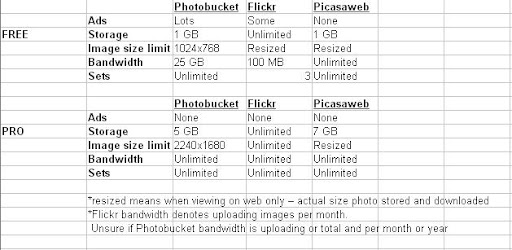
    "Wait, wait, wait!" you say. "$25!" Yes, Photobucket, Flickr, and Picasaweb all offer more bang for your buck. "How much," you ask? This much:


    So in the end, what am I to do? Clearly, Snapfish and Shutterfly are inferior products. Photobucket is better than Flickr for the free tier because it gives me unlimited albums, but is worse than Flickr because it has those stupid ads. Picasaweb is probably the best for a free tier, but Yahoo didn't give me that option, so I'd have to download every photo one by one, and then upload them to Picasaweb. If I pay money, I think Flickr is hands down the best.

    So, do I go with Picasaweb and downloading, so I stay free?
    Or do I go with Photobucket because no downloading and free?
    Or do I go with Flickr because no downloading, and $25/year gives me great stuff?

    What do you think?

    Tuesday, June 26, 2007

    Societal Maturity

    In today's world, the elephant in the middle of the room is Mature Responsibility. There it sits, huge, unmoving, affecting everything and everyone that moves into and out of the room -- and nobody will address it.

    People clamor from both sides, "Let me live my own life! Let us govern ourselves!" but little importance is placed on actions.

    Look at soccer. Across the world, hooliganism infects and destroys perfectly good matches like a virulent virus. The latest example of such stupid immaturity happened yesterday in Argentina. Fans unhappy with a referee's call in the 2-1 Tigre win over Nueva Chicago, stormed the field. People threw rocks, swung metal pipes, and torched a bus. One man died, fourteen were injured, and 78 people arrested. Security was overwhelmed and had to be backed up by police shooting rubber bullets and tear gas.


    This should go without saying, but soccer is a SPORT! Sure we all love to watch it--the artistry and power that accompany truly great soccer is a beauty to behold--but ultimately, win or lose, we all go home and live our lives. We go back to work, love, play, and live. Never has soccer reached the importance that we must kill over it, and definitely not at some small game merely deciding the relegation of a team to the second league. If people can't control themselves watching a match, they shouldn't be given the luxury of watching it. Italy did this a couple months ago. If fans are going to act like children, then governing bodies will have to treat them as such.

    But this incident is just a harbinger of larger manifestations of the elephant in our world room. Iraqis want control of their own destiny, yet they continue to kill each other. More innocent Iraqis are killed every day than American troops or terrorists. The country has split in two in many places, Shi'a against Sunni, because people can't maturely put down their weapons of war, quell their emotions, put aside their differences and work for a peaceful compromise and future.

    The situation is similar in Palestine. After Palestine achieves semi-recognition in the international community, and Hamas wins a general election and gains a stake in the democratic future of their country, they throw it away, killing people, stomping on Yasser Arafat's picture, and controlling the Gaza strip--effectively splitting the small Palestinian state in half. Why? Because they didn't have the patience to continue gaining political power through democratic means, they didn't believe in the ability of the people to choose for themselves, they didn't believe in a joint West Bank-Gaza Palestine?

    America's idealistic view doesn't help. We seem to think that every child is perfectly capable of obeying those most basic sandbox rules--the ones your mother taught you while you played in the sandbox at the park: have patience, share, and no hitting/biting. However, children who know no education, no discipline, seen no prior example, find it hard to share toys when the situation arises. So too Americans think Palestine and Iraq should be able to govern themselves, yet the more autonomy they are given, the less they seem to be able to manage it.

    In both Iraq and Palestine, as in Argentine soccer yesterday, people have shown an paucity of those most basic sandbox rules. If you didn't follow those rules, mom took away the privilege to play with your toys in the sandbox until you could show you were fit to play again. Since people in Argentina, Iraq, and Palestine can't seem to follow the rules either, perhaps they need their toys and sandbox taken away too.

    Monday, June 25, 2007

    Shame on the Media, Go USA!!

    Congratulations to the USA soccer team, for their 2-1 victory of Mexico yesterday. I was not able to watch the game in English, because no basic cable (Comcast, Houston, TX) channel carried the game.


    (Above is a 1:48 video of the winning goal and this is the whole second half)

    I find this fact sad--depressingly so--and a grave error by Rupert Murdoch, Ted Turner, and every other media mogul who had a chance to broadcast this game but did not.

    SHAME ON YOU.

    The semifinals and final of the CONCACAF Gold Cup were played at Soldier Field in Chicago. I was in Chicago from Thursday through Sunday for the American Medical Association's Annual Meeting (Medical Student Section). Unfortunately, I was not able to join Sam's Army in the stands because America played against Canada in the early game, and I did not get out of my meetings in time. To add insult to injury, my flight left Sunday morning, so I could not stay and go to the final, either.

    I arrived home hoping to catch it on TV, and instead I find only Univision broadcasting the game. Boy, was I disappointed. I love watching soccer on the Spanish Channel because of the awesome announcers, so watching it in Spanish didn't bother me, but rather that no English language channel covered it.

    If there are enough viewers and ratings to justify broadcasting Major League Soccer matches, surely there's at least that many people willing to watch the USA in the final of the Gold Cup?

    Let's give props to the USA team--often regarded as a weak side, they are now 10-0-1 on the pitch under new coach Bob Bradley. Although we are not bringing all our veteran starters to South America for the Copa America, I think we'll still put in a good showing. American soccer is steadily improving, and deserves our support, and we deserve the opportunity to support it.

    Put our team on the air, ESPN!

    Thursday, June 07, 2007

    The TB Lawyer

    When I read this a couple days ago, I was incredulous. How many things went wrong? What, if anything, should be done?


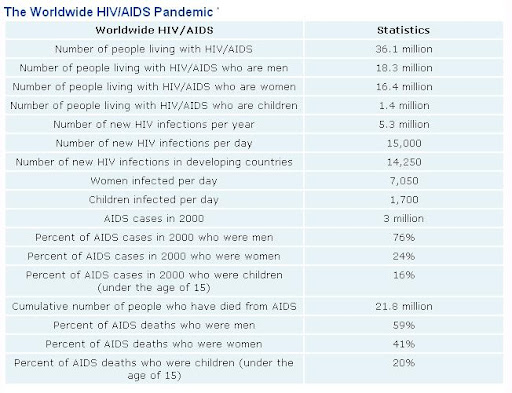
    Andrew Speaker would be thrown in jail if he had done these actions with AIDS
    First, what is TB? Many people in the United States probably know it by name, but have little or no experience with it. TB is the common acronym for tuberculosis, the disease caused by the bacterium Mycobacterium tuberculosis.

    For those unfamiliar with microbiology, think of a bacterium (singular for bacteria) as a pill. Some come in ball shapes, others in more elongated brick shapes, just like your medicine. The genus Mycobacteria is a group of bacteria characterized by a brick shape and a thick waxy coat around the bacterium--like a long gel cap.

    Mycobacteria are typically the "jungle ulcers" and tropical diseases you think about when you see movies or read history books. They range from Mycobacterium ulcerans, the cause of Buruli ulcer (my personal favorite and target of research for many years), to Mycobacterium leprae, cause of Leprosy, to M. tuberculosis.


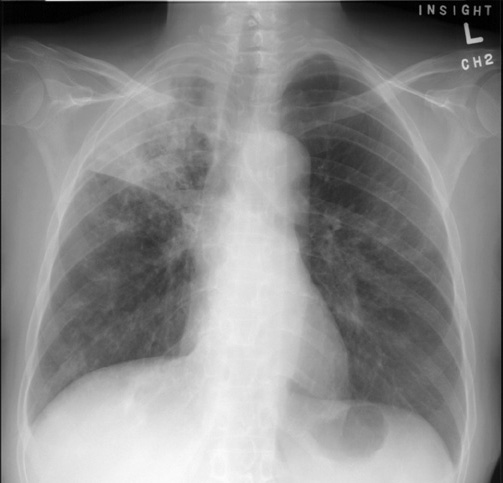
    M. tuberculosis typically causes a respiratory disease. The bacteria get into the lungs of a person, and your immune system tries to "wall it off" by encasing it because it is hard to kill. When looking at x-rays, you can usually see white spots showing these hard encasings in a person that had infectious TB in the past. Someone with TB will have "chronic, productive cough, low-grade fever, night sweats, easy fatigability, and weight loss" (Medical Microbiology, 4ed, Samuel Baron, ed.). As the disease progresses, the sick person starts coughing up blood.

    This month I am at a county hospital in Houston, TX and have seen a couple of tuberculosis patients. Pulmonary TB is highly infectious, and every patient suspected of having TB is put in isolation. Everyone who interacts with the patient must wear protective masks, because TB is spread by coughing.

    How bad is this disease? In America there are about 5 cases per 100,000 people (CDC data, 2003). In the rest of the world, it is
    the second-largest cause of death from an infectious agent worldwide—killing approximately 1.7 million people in 2003. Despite steady drops in the number of cases in some parts of the world, the number of new cases appears to be growing, with an estimated 8.8 million new cases in 2003. (Disease Control Priorities Project, Tuberculosis, fact sheet)
    Approximately 1/3 of the world's population is infected with latent TB, but fortunately only about 10% progress to disease every year.

    The short synopsis of Andrew Speaker's journey is thus: he was diagnosed with TB in America, and told not to go anywhere. At that time they didn't know it was the extremely drug-resistant strain he actually has (XDR-TB). He goes against medical advice and flies to Europe for his wedding. Then it is confirmed he has XDR-TB and he goes against medical advice again and against the USA "no fly" policy and flies into Canada and drives into the US. Now he's in isolation in Denver.

    You can get a more detailed timeline based on Speaker's view of the events, at abcnews.go.com

    In all this ruckus, people have forgotten the most important point--Speaker willingly flaunted medical advice more than once, blatantly snuck into the United States and, most importantly, exposed so many people to this disease.


    Mycobacteria are typically the "jungle ulcers" and tropical diseases you think about when you see movies or read history books
    He can blame his actions on ignorance, or "he said, she said" stuff, but the truth is he's a bright young man and can't seriously feel the ONLY place he could get treatment is in Denver, CO. He can't seriously believe that when doctors in Europe tell him not to leave, after already being told that in America, that he knows better than them and he should be ok to go to Canada. He can't be a good lawyer when he blatantly flaunts the law he went to school to learn and prosecute and adjudicate.

    Let's change the name for a minute. Instead of TB, it's AIDS. Imagine with me. Andrew is diagnosed with AIDS. He is infectious, but doesn't look overly sick. Doctors admonish him to be celibate or practice safe sex. He flaunts their advice and sleeps around without protection and without telling his partners he's sick.

    Then he moves to another area, and the doctors there tell him he has a rapidly mutating form of the virus that depletes the immune system far faster than the more prevalent form. They tell him again to be celibate/use protection and that he is required to tell his partners he has AIDS.

    Speaker proceeds to again have unprotected sex with many people and not tell them he's infected. Finally, he checks into a hospital.

    Andrew Speaker would be thrown in jail if he had done these actions with AIDS. In America it is a crime to knowingly infect or expose someone to HIV. But Speaker had TB, not AIDS. He had a disease that is easier to transmit, infects more people, and kills about as many people. He knowingly put other people at risk many times -- especially when flying to Canada WITHOUT wearing a mask and AGAINST both medical advice and US law.


    Many people walk out of hospitals against medical advice every day. Usually they only hurt themselves. TB is a special case. If you do not follow your treatment regimen, you can be locked in isolation until you finish your medication--9 to 12 months. So, a precedent was set by making TB a special disease under the law, and another set by prosecuting special diseases in criminal court (AIDS).

    Given what Andrew Speaker did, passengers on that plane have a very good basis for a civil suit, and possibly criminal charges, due to his reckless endangerment of their lives. And that opens up a whole new can of worms...

    Friday, May 25, 2007

    How News Travels About Periods

    What have I done??

    Honestly, I never expected this would happen. All I did was write a short comment on a post about the new birth control pill that stops menstruation, and I released a firestorm. If I had known my comment would be picked apart with a microscope, I might have elaborated my position more, clarified some sentences, etc. But now it's generally lost in the conflagration.

    One post here, a comment there, causes another post somewhere else, and more comments
    This is what happened, and I think it's incredibly interesting as a example of how the blogosphere undulates--if I can use that word--when something is added.

    First, Apoorva Mandavilli wrote about the new pill, Lybrel, at Spoonful of Medicine.

    This got me thinking about the issue, and I read the articles the post linked to. I thought that was the end of it.

    Second, Ann Althouse heard the news and posted a short question on her blog.

    Is there some deep psychological/sociological/feminist angle to this story or is it obvious that everyone should obviously want to avoid something that's so inconvenient and annoying and that the only serious question is whether the pill is safe?

    Well, maybe it didn't start with me, it started with her assertion that "the only serious question is whether the pill is safe?" (emphasis added). One commenter disagreed with the absolute nature of her question, and replied,

    menstruation, like childbirth, is just part of being a woman. If another woman would want to escape it, then sure, she should go for it. But, not being punny, it just wouldn't feel right to sidestep it.

    This got Eugene posting on The Volokh Conspiracy. He said,

    Again, concerns about long-term health effects are quite sensible. But I don't see any justification for the feeling that it's not "right to sidestep" something that's "part of being a woman." I suppose it could be some esthetic judgment that argument won't much drive; but setting aside esthetics, why on earth should we want to accept natural but painful or unpleasant things?

    At this point I jumped in. The Volokh Conspiracy gets so many comments, that I didn't think much about mine--subconsciously figured it would be lost in the proverbial sea, so to speak. I said,

    This is an example of how much medicine is an ART and a science. Ultimately, pills treat symptoms and change chemicals that produce a different state of being--but the ideal state of being differs from person to person.

    It's been amazing seeing my wife and other women deal with her first pregnancy. Immediately upon announcing to the world she's pregnant, my wife was part of the "in crowd." Every mother--whether she knew my wife well or not--could smile and talk about morning sickness, or finding out the baby's gender, or feeling bloated, etc.

    So, it is not aesthetic. Humanity derives meaning from shared experiences, and deleting one of the most universal and central of all female experiences can subtract perceived meaning from people's lives. In that regard it is very important.

    As a soon-to-be-doctor, I would never recommend such birth control without bringing up and discussing the social and emotional ramifications in addition to the physiological ones.

    Apoorva Mandavilli over at Nature's Spoonful of Medicine posted a little on it about two weeks ago.

    The blog post links to Mandavilli's good article on pros and cons in Women's Health. Check it out too.

    The other reason I felt this comment wouldn't be noticed, is because I didn't feel I said anything too inflammatory. It turns out I was wrong on two counts.

    I figured people were being too literal and misunderstanding my point when a commenter, UVAgirl, wrote,

    From the doctor, I get a condescending lecture that I'm missing out on the experience of being a woman if I choose to take this pill.


    Then, Eugene Volokh posted a response post, quoting my analogy to pregnancy and saying,

    Humanity does derive meaning from some shared experiences — but not all. Shared experience that you bond over: pregnancy. Shared experiences that you don't bond over: hangnails, nearsightedness, tooth decay.

    ...But let's hear from some people who actually menstruate, and have been pregnant. When you menstruate, do you feel that you're part of the "in crowd"? If you chose to stop -- not because of menopause, which is a marker of age and of lost fertility, but voluntarily and reversibly -- would you feel "out"? Do you smile and talk to your friends about the cramps, the mood swings, and the like? Do you feel you derive meaning from the fact that you share menstruation as an experience with other women? Would you feel meaning subtracted if you stopped menstruating, because menstruation is so "central" a "female experience[]"? Do you find menstruation to be similar to pregnancy in any emotionally positive way?

    Eugene posted a comment later where he defended his second post by saying,

    When someone says "menstruation and pregnancy are analogous, and pregnancy is A, B, and C," it seems sensible to explore the analogy by asking whether menstruation is A, B, and C, too.

    Is it that people didn't connect that my questions were just quotes from Triet's comment, aimed at showing that Triet's analogy was unsound?

    Well, obviously no analogy is perfect. And yes, you can sit and look at why the analogy might not work, but that's only half the issue--you should also look at why the analogy might work too. Some of the comments on the first post had basically agreed with me, but things changed. Taking just this quote, people became very polarized about whether or not you can derive meaning from a period. Now I sit here and wonder if the rapidity and severity of the response doesn't prove my point.

    Có tật giật mình.

    But that's not the end. Ann Bartow from Feminist Law Professors remarked on her blog that he needed to be educated. Someone defended him at Is That Legal? by saying,

    Some guy said something kinda stupid, and Volokh replied: "Oh, really? Lets ask actual women about menstruation. So, women, how about it? Is it a life affirming shared cultural experience?"

    That's an entirely reasonable response.

    So now, I've said "stupid" things, according to someone I'll never know. But that's not all people said. In the comment section to the second post, many women agreed with me, like the first one that said

    Is it a bonding experience? Sure; it can be. Especially if you live with the women in question, because then you all get cramps together.

    and of course other's disagreed

    A bonding experience? Puhleeze. Look men, would you want to spend five or six days every month with blood leaking from your body, sometimes coming on with little warning, and potentially putting a very embarrassing stain on your business suit?


    All I did was write a short comment ...but now it's ... lost in the conflagration
    Unfortunately, as often happens in comment threads (see Xanghe's post on Breeder's of Hate), the discourse tends towards the extremes instead of answering the question in a logical and amicable way. I noticed that people had now totally missed the point of Lybrel--to offer a way for women to take birth control without monthly periods, but that it still comes with it's own issues (one of which is random bleeding). Everyone is pontificating on how many periods are normal, etc. Another commenter, Falafalafocus, summed it up greatly, saying,

    I must say, this topic is like an incredibly large automobile collision. I can do nothing to help it along and there are parts that make me want to run and hide, but I find myself strangly [sic] fascinated by the discussion nonetheless.

    Since it was my comment that caused the "automobile collision," I felt obligated to respond and clarify. On the subject of bonding, I said,

    I believe it does derive meaning from all shared experiences, good or bad. Some may play a larger and more central role in a person's life, and the composite of experiences that people share changes from relationship to relationship, but we bond over the bad and the good, the trivial and the important.

    Haven't we all complained off the cuff about stubbing our toe or having a hang-nail and someone else said "yeah, that sucks." Such a small and arguably insignificant thing has demonstrated another level of understanding between the two people involved.

    And shared bonds that we may not want to endure still provide meaning to our lives. When my lung collapsed spontaneously as a high school student, I was introduced serendipitously to a girl in Minnesota who had the same thing. We became pen-pals and friends, bonding on many levels including the pain we suffered dealing with a collapsed lung. In addition to the bonding, I also gained a little more "meaning" to my life by realizing that I would be dead if not for some modern machines.

    And on my last sentence which caused such consternation, I said,

    This is not because women should be persuaded out of this pill--no, not at all!--but that all women should be advised of the physiological changes and risks taking the pill entails, as well as the lifestyle changes (including possible absence of monthly menstruation), so that they can decide with their doctor if taking the pill is in their best interest for their health, lifestyle, and vision of who they are.

    Another commenter, JM Hanes, totally misunderstood how humanity might derive meaning from common experiences and yet people can derive individually different meanings from experiences. Well, I'm going to use another analogy--which we all know are never perfect--that I think can illustrate the premise.

    When you learn about bacteria, there are many kinds. One for example, is Escherichia coli. E. coli is familiar to us because we get sick from it, typically if we eat an undercooked hamburger. But not all E. coli's are the same. In fact, there are broad categories of E. coli--ones that cause watery diarrhea, ones that cause bloody diarrhea, etc. And when you look even closer at one type (say, Enterohemorrhagic E. Coli, or EHEC, that causes bloody diarrhea) you will see numerous variations in its genetic code that gives attributes, such as increased susceptibility or protection from antibiotics.

    So also is humanity. We may gain meaning from shared experiences, but yet have differences. On a microscopic scale we may seem incredibly different from each other, espeically if just one issue, like menstruation, is looked at. But when we step back and look at the aggregate of our experiences, we start to have more and more in common.

    JM Hanes also said this about my last assertion to talk with the patient about all the consequences of a pill:

    I'll chalk up the unwitting condescension here to youth, and suggest that you pay your future patients the courtesy of keeping your ruminations on the subtractive nature and social raminfications of the decision at issue to yourself! There is simply no way you can inject questions about the symbolic, psychological, and social affects of womanliness without adding gratuitous, if not specious, judgmental freight to a decision which, per this discussion, women are perfectly capable of sorting out as they, themselves, see fit.

    to which I responded,

    And I'm sorry you groaned over my last comment, but you must have missed the point. How could I bring up any birth control pill without discussing the social and emotional ramifications with a patient? I have been taught repeatedly to do that in medical school and I believe it is a correct principle. If a woman came in wanting birth control, I am going to talk to her about ramifications such as:

    1. Social -- do you know this birth control causes random spotting and bleeding? If your job or lifestyle puts you in situations where this might be inconvenient, then I might recommend a different pill.
    2. Emotional -- do you feel a period is a part of being a woman you don't want to give up? If yes, then obviously I'm going to suggest a typical estrogen+progesterone pill. If no, then the new one might be right for her.
    3. Physiological -- as with all progesterone+estrogen pills, this one carries with it an increased risk of blood clots, heart attacks and strokes. Typically estrogen+progesterone pills do not carry the increased risk of cancer that progesterone only pills carry.

    Such a discourse in no way dictates condescendingly to a woman what pill she should take, but gives her the full knowledge so she can make an informed decision about what is best for her life.

    Oh, but that's not the end. For the furvor caused not only my first post on menstruation, and this second post, but a third post on The Volokh Conspiracy, those posts on Feminist Law Professors and Is That Legal?, and a post on Conglomerate by Christine Hurt. It is refreshing for a couple reasons.

    1. It is a real thoughtful response to his second post's questions, which the other commenters didn't do, and
    2. It agrees with me, which is very nice since my first comment got picked apart.

    She says, in part,

    1. Yes, pregnancy and childbirth make women part of a very large club whose members have something very important in common. Consider it like sports for men, or Dungeons and Dragons. Female culture doesn't have a common theme that most girls' youth revolves around that joins generations of women together other than fertility and childbirth. I remember finally having something in common with my grandma when I got pregnant. Menstruation is similar. When girls begin to menstruate, they do join sort of a club, but it's much more underground. Once girls begin to menstruate at school, their other friends want to also. No one wants to be left out of this growing up thing, obviously.

    2. Menstruation might be more of a bonding thing in this country if the culture were different. In the U.S., our culture is one of sanitizing and deodorizing must bodily functions. We shave a lot, bathe a lot, shampoo a lot, powder and perfume a lot, etc. Menstruation runs against that. So to some extent, especially among young girls, menstruation is embarrassing. The onset of menses also comes when girls are the most self-conscious they will ever be, adding to the secrecy and embarrassment. I'm not sure it has to be that way, though.

    It is a great post, so please click on the link and read the whole thing.

    Ultimately, I take you through this journey partly because I'm very interested in how YOU feel about the new pill and menstruation, but more because I'm fascinated by how discussion travels in waves around the blogosphere. One post here, a comment there, causes another post somewhere else, and more comments. Eventually people like me are reading blogs I would never have before (like Feminist Law Professors or Conglomerate) and different types of people are mingling. I'm sure some sociologists far smarter than I will or have already dissected this phenomenon and shed some light on it.


    [+/-] read/hide the rest of this post

    Thursday, May 24, 2007

    A Woman's Life Without Periods?

    A new contraceptive pill cleared by the FDA that drops the monthly menstruation some common in women's lives has garnered a lot of publicity and talk from a variety of corners.

    Ultimately, any decision on birth control should not be made on the fly
    I first heard of the pill from a new blog I'm following: Nature's Spoonful of Medicine.

    At the time, I thought it a curious concept, but nothing too serious. After all, the pill women take now in effect does away with true menstruation anyway, since there is no ovulation. As Spoonful says,

    This fake period was designed into the pill when it was first introduced in 1960 so as not to freak women out too much.
    Later, Eugene Volokh posted his take on it at his blog, The Volokh Conspiracy. He felt it was
    perfectly sensible to be concerned about the pill's safety, ... But [he didn't] see any justification for the feeling that it's not "right to sidestep" something that's "part of being a woman."
    It was the second assertion where I disagreed with him. I left a comment, and that was that.

    Today I noticed that he posted about it again, but this time QUOTED ME. I must say, I was quite flattered, even if he agreed with me in part. I respect his opinions and intelligence greatly (part of why I read his blog). So I have commented again.

    I feel that this discussion lends itself easily to tangents that confuse and distract. From a medical standpoint we must not forget that no contraceptive pill is perfect. Pills come in two general classes: estrogen + progesterone pills and progesterone-only pills.

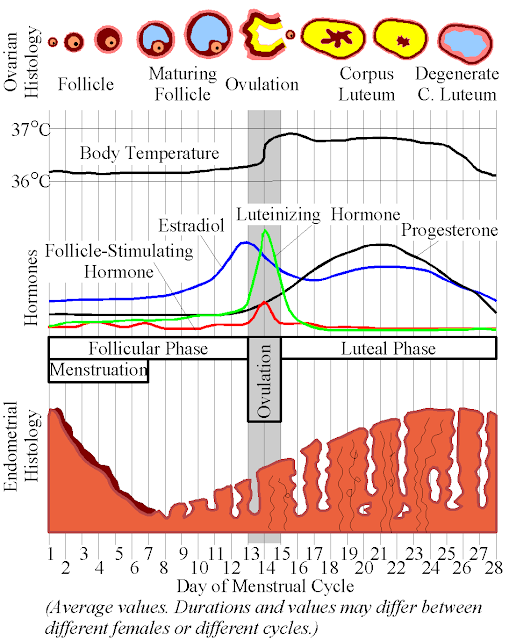
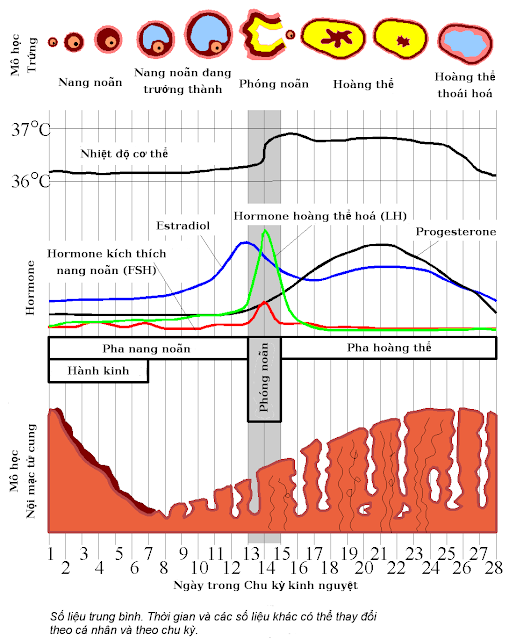
    The standard menstrual cycle is roughly 28 days. The follicular phase lasts 12-14 days, ovulation is 1 day, and the luteal phase is 12-14 days. Normally, a woman's anterior pituitary in your brain secretes two hormones, FSH and LH, into her bloodstream. The amount of these hormones in the blood cycles throughout the day. At ovulation, a surge in Estradiol (an estrogen) sparks a surge in FSH and LH and a release of an egg from the ovary. Progesterone functions to maintain pregnancy by decreasing fluid secretion and motility of the uterus. Without fertilization, progesterone levels drop, and the body sloughs off the bloody lining of the uterus with the unfertilized egg during menses.


    Estrogen + progesterone pills block ovulation by "tricking" the woman's body into believing it doesn't need to secrete an egg. Then, a placebo week drops progesterone levels and the woman's uterus sheds the blood-filled lining.

    They have two types: monophasic and multiphasic. Monophasic pills have a fixed dose of hormones that the woman receives daily. Multiphasic pills have varying dosage of hormones throughout the month and lower total steroid levels.

    Today I noticed that he posted about it again, but this time QUOTED ME
    Progesterone only pills have an increased risk of endometrial breakthrough (i.e. cancer), but are a good option for nursing mothers because estrogen messes with lactation. They also have a higher failure rate because technically progesterone doesn't prevent ovulation, it just makes it near impossible to be fertilized and implanted in the uterus.

    Lybrel, the new pill that eliminates periods, is an estrogen + progesterone pill, and therefore blocks ovulation. However, it's not the magical bullet people think it is. The FDA says,
    Women who use Lybrel would not have a scheduled menstrual period, but will most likely have unplanned, breakthrough, unscheduled bleeding or spotting.

    ...The risks of using Lybrel are similar to the risks of other conventional oral contraceptives and include an increased risk of blood clots, heart attacks, and strokes.
    Seasonale, a pill that came out in 2003 and limits menstruation to four times a year also has spotting.
    "It was really inconvenient, which kind of defeats the purpose," grumbles Pierrette Lo, 27, of Houston, who tried Seasonale last year but gave up after a few months.
    For those women who don't have horrible cramping during their periods, they might be better off with the regular pills, because at least then a woman knows when she will bleed. Lybrel's real benefit comes not in giving every woman who doesn't want a period an out, but in helping those women who really have bad cramps and other symptoms. Those women can opt to give up the five days of torture for unscheduled bleeding and spotting.

    Ultimately, any decision on birth control should not be made on the fly. All options should be discussed with a doctor, so a woman can best decide what type of pill will do the job effectively without causing undue physiological changes/problems. She will also be able to decide if the lifestyle changes that taking the pill entails is truly what she wants. For a patient's emotional well-being should be just as important to the modern physician as her physical well-being.


    [+/-] read/hide the rest of this post

    Tuesday, May 22, 2007

    Snapshot of Bus 87

    Yesterday morning I hopped on the 87 bus and headed up to the medical center. Route 87 is the main conduit for students and workers to the two medical schools in the medical center--Baylor and UT-Houston. In addition to the 87, routes 297 and 298 carry professionals to the medical center from the 'burbs, and the light rail carries professionals and students from the southwest. But nothing says student bus like the 87.

    I got on about 9:00am and the bus was packed--standing room only--as usual. So I, being the bored, odd person I am, counted everyone who got off the bus. I can do this because UT-Houston is the "last" stop--it's the last place people need to go in the morning, so I'm always the last person off the bus. Then the 87 starts the return part of it's loop.

    Now, the 87 is an incredibly interesting loop, because it runs from Sunnyside through the southside of the medical center and ends at the medical center proper. Then it backtracks. Sunnyside is predominantly African-American and very poor. South medical center is racially heterogeneous and predominantly students or middle class professionals who work at the medical center. Hence it has two incredibly different population bases that it services. Also interestingly, they don't overlap. Those who use the bus in Sunnyside rarely go to the medical center, and those who live south of the medical center rarely travel to Sunnyside.

    My impromptu count represents a snapshot of the populace that lives south of the medical center--not Sunnyside. The results?

    Total people: 45
    Caucasian: 5
    African-American: 7
    Indian: 12
    Chinese: 21

    Thoughts?

    Sunday, May 20, 2007

    Finals

    I've reached the other side...

    At 3:00pm Friday I walked out of the NBME Microbiology test, heaved a sigh of relief, and laughed. For the first time in a month, I did not have a test to study for. For the first time in nine months, I did not have anything school-related to do.

    I was free.

    Oh, how beautiful is freedom. Our founding fathers got it right. How could they have foresaw the exquisite joy of having no pressing responsibilities weighing down on your shoulders as you watch tv in the evening? They were men of genius.

    The exam schedule was rough--nine exams spaced over two and a half weeks. Studying for the exams starts about a week and a half before the first exam, so in reality a full month is spent on these things. I study and go to class from 8 am until 2 am for a week and a half, then have three exams in a row--Wednesday, Thursday, Friday--just to finish the fourth block. Two weeks, six exams, and no sleep later, I'm done.

    Thank you to everyone who's helped me--or laughed at me--especially my wife, who lived without a husband for a month. It's no fun going to bed before your spouse, so you only see him for ten minutes as you drive him to school each morning, but that's what she did for four straight weeks.

    Now it's on to summer--the last "summer" of my life. I start a preceptorship at Ben Taub hospital on Tuesday and hopefully I'll do research to keep me busy once the preceptorship is finished.

    But for now, it's nice to watch tv....

    Tuesday, May 01, 2007

    The Month from ...

    This is a disclaimer. I will be blogging only SPARSELY -- and by that I mean only if something really tugs at me -- because starting tomorrow (May 2) and running through May 18 (three weeks) I have exams.

    Yes, you read that right. Three weeks of exams.

    This week are my Block IV exams, and the next two weeks are finals. Do I think it's stupid to have three whole weeks of exams like this? Yes, yes I do. But it could be worse (such as dropping on the class the day before the exam the news that the exam is cumulative over the semester and not just over this block's materials...like my Physiology prof did today).

    So, pray for me, that I will make it out alive, with my sanity, and passing.

    As I used to tell "dying" missionaries back in California, "I'll see you on the other side."

    Wednesday, April 25, 2007

    Medical School Lecturers

    Liveblogging from neurology class...

    Today we're learning about language and higher cortical executive processes. Overall, one of the more interesting things to learn about in neurology. So why is it so boring? And why are there only 23 people, out of a student class over 240, here?

    Medicine is an interesting profession, because it constantly stives for the new -- new medicine, new procedure, new discovery -- while stubbornly and stupidly holding on to the old. This includes surgeons working billions of hours, and didactic learning.

    they grasp didactic learning like a cadaver's hand in rigor mortis grasps a broken tool
    At my school, we see this poignantly. Embracing modern technology, my school has wi-fi in every classroom and videotapes every lecture. This allows students to review the lectures from home, at faster speeds if preferable, or not go to class at all. On the other hand, my medical school stubbornly holds to lecturers in stand alone courses (biochemistry, neurology, etc.) instead of embracing a new, organ systems-based teaching model and moving away from didactic learning.

    Having taught ESL in California and Vietnam, and worked as a Teaching Assistant and tutor in college, I've taught my share of good classes and boring ones. Didactic learning, we all know, is horrible for teaching and retaining material. Having a lecturer stand and speak in monotone about brain hemispheres to many students does very little to help them learn.

    While researching ESL teaching methods and curricula when starting an ESL school in SoCal (at which Xanghe helped), I listened to many audio seminars and read books advocating the benefits of including the student in the learning process. Having students repeat things, connect thoughts, work in groups, perform, and create projects, in addition to using audio, visual, and tactile stimuli together in unconventional ways (songs and poems, demonstrations, props to pass around class) always result in better student scores, and greater retention (not to mention my own opinion of a happier student body).

    Nevertheless, my school is stuck in didactic learning. Slowly medical schools around the country are integrating classes into a systems-based structure, but they grasp didactic learning like a cadaver's hand in rigor mortis grasps a broken tool. Systems-based (organ-based) learning melds the biochemistry, histology, pathology, etc. together in one class as the student learns about one organ system. This makes sense, since a bacterial infection of the liver will influence all of those things--in the liver or circulatory system--and not, in normal cases, your big toe.

    In addition, some professors are gifted at teaching and others aren't. It makes no sense to get the most knowledgeable person on the limbus system teaching it if he or she is dry as the Sahara desert, monotone, speaks incredibly slowly, and repeats his/herself. It is logical to take the second or third most knowledgeable person, who is a much better teacher, because the depth of material we need is not great (we're doctors not PhDs) and overall learning and retention will be much better. Any questions too deep for the lecturer can always be forwarded to the expert anyway.

    Medicine is an interesting profession, because it constantly stives for the new ... while stubbornly and stupidly holding on to the old
    So if you're thinking about medical school, study hard what schools teach what ways, and if possible, sit in on classes. I feel I have regressed back to the stone ages in learning material coming from Brigham Young University to my current school. At BYU, I was mostly in small group classes, with professors that encouraged alternative learning methods. Some of this was my astute choice of teachers and classes that fostered that, and some of it was BYU's emphasis on teaching. Not every class was that way, but the percentage was far higher than the 0% of my current institution. And although my grades aren't horrible, they have definitely decreased.

    Medicine is a fun and exciting field, and the prospect of helping people each day drew me to it. I encourage any who want to help people, and be compassionate, to go for it. But beware the lecturer...the almost extinct beast whose last bastion of strength is the medical school. He may bore you to death.

    Monday, April 16, 2007

    The Heart Beats

    Today, amid all the sadness we've heard, I think I'll blog about a little bit of happiness.

    Today my wife and I saw the OB/GYN and heard the future blogger's heart beating for the first time. The nurse stuck the gel on my wife's belly button, and moved around her "magic wand," and wow! Thump thump, thump thump, thump thump.

    The heart was beating steadily and healthily at 165 beats per minute. FYI, that is normal. Adult hearts beat about 70 bpm, but fetal hearts and newborn hearts beat much faster.

    Some of my favorite quotes of the appointment:

    Me: Did you just go to the bathroom?
    Wife: Yes.
    Me: Why?
    Wife: I had to pee.
    Me: Why do you go to the bathroom every time you come?
    Wife: I dunno. They tell me to pee and I pee.

    *****

    Wife: There's life growing inside me!

    A Tale of Two Peoples

    "IT WAS the best of times, it was the worst of times, it was the age of wisdom, it was the age of foolishness, it was the epoch of belief, it was the epoch of incredulity, it was the season of Light, it was the season of Darkness, it was the spring of hope, it was the winter of despair, we had everything before us, we had nothing before us, we were all going direct to Heaven, we were all going direct the other way ..." Charles Dickens, Tale of Two Cities, pg.1


    Two weeks ago a Thai court overturned an extradition ruling for Ly Tong and made him a free man. For many people, they may say, "So what?" and they'd be right. Ly Tong is whom??

    I would bet that most people in Vietnam don't know who he is. I would also bet that most older Vietnamese in America do know who he is. You see, Lý Tống has made a life trying to get the Vietnamese to rise up and throw off communism.

    This message reverberates through Vietnamese-American communities. Most of the adults -- the older generation -- came to America as refugees after 1975. When they talk about Vietnam today, there is still sadness, a tinge of bitterness and invective, when refering to the current government. Over ten states and numerous communities in America have recognized the "Vietnamese Freedom and Heritage Flag" as the official flag of Vietnamese-Americans.

    Also,organizations use it in their logos.


    So you can see, that the war, democracy, and the hurt from years of fighting and exile from your homeland is still very much ingrained in the lives of Vietnamese-Americans today. I remember visiting a house of a man who had a big picture of Lý Tống on his wall and the words "FREEDOM FIGHTER" printed above it -- and I didn't think anything of it.

    the exact poster he had on his wall

    But this is a "Tale of Two Cities" so to speak. Before my first trip to Vietnam, I'd never been out of America except to the border towns across the Rio Grande in Mexico, and they don't really count. My only Vietnamese experience was with Vietnamese-Americans, so I naturally based my expectations on that prior experience. In other words, I half expected Vietnam to be a poor country where everyone lived in fear of the government, rushing to and fro quickly, speaking in hushed tones, and hiding as the police rode by.

    In Ho Chi Minh City, I saw a different Vietnam--a Vietnam where people really came and went as they pleased. It was markedly more open than in the North, and NOTHING like what my naive brain had envisioned before I left America. The Vietnamese in Vietnam don't know or care about Lý Tống because they are satiated with what they have. Those in the North fought for the communists. They will not go against it. Those in the South are too happy not worrying about bombs, or standing in long lines for handouts, being in "reeducation camps," or buying things on the black market.

    Economic prosperity has quieted the masses. People are happy because of the foreign investment, the jobs, the opportunity, and the paychecks. Ultimately, the human mind has a very short attention span, and in a world of "what have you done for me lately," the communist government has done quite a lot.

    Foreign investment in Vietnam

    My wife still bristles at seeing that yellow and red flag flying. It isn't her flag. Her flag is the red field with the single yellow star. To her, that is not communism, that is Vietnam--her country, the country she loves. Her feelings mirror most of the other young adults and youth in Vietnam today. They are happy for the progress Vietnam's made, excited about the future. Some are level headed and wish for better, but the majority are quieted by the relative opulence that Vietnam now enjoys.

    And so it is truly a tale of two cities--two peoples. The Vietnamese look at the Việt kiều as another nationality, because in a sense they are. Although they call themselves "Vietnamese" in America, they are at most Vietnamese-American. Their culture has become wholly different. Their history is different (after 1975). Even their language is different (speaking half Vietnamese, half English or "Viet-glish" and using Vietnamese vocabulary circa 1975).

    And in Vietnam you have a new young population that doesn't remember war and food shortages, and who's youthful optimism is buttressed by economic progress and growth of a new middle class. They are learning English as a second language, working for foreign companies, and worried more about the new CD by Mỹ Tâm than the latest actions of Lý Tống. In many of their minds, it truly is "the best of times ..."

    Friday, April 13, 2007

    New Edition to the TBE Family

    As I mentioned in my last post, Vicissitude, life is a series of ups and downs, circling constantly back around on itself. It really is a series of stages of awareness--to self, others, God.

    Along the way, we enter into the vicissitudes of humanity, contributing consciously and without effort, to the upswing in the wave and the downswing. It is a matter of debate whether or not the wave circles back on itself--whether "history repeats itself." It is a greater debate whether we, as individuals, can affect the outcome of humanity on a macroscopic scale. I believe it does repeat itself, and I believe we can change that.

    So, back in January I learned that I was joining humanity as it repeated itself. My wife came yelled at me from the bathroom while I was studying.

    Anh! Come see this!
    This is what I saw:
    "Am I pregnant?" she asked.

    "Well, when are you supposed to have your period?" I replied.

    "This week," she answered. "I haven't started yet."

    "Well then you better wait. The second line is faint. Maybe, maybe not."


    My lovely wife did not heed my advice, quite usual in our family, and used another test the next day.


    Again, I told her to wait.
    "Em, usually the female body does not make that hormone unless you are pregnant, however, I don't know how sensitive the tests are or your specific hormonal makeup, so just wait a week and do it again. It won't change anything." I cautioned.


    Obviously, that did nothing to calm her curiosity--I mean who wouldn't want to know right away if there's a life growing inside them?--but this time she waited (it also helped that she had no more test sticks). On the other hand, I knew pretty well that those tests are 99.99% accurate, and a healthy non-pregnant body should have NO hCG hormone. In all likelihood she was pregnant. That 0.01% wrong is usally a false NEGATIVE, not false positive.

    A week later, she grabbed another box of sticks and tested herself again. The results confirmed my suspicions.


    Needless to say, we were very excited. My wife immediately started dreaming up ways to paint my study room into a nursery, and looking at maternity clothes. I just stared at the wall wondering how I'm gonna do school and be a dad. She didn't want to tell anyone until we saw the ultrasound, but after about one week she broke down and told my mother.

    Then, the second week of March, we went to the doctor and saw the little blogger for the first time. Here is the new edition to The Bleeding Ear:


    The doc forcasts his/her first blog to be about October 22, 2007. We find out the gender in June-ish. (You can see at the bottom of the ultrasound, the new blogger is currently 1.69cm long, at the 8 week mark, and the computer's due date)

    And so, I am now filling the role my parents went through some 28 years ago. My life is definitely on the upslope of the wave. Ah, the vicissitudes of life!

    Tuesday, April 10, 2007

    Vicissitude

    I was walking with my companion, Thuan, when he stopped suddenly. I turned, a couple steps ahead of him due to my slow reflexes, and noticed him reading a poster. Here in Little Saigon, glossy posters covered with famous Vietnamese faces and advertising everything from plays to Paris by Night were commonplace--more than commonplace. On this particular wall the poster melded into a sea of posters, all taped up with clear packing tape, one right next to--and sometimes on top of--the other.


    (example of the posters I'm talking about)

    For the most part, we ignored the ubiquitous posters, but this time was different. Thuan had found a word he didn't know. We searched are pockets for our faithful "girlfriend Kimmy" (electronic dictionary). "Những nỗi thăng trầm của cuộc đời" or "The vicissitudes of life."

    Vicissitudes...I have never forgot that little moment, and it is just those times that make language live. At that moment on Bolsa Ave. "vicissitude" gained a second meaning outside of the dictionary--that memory.

    The other day, while reading a post on Virtual Doug, I realized one more time how life moves in circles. However, after finishing Block III exams, I realize it's more complicated than that. It's like photons--at once both a particle and a wave.

    Everyone in life deals with vicissitudes while at the same time circling back to where we were before. It's like a wavy circle, if you can picture it. For me, a medical student's life runs in four-week waves. The first week (this week) is very low key, because you're exhausted from the exams you just finished. You sleep 8-10 hours a day, and your schedule is malleable. The second week starts the dip. You start to focus, and play catch-up on what you missed during week 1, because studying is immensely difficult. Week three is near the bottom of the wave. By this time you're in your last week of studying, so every minute is spent looking at a notecard or memorizing some random fact that could be on the test. Sleep has now dropped to four hours a night or less. Time spent with the wife is even less than that. You have a blood caffeine content of probably 0.05%, and you've got sharp headaches from the tension built in your shoulders from reading constantly.

    Week four is actually on the upside of the next wave. You see, taking the exams is horrible, but it's mitigated by the fact that you're now knocking them off one-by-one. No more juggling time to study for every exam--just spend all day on the next one up. Then it's over with and out of mind. Once Friday evening hits, you're back to the top of the next wave, and coincidentally, you've made a circle back to the beginning of the cycle.

    Take a deep breath! You've gotta do it again...

    Sunday, April 01, 2007

    Google's Free Broadband


    Is it real?? I dunno. At first I thought, "cool!" but then I noticed it was after midnight, and that made it ... April Fool's Day.


    So what is it? Well, Google has announced free broadband internet. You sign up and they will send the stuff out to you. Sound too good to be true? Well, maybe not. It's been talked about for a while that Google is doing internet. Something about free wi-fi in San Francisco. They actually actualized (is that grammatically legal?) the plans by providing free wi-fi to everyone in Mountain View, CA at the end of August, last year.

    So, giving out free internet isn't too much of a stretch...

    ...which also makes it the perfect April Fool's Day joke.

    If they had stopped there, they would have had me. But they didn't. I clicked on the install link at http://www.google.com/tisp/install.html. That took me to a page showing me how to install the internet -- THROUGH MY TOILET.


    Awesome. Instead of crappy internet, I can get my internet crappy.

    Sorry .... it's late and I've been studying hard.

    So, in case you think we might actually get super fast internet for free, it's all a joke. You're stuck with the junk we have from our cable companies or DSL providers or AT&T, who all want to charge us an arm and a leg for slower connections than the Japanese and Koreans have, and have the audacity to want to start making the internet a tiered system by preferentially charging websites for faster access by surfers.

    Unless you live in Mountain View, that is.

    Thursday, March 29, 2007

    Define Anti-Semite

    How is this anti-Semetic:

    "They got a lot of power in this world, you know what I mean? Which I think is great," Richardson told The Times Union on Tuesday. "I don't think there's nothing wrong with it. If you look in most professional sports, they're run by Jewish people. If you look at a lot of most successful corporations and stuff, more businesses, they're run by Jewish. It's not a knock, but they are some crafty people."


    That's what Michael Ray Richardson, ex-NBA player and current CBA coach of the Albany Patroons, said to a newspaper. The result? The CBA suspended him.

    Now the beauty of MSM is that they never give you all the facts--no links to the original interview, etc., so we can never know how in- or out-of-context that quote is, but looking at it on face value, it seems pretty inocuous. Is "crafty" the word they're mad about? I've always taken it as a compliment to be crafty, but it could possibly be taken the other way.

    Otherwise, I don't see how his comments are anti-Semitic. If he replaced "Jewish" with "White" or even "American" in his statement, would he have been fined?

    I'm all for discouraging racial slurs -- I've grown up in the South and I've seen/heard them many a time. This one just seems a little overboard given the info at hand.