• People Talk and My Ear Bleeds

Thoughts

    from Twitter

    News

    Thursday, June 22, 2006

    A Late Father's Day Story

    I caught this Father's Day story the other day as I was surfing newspapers online. I think this is a must-read.
    My only regret? That I couldn't do it more or start sooner.
    Louis DeLuca, a staff photographer for the Dallas Morning News, shares his story of adopting Fu Yang, an orphan from China who was born with sever facial deformities.

    I love the mental progression he and his wife went through when they first met Fu Yang and decided to adopt him. I think it's very typical of many people that deal with disabled people.

    "It was October, the middle of the football season and I was busy," Mr. DeLuca recalls. He complained to his wife, Dinah.

    "He's an orphan," she said. "You can take the time."
    We're all so busy in our lives, that we all think this, proably daily. Work, family, school -- legitimate time-consuming enterprises. And we all probably miss some great blessings in life by just going through our routines.

    Then, after meeting and falling in love with Fu Yang, Louis and his wife think this:
    "I thought of every reason why I couldn't do it," he says, "language barriers, economic barriers. It costs lots of money to adopt a child." Adoption was the furthest thing from his mind. Especially a child with special needs.

    "I have no special skills for that," he says.

    "It was a very volatile time for me emotionally. My heart was saying, 'Go for it! Do it!' And my head was saying, 'No way!' "
    How often have we come to a trial in our lives and told ourselves "I have no special skills for that." We, like they, think up all the excuses we can not to power through and overcome the situation before us. But I feel strongly in God, and I feel he gives trials in life to make us stronger. When we see a trial or challenge and decide to endure, he will increase our skills--be it patience, knowledge, strength, kindness, etc.--to have success.

    Especially with people that have disabilities. It is very easy to think "they are different from me" and not associate with them. I mean, how much does one have in common with someone who has Down syndrome, or is in a wheelchair, or has cerebral palsey? As a teenager in Houston, I had the opportunity every year to work with special olympics. However, I fell into that group--the doubting group--and spent most of my time doing jobs that took me away from interaction with the participants.

    "In retrospect, it would have been a huge mistake not to have done this," he says. "When he's around, he has a way of brightening your life."
    That is how I felt in Vietnam the last five months. I had the opportunity to volunteer at an orphanage for disabled children. When I first volunteered, I did so half-heartedly. I didn't know if I could do it. The first day was so taxing mentally and physically. Most of the children have cerebral palsy. I volunteered there two days a week for four months and established such great relationships with the children and workers. My only regret? That I couldn't do it more or start sooner.

    I'll talk more about my experience at a later date, but for now, read the article and make sure you look at DeLuca's photo and audio essay. Wonderful.


    [+/-] read/hide the rest of this post


    Monday, June 19, 2006

    Turmoil in Oaxaca

    Please, please read this excellent post by Mark in Mexico. He has updates here, here, and here. This really irks me. Not what he talks about, but that I haven't heard about it before now.
    I'm reminded of a quote by Dave Chappelle in Black Bush ... It starts with "shut" and ends with "up"

    My wife and I were just remarking the other day about how dumb we feel listening to CNN or Fox. This last weekend, Fox spent 80% of it's coverage on the failed terror attack on New York City that was planned for three years ago and was never tried. Who cares??!!?? Ok, telling me about it once, I can understand, but for 80% of your coverage all day?? Give me a freaking headache.

    So what do they do with the rest of their time? FOX tells me about the Duke lacross rape trial. Like I care. It's a rape trial. It hasn't even gone to trial. It's just a case. Granted, it may have caused a stir in Durham, where most people are black and most Duke students are white or asian, but I don't live their and never will. I never want to heard about the trial again, let alone hours of idiots pontificating about whether the DA has a case or not. I'm reminded of a quote by Dave Chappelle in Black Bush when he's at the podium talking about the UN. It starts with "shut" and ends with "up."

    Mexico has issues. Serious issues. Besides this teacher strike, its own southern border is proving a little too porous for its own good. That is news worth telling us about, FOX, CNN. Until then, I look to the blogosphere.

    P.S. I was led to Mark in Mexico by The Glittering Eye (not related to me, The Bleeding Ear). Check it out too.

    Javascript vs. Browser: My blog

    Why oh why can't web browsers do things the same AND WELL?? You may have read about my new blog layout....well it's taken another iteration, and is in Beta form. The Bleeding Ear v.2 Beta. you can catch it on my test blog: here.

    The problem is, I am not a good programmer. It takes me forever to do what I'm sure some others, like ecmanaut, Aditya, and those at Freshblog could do in minutes. Because of that, it's taken me quite a long time to put this together and I have two issues to resolve.

    First, i need to think up a good header. Oh...I dunno. Any ideas would be appreciated. Something that really encapsulates this blog.

    Second, my new layout doesn't look the same in all browsers!!! AAAGGGHHHH!!!! It's getting annoying, because I spent a long time yesterday trying to fix my blogroll only to see that it looks fine in Opera 9.0 Beta 2, and pretty good in IE 6. Why does it look funny in Firefox and Flock?

    (Yes, I have four browsers, but I don't think that's abnormal anymore, do you??)

    I know it must be the javascript. Whenever I import the javascript and write as a list (see my blogroll from blogrolling and my topics from Freshtags and my recent comments by BloggerHacks) the css formatting doesn't look right in Firefox. This is odd, because firefox is the more modern browser compared to IE 6, so I thought IE would be the one giving me problems. And Opera shows the javascript correctly, but doesn't center the icons in the sidebar like I get in Firefox. O tempora O mores!!

    Father's Day

    My wife made an astute comment yesterday.

    "You better celebrate Father's day because men only get one day a year, and women get two."


    I haven't looked at a list of holidays, but it seems to ring true. Men get father's day and women get both mother's day and international women's day. Always the short end of the stick... just kidding.

    Actually, I'm not a father but I love Father's Day. Two reasons:

    First, I have a great father role model. My father is a great man, and although as a little kid I hated his disciplinarian style (and loved his coaching of my little league teams) I find myself turning into him more and more, and wanting to be like him. My father grew up in a small town, and brings a farm work ethic to life. He changed religions when he was 17, and that moral/religious conviction drives his life. He has always been a good role model as a father and husband, hard worker, always volunteering to help people, a genuine love for others, for God, and family. I hope that today, for father's day, everyone can celebrate the father's in your lives, and hopefully you have one as good as mine.

    Second, what a better tradition than watching the US Open on Father's Day. I love the fight. I love golf and it's family legacy. So often the golfer got his start because of his dad. His dad caddies for him. His dad cheers him on. I don't golf much, but I love being out on the course, especially with my father and brothers, just able to enjoy the scene, relax, and enjoy the company. It's a great game.

    Happy Father's Day.


    Saturday, June 17, 2006

    Mystic River

    Last night my wife and I finally saw the movie Mystic River. Rent it edited. Generally, I am against editing, but this is a movie where CleanFlicks does a service. Cinematically, the movie is solid. The plot is interesting, acting well done, scenes filmed and edited well.

    Mystic River uses language almost as colorful as a Quentin Tarantino film

    Language ... profuse. I grew up in Houston, and have heard enough colorful language in my day to not flinch to much when someone drops the "f-bomb" or something, but I choose personally to associate with people who language is clean. My wife even more so. She grew up around clean language and so any foul language really irks her.

    Anyway, Mystic River uses language almost as colorful as a Quentin Tarantino film. Do yourself a favor, get a copy with the language edited (it's the only thing that needs editing) and watch the movie. Great movie. Really leaves you thinking about life, choices, and luck.

    Secondly, pedophiles are sick. Dave's abuse and escape as a child is a central theme to the movie and Tim Robbins does an amazing job portraying the psychological scars an incident can leave. So, all morning I've thought about "girl-lovers" and "boy-lovers" and how my stomach turns. I won't give you any hyperlinks, but I'm sure you could google the terms if you want. Those terms are becoming the two terms of choice for advocates of legalizing pedophilia.

    Here's the situation. In western society, specifically America, homosexuality was considered deviant behavior and a psychological disorder for years, centuries. However, in 1973, the American Psychiatric Association (APA) decided to remove homosexuality from the list of psychiatric disorders. There were reasons for this. Some thought it was a disorder. Others thought it was, but labeling it as such brought discrimination against homosexuals. Whatever the personal reason, psychologists at the APA removed it in 1973 and since then homosexuality has gone from hidden, to marginalized, to tolerated, to accepted, and finally to the point of turning into a civil rights movement (marriage).

    Pedophiles have seen this and want to do the same thing. They understand that if they can get the APA to remove pedophilia as a disorder,

    homosexuality has gone from hidden, to marginalized, to tolerated, to accepted

    they can start on the same path towards acceptance. I am sort of open to bending the legal age of consent...it's always difficult to say "hey, at this age you can accept and act on your feelings but not before," but children are just unacceptable. Children are pure. They are innocent. They are definitely not sexually developed, and anyone who argues feelings or actions with them are normal is NOT.

    I had a friend named Amanda who was sexually assaulted in college by someone close to her. I remember the nights my friend Rob and I spent talking with her, helping her deal with her feelings. I remember poignantly how she related her feeling of causing it, and being so dirty afterwards--always wanting to shower but never feeling clean. And Amanda was an adult. I can only imagine how a child would or would not deal with these issues.

    So, watch Mystic River (edited) and oppose mainstreaming pedophilia. It's a stronger movement than most people think. Nip it in the bud before it grows more. Contact the APA (here).


    [+/-] read/hide the rest of this post


    Wednesday, June 14, 2006

    Med School Computers

    Oh the headache!!

    I have spent many hours yesterday and today looking at laptops. It's a racket, I tell ya. I have to get a new laptop for medical school ... and because this one is dying.

    Currently I have a Gateway S something. It has:
    Intel Celeron 2.0ghz
    512 MB DDR RAM
    40 GB HD
    integrated graphics/video card
    integrated 10/100 ethernet
    external Netgear WG511T 802.11b/g 108Mbs wireless
    24x/8x CD-RW/DVD-ROM


    Why am I getting rid of it? Well, one of the two hinges for my screen is broken, meaning the screen stays up most of the time, but slips now and again.

    and how come nobody says how hot or loud their notebooks run

    Secondly, my cdrw/dvd-rom is dying. As in not reading things.

    Otherwise, it's been a good comp. I've had it for three years. It's a little hot, and runs a little slow, but it's survived viruses, tons of programs, videos, being dropped, etc.

    What do I need? UT-Houston says:
    Intel Pentium IV 1.5 ghz
    512 MB RAM
    30 GB HD
    cd-rw/dvd-rom
    10/100 network interface card
    802.11b/g wireless
    windows XP Professional


    Yes, I must have win XP professional. Luckily, it doesn't rule out a mac anymore because boot camp lets me have both OS on a macbook pro. Unfortunately, macs are still expensive, and do I really want to mess with two OS?

    Now I'm seeing AMD vs. Intel all over again. AMD is cheaper, it's faster, but it's 90nm. Intel Core Duo is more efficient than the Turion as a chip, because its 65nm, but not as a system. It's also usually $300 more expensive. Things are making HP and Compaq look more and more enticing with the AMD systems. Does anybody have experience with them?

    AND HOW COME NOBODY SAYS HOW HOT OR LOUD THEIR NOTEBOOKS RUN!!???!! That is freaking annoying. My biggest pet peeve with my current laptop is that when I used to study in the library I felt it was really noisy, and it gets hot fast. I want to know how laptops compare to each other in that dept.

    Ugh...*sigh* I guess I will just have to keep searching.

    (By the way, name means a lot. A Dell latitude cost me $1750, and the EXACT same components in a Dell XPS cost $2400. Crazy, huh?)


    [+/-] read/hide the rest of this post
    Categories:

    Friday, June 09, 2006

    Today's Non Sequitur Cartoon


    I think today's Non Sequitur cartoon embodies America's definition of marriage debate.

    Cultural liberals argue that the constitution protects privacy and individual rights, not marriage as man and woman. Conservatives say marriage has been between man and woman for thousands of years, my religion and moral ethos preach that, and we must keep it that way.

    To paraphrase Abe Lincoln, "A house divided cannot stand."

    Thursday, June 08, 2006

    Abu Musab Al-Zarqawi is Dead

    I, like everyone else woke up this morning to the news that American soldiers killed Al-Zarqawi via two 500lb. bombs.

    If you decapitate one head of a hydra, does the body die?

    We will find out.

    Fox News
    has been very positive about this development all morning, reporting that,

    "Loud applause broke out as al-Maliki, flanked by U.S. Ambassador Zalmay Khalilzad and U.S. Gen. George Casey, the top commander in Iraq, made the announcement at a news conference in Baghdad Thursday that Zarqawi was "terminated."

    CNN's very first paragraph is:

    "Al-Zarqawi's death gives Iraq a chance to "turn the tide" in the fight against the nation's insurgency, President Bush said at the White House."

    The only really lukewarm reaction is from the BBC, saying,

    However, the death of one man does not necessarily bring a breakthrough ... he was not a one-man band.

    Lately most of my posts have been about Vietnam, but those of you who know me personally should know that I supported the war in Iraq when we started. Since that time, I personally disagree with much of how the Bush Administration has conducted it, but I still support the general issue.

    If you decapitate one head of a hydra, does the body die?

    I think we need to be in Iraq, and I am ok with the realization that troops will need to be in Iraq for probably 50 years.

    You may call me a warmonger, but that's not it at all, and the reasons behind my simplified position stated above warrant a separate post or three, but I think this is pretty good evidence that although people die, things are moving forward over there.

    And moving to Vietnam...where's the reporting of Al-zarqawi in Vietnam? Actually, the Tuoi Tre has an article on his death, but it is not on the front page like CNN, BBC, and FOX. You have to dig through the "the gioi" (world) section to find it. NOTE: Before finishing this article, the front page of the Tuoi Tre was updated and this article was put on the front page, though not the number one article.

    Although down towards the bottom of the first page, the Nhan Dan gets it on the first page, still under the "the gioi" section.

    Let's hope that this is a significant step towards stabilization in Iraq and pressure on Iran, not just a fleshwound to a hydra.


    [+/-] read/hide the rest of this post


    Sunday, June 04, 2006

    Bicycles in Vietnam

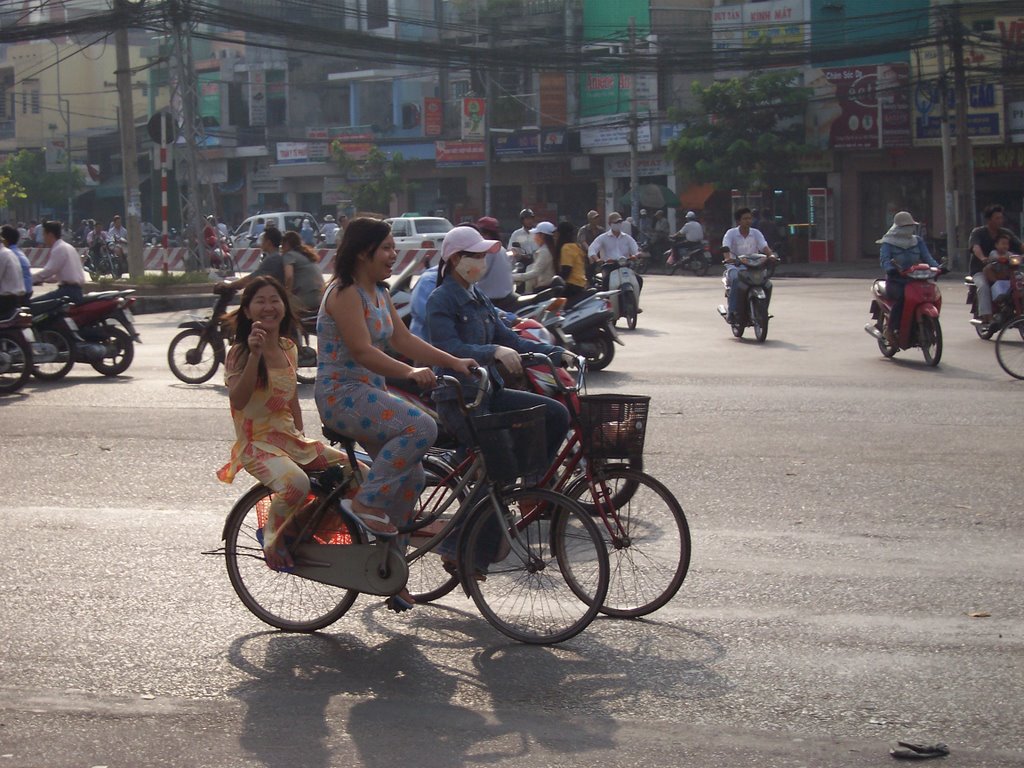
    The Vietnamese are great at many things. They are hardworking, family oriented, optimistic about the future, and great bicycle riders. Yes, bicycle riders. If that's a word. Does it need to be hyphenated? Bicycle-rider?

    I digress.

    Talk about giving your kids a ride to school

    Since I returned to Vietnam, I have endeavored to take pictures of people living--candid, real, rough, and fresh. I want to see the true feelings people have. Bicycle riding is a very integral part of many people's days. So the pics I will post will hopefully give you a small feeling of what it is like.

    Because the Vietnamese have perfected the art of bicycle riding. Yes, an art. They pump two, sometimes three people on a bike. The pump them behind, on the handlebars, on the frame...I've even see a kid riding on the shoulders of the rider (unfortunately no pic...that was two years ago in HCMC in District 6...). One of their improvements, mainly due to their great dexterity and small foot size, is that two riders will sit on a bike and both will pedal--their feet are small enough to fit two feet on each pedal.

    Here's some bicycle riding pics from Vietnam. Enjoy.
    This is a good general picture. Notice the steel-framed bike with basket, typical of Vietnam. Also, I love the girls faces as they laugh about something.


    A little farther away, but you can see a mom and two daughters on this bike. Talk about giving your kids a ride to school! The older daughter is sitting on a book rack over the back tire, and the little girl is sharing the saddle with her mother.

    These women (mostly) are becoming a thing of the past as the omniscient Communists crack down on all social evils...including poor Hanoian women who come south to sell fruit at markets...obviously a social ill. Besides their outfits, which I will never forget, look at the wire boxes on both sides of the bike, full of produce in the morning, and empty about noon as they return home. For the Vietnamese, the bike is more than recreation, it is a work vehicle.

    This is one of my favorite pictures. With the advent of motorbikes, bicycles are fading from the scene, and are now seen mostly with teenagers. The boys here were on their way to the swimming pool for an afternoon of fun and sun. Notice how there are three boys on one bike. Swimmingsuits and towels are in the backpack in the basket up front. Behind them are two girls, coming home from school. If you look closely you will notice what I talked about earlier--both girls are pedaling the bike.

    Although the motorbike is increasingly used in place of the bicycle, and now the car is making inroads on the motorbike, there is still a special place in Vietnam for the bicycle. Perhaps, as Vietnam's economy grows, more Vietnamese will take up cycling. With their body size, and expertise at utilizing a bike, I think it's only a matter of time before we see one in the Tour de France.


    Categories:

    Friday, June 02, 2006

    Vietnamese Blogs

    I'm sure I'm not alone in my frustration at the lack of Vietnamese-themed blogs and blogs by Vietnamese people in the blogosphere.

    When I can get political blogs and law blogs and econ blogs just like in America...that will be a great day.

    Vietnam is such an amazing place and the people are so .... real that blogging would be perfect for them. By "real," I mean everyone I know in Vietnam has so many facets, good and bad, foibles and talents, that I just love talking to them, listening to them, learning about their lives, their wants, their likes and dislikes ... what makes them tick.

    Growing up in America, I'm used to the open-ness of the culture. Well, and I grew up in Texas, where "bigger is better," and big mouths seem to follow in that vein. So even though Vietnamese culture says almost as much through not speaking as through speaking, and the general xung ho questions--"hello, how are you?" "what's your name?" "how old are you?" "how many children do you have?" etc.--are ok, the average person on the street won't just sit down and tell you how they persevered through the loss of their mother when they were 11. That being said, once you do know someone, the strength of Vietnamese relationships allows those stories to really blossom.

    "Enough ranting!" you say. Ok, Ok. The reason I bring it all up is because blogs act as that window to the soul. Blogs in Vietnam would do many things:

    1. they would shed light on what the desires of Vietnam's older and, especially, the younger generations have
    2. the vietnamese press is opening up, especially with the latitude give the Tuoi Tre to cover bribery scandals, and oh... I'd love to hear what press bloggers say about their jobs.
    3. along with the press, the economy is burgeoning, and I know many educated men and women working in banks and companies that could blog in english or viet and shed light on life "on the inside" as Vietnam opens.
    4. of course, I'd love to see some political pundritry, law blogging, doctor's blogging
    5. but mostly, what I have the least chance of seeing is what I'd want to see most--blogs by street vendors, xich lo drivers, and women who sell fruit at the cho

    I want them in english if they want, but Vietnamese for sure, so they can express themselves in their native tongue.

    When I can get political blogs and law blogs and econ blogs just like in America...that will be a great day.

    Which makes it interesting, that of all the blogs I do stumble across by native Viets (not Viet kieu--overseas Vietnamese--) most seem to come from Hanoi and are in English. This surprises me, because Ho Chi Minh City is more open internet-wise (blogspot is blocked in most of Hanoi) and thinking-wise (hence the Tuoi Tre is leading the bribery charge), yet it's in Hanoi that the blogs are popping up--blogspot blogs, no less.

    I wonder how this is happening? And why are most bloggers I find blogging in English? Is there something vital that I am just missing?

    Here are some new blogs steered my way by Noodlepie. Gotta give him props. They're new blogs, a couple months old max, but they look to be good, real, and well...tuoi("fresh") if I can use that word.

    Check them out:
    Elmoooh's
    I am Moony
    Rose's Blog (although I have a sneaking suspicion that she's Viet kieu, and therefore disqualified for the narrow category I'm taking about, she does do humanitarian work and live in the north, which gives her high props from my wife and me if you know what we do)


    [+/-] read/hide the rest of this post

    Monday, May 22, 2006

    The Constitution and my wife

    Here's my wife's second essay on the founding principles of the Constitution. As before, she is taking a class, "American Heritage," which functions as a politica-history class. I help with ideas, brainstorming, grammar, vocabulary, and editing.

    Warning, it is long. Read at your own risk!

    *****Essay 2 by My Wife (quotes may be used with proper annotation. This work may not be reproduced in full without the expressed written consent of the author. A reminder, everything on this blog is under copyright)*****

    One of the favorite foods in Vietnam is rice paper. It is used in many ways. Some people wet it, and fill it with chopped meat, and vegetables, then roll it and eat it as spring rolls. Others put in rice noodles, big leaves of lettuce and mint, and beef, and then roll it in half. In both cases, the rice paper is not the center portion of the food that the palate tastes—it is the structure used to hold all the various ingredients together. Rice paper is chosen for this work because of its flexibility, its size, edibility, taste, and look. In just this way the Constitution influences our lives. It is not the main law that Americans see every day—but it is the underlying structure that holds all laws together. And the principles of the Constitution, like the attributes of rice paper, are what gives it this ability and makes it special.

    One of the basic principles of American government is the sanctity and amorality of the Constitution. It is a written fundamental law higher than man or government. The Constitution is a legal document that serves the country and its people—not a moral theory. The Framers of the Constitution did not use it to expound certain moral theories or beliefs or enforce righteousness. In fact, they tried to keep morality from the Constitution on purpose. They believed that a document focusing on truth and justice, without preaching morality, would accumulate support from the individualistic Americans who did not want someone or something telling them how to live their lives, and who were inherently virtuous anyway.

    This pose on amorality stemmed from a strong belief in natural rights, like those described by John Locke, and an opposition to British common law. Americans felt that the Constitution outlined all the basic rights citizens and the government had, thereby making it impossible for someone to pass a law contrary to these basic rights, and that by writing down the Constitution, it would serve as a clear benchmark to judge laws passed later by Congress.

    Today we see the wake of these of ideas in the turmoil over Supreme Court Justices. Ultimately, all controversial decisions about the constitutionality of a law appear before the Supreme Court. When Pres. Bush nominated Justice John Roberts and Samuel Alito, they were subjected to extreme scrutiny from all parties because their voices would be the voice of the constitution. Also, this principle is shown clearly in the language of today—just two sentences earlier. People talk about the “constitutionality” of things, of laws. All actions are not answerable to the government, but to our constitution.

    Creating an amoral document did not mean the Founding Fathers wanted an amoral government. In fact, they hoped for the opposite. Madison argued in Federalist 43 for not just any government, or any form of self-government, but for “good government.” The Founding Fathers lived in a land with a strong emphasis on Christian moralism, and to achieve this, they expected virtue to pervade, influence, and guide the actions of the polity. In Vietnamese, virtue is “duc hanh,” the combination of “duc,” meaning morals or righteousness and “hanh,” meaning good nature or sweet character. Its overall meaning is “behaviors that show high moral standards or goodness.” The Constitution was written with the expectation that a moral populace could be trusted to vote and elect leaders in a federal republic.

    The Founding Fathers also realized that communication and coherent political process in between such a large population in a spacious country would be weak and inefficient at best. In order to merge their hopes with the reality of America, they settled on the principle of popular representation. Popular representation was a republican form of government more than a democracy. People chose individuals who would represent them in the government. This way, the numerous, varied, and sometimes specific wants of the populace would be relayed efficiently to the government, and the often unpopular and necessary laws could be relayed back to the governed. The Framers, believing people to be inherently virtuous, expected the people to choose representatives more virtuous and intelligent than themselves.

    Today we see the importance a virtuous candidate has in the political process. It is widely accepted that the sexual misconduct President Clinton did with his aide, Monica Lewinsky, occurs often between coworkers in the workplace. Yet, the scandal seized the attention of the American public for years. Why? Because a president is supposed to be above such moral lapses in character. Any student of history can find plenty of examples of past presidents and sexual license (Thomas Jefferson and children by his slave), but most instances were kept under wraps. In retaliation, President George W. Bush has served two terms in office riding the backlash of this scandal—the growing power and popularity of a morally-conservative Christian movement in the Republican party. His allegiance to them, a portrayal as a down-to-earth politician with a genuine love for his wife, answered the virtue questions that Pres. Clinton raised, and overcame other political shortcomings (a controversial war, etc.) to earn him victories over both Al Gore and John Kerry.

    The Founding Fathers realized that nobody was virtuous all the time. Some people were never virtuous. Often when personal benefit and virtue crossed each other, self-interest would be the first choice. Laws and government structure based on self-interest is called auxiliary precautions because all actions taken with self-interest as a guide are supposed to be auxiliary to virtue.

    Due to auxiliary precautions, the Framers of the Constitution structured this document according to the principle of counterpoise. Everyone has his or her own interests that might conflict with others’. One interest is balanced against another, so no group can be in control. This helps maintain the power of balance and control within a large republic. It also led to the principle of shared sovereignty.

    Using counterpoise, the Founding Fathers insured that people choosing leaders out of self-interest instead of virtue would never gain a permanent hold on the government by setting up a federal republic. A classical republic often lost effectiveness due to factions. This attribute was of extreme importance to those like James Madison, who wrote in Federalist 10 against all forms of factions. However, Madison counterintuitively rebuffed the arguments against republics by saying that the larger the republic the less corrupt it would become. The more tiers of government, the more factions would be represented. It would be easy for a representative to represent one faction if he or she represented one small group, but a larger group would have more varied needs and would be less likely to be ruled by one faction. Modern political parties, although factions, rely on such a broad support base of people, that the sub-factions make it extremely difficult for one faction to control a government and oppress the other.

    A strong central government was also likely to be led by one faction; however, a government where the federal government shared some sovereignty with the states muted this point. People living in states would work for their own self-interests—states’ interests—and those on the federal level would argue for federal interests. Often these two outcomes would be at odds with each other. It also let people turn to the states for specific needs that would be poorly addressed at the federal level. Today this is seen again with the marriage issue. When Massachusetts legalized same-sex marriage, many other states’ voters opposed the idea by writing amendments to their constitutions defining marriage as between a man and woman only. This freedom of states to legislate for their constituents provides a laboratory to see what works before implementing it on the federal level, and allows the government the flexibility to meet individual needs of states without affecting all other states.

    Such a balance of counterpoise was achieved by structuring the Constitution according to the principles of separation of powers and checks and balances. The Founding Fathers were fearful that an omnipotent executive could usurp power and create a monarchy. On the other hand, without a strong central government, the representatives of the people and the states (House and Senate) would be about as weak and inefficient as the old Articles of Confederation government. First, they divided powers. By creating an executive branch that is responsible for administering the laws and a legislative branch that is responsible for creating the laws, the desire for reelection by the people would keep the branches working towards separate goals. There would be little incentive to create a “grand coalition” because carrying out the laws and international duties had a different set of goals than creating laws. This set up prevented Congress from passing laws to achieve a particular purpose because it did not enforce the laws, and it would never want to give up that power to an executive either. The two branches became counterweights.

    In addition to separation of powers, the Founding Fathers introduced checks & balances. The executive office was given a veto power over bills and the legislative branch could override the veto with a two-thirds majority. The judicial branch checked to make sure all proceedings followed the Constitution, and in return the justices must be appointed by the president and approved by the senate. This set up not only gave separate powers, but made the three branches fundamentally at odds with each other on some basic points. A popularly elected president would reap the blessings or cursings of bad federal legislation, and would be free to enforce or veto as necessary to keep himself in office. Meanwhile, a representative of senator must create laws that reflect his or her constituents’ views—that might not reflect the average American voter—and if enacted might benefit the senator at the expense of other Americans.

    Today, the immigration question highlights the balance of powers in the American government. A republican led House passed a bill restricting illegal immigration by building a wall and making it a felony to be illegal. The Senate, also republican led, cannot pass that same bill because (ironically) a republican president would veto it. He is pressing for worker permits that are far more liberal than many senators’ constituents want. So, the senators are caught between a rock of a house bill and a hard spot of easy “amnesty” (as opponents call it). Pres. Bush does this because he is trying to court Hispanic voters on a national stage. Senators, meanwhile, worry about their constituents, which may or may not be predominantly Hispanic. If not, they have little incentive to vote the way President Bush wants.

    Ultimately, the Constitution of the United States of America became one of the most libertarian of all documents in this government. It hoped for virtue from citizens and leaders, but expected self-interest. Through that expectation, it setup a system of counterpoise, by playing the goals of the branches of government off each other. By sharing sovereignty with the states, the federal government gained flexibility to meet the needs of smaller constituencies without sacrificing a strong central identity. Ultimately, the constitution became the perfect skeleton to hang an ever increasing and changing set of laws and statutes.


    [+/-] read/hide the rest of this post
    Sunday, May 21, 2006

    Short Airplane Thoughts

    I'm sorry for the sudden drop off the earth, but I and the wife spent the last week traveling around the middle of Vietnam. It was great, and I'll have stories and pics later. For now, I want to start at the end of the trip.

    Here are some thoughts on a Vietnam Airlines flight from Hue to Saigon...

    The cha sandwich is barely better than eating bread alone...no wait, it’s not. The Uni chocolate bar (from Thailand)
    In America you get the airline magazine and a catalogue of overpriced, quirky items to buy
    tastes like chocolate covered cardboard, and is worse than the cha sandwich. But the water was good.

    Fashion magazines. Why are Viets so obsessed with fashion? Actually, that would be an interesting comment thread, so respond if you want, but the question is largely rhetorical. I find it extremely poignant that on Vietnam airlines' flights you get two magazines to read from the back of the seat in front of you – Heritage Fashion and Heritage (the airline magazine). In America you get the airline magazine and a catalogue of overpriced, quirky items to buy. Indicative of our cultures? I think so.

    This month's models are ugly
    Who is Elka Ray and how do I get her job as an English Consultant for Heritage Fashion magazine? In the first article alone I saw two glaring misprints – the English short version of a story about ancient art in Vietnam said that art appeared 4,000 to 5,000 years ago, and a fish tablet was 18cm x 18cm x 1.2cm. The Viet long story said 40,000 to 50,000 years ago and 18cm x 8cm x 1.2cm. Sorry, but when talking about ancient stone art, those are BIG errors.

    This months models are ugly.

    My favorite section is the “Fashion & Health Briefs.” Read this:

    “Big baby, fat adult?
    Large infants or those who grow rapidly in the first two years of life are at increased risk of obesity as children and adults, say British researchers. An analysis of 24 studies on 400,000 infants found that one in five UK children is overweight or obese. The heaviest infants (those with the highest body mass index) and those who gained weight rapidly during the first and second year of life were more likely to be obese at all stages of life – childhood, adolescence, and early adulthood – than other infants. The doctors noted that breastfeeding helps to protect babies from excess weight gain.” (p. 48)


    1. BMI is not accurate, so stop using it.
    2. Yea, Americans aren’t the only fatties on the planet (also see children in HCMC)
    3. Why are “all stages of life” only three?? Since when did we all die in early adulthood? Isn’t that the definition of early adulthood – that there is life after it (i.e. adulthood)?
    4. One more reason why breastfeeding for the first 6 mo to one year is imperative unless you are not healthy enough to do it. Time isn’t an excuse. Love your children and do what’s right – breastfeed.

    And the other good article:

    “Migraine relief
    German researchers report that acupuncture works as well as standard drugs for migraines. Surprisingly, drug treatments and both real and fake acupuncture were all found to be equally effective. All of the more than 900 patients who had been randomly selected to receive Chinese acupuncture, sham acupuncture, or drugs reported similar. In the so-called sham procedure the needles were put in places that were not traditional acupuncture points. (p. 49)


    1. Hey Ms. Ray, similar ... what?? The end of the sentence should say "similar benefits." How do I know this? Because ...
    2. ...you wrote half of the short brief one page earlier. For someone whose title is "English Consultant" in English and "Assistant Editor of English" in Vietnamese, you seem to be woefully inept.
    3. What kind of crap reporting is this? The tag line is "acupunture works as well as standard drugs." Shouldn't we all be looking closely at how real and sham acupuncture both received the same results?? More proof that acupuncture is mental. Gotta love that placebo effect.
    4. Western drugs with documented physical effects also worked as well as the sham stuff. Maybe most of western medicine's efficacy for migraines is also due to the placebo effect?

    There needs to be a warning light before the person in front of you leans back in his/her seat. My laptop almost got crushed as the man in front of me just leaned back. My very loud shout didn't even elicit a look back or "I'm sorry" from the man.


    [+/-] read/hide the rest of this post


    Friday, May 12, 2006

    Stop the birthing!

    I know you have no more desire to hear about caesarians in Vietnam, but I thought I'd share this anecdote. Two days ago, I was talking with my coworker, Tam, who recently had a baby (by recently I mean within the last year and a half).

    When I mentioned that I wanted four children, she, typical of people in Ho Chi Minh City, flipped out. "How can you want more?"
    if your parents had stopped at two, we wouldn't be having this conversation would we?

    "Why not?" I said. "What number are you?"

    "The last five," she replied.

    "So," I countered, "if your parents had stopped at two, we wouldn't be having this conversation would we? And I'd have missed out on the blessing of knowing you. If you have the ability to support more than two, and the desire, I say more power to you."

    "Yeah..." she sighed, "but I can't have more than two anyway. My last one was caesarian and the doctor said only two."

    "Really...why'd you have it caesarean? You do know that Vietnam has 40% of total births via caesarean section?"

    "40%, more like 95%" interjected Hao (another female coworker).

    "Well, I wanted it vaginal," continued Tam, "but the doctor wouldn't let me. When I insisted, he told me that my healthy pregnancy wasn't healthy anymore and I'd have to have it caesarean."

    The more people I talk to, the more this story gets repeated: caesarean rates are above 90%, everyone wants a normal birth, somehow everyone's birth is incredibly dangerous, and a caesarean is performed, and finally, doctor says that you can only have two children if you have a caesarean. What an ingenious way to enforce an unenforceable rule. Oh the ethics irk me.


    [+/-] read/hide the rest of this post


    Sunday, May 07, 2006

    Oh, the humanity!

    Although this is my first post in 7 days, I have not been away from my blog. It's just, most of my work is on the back end--coding and coding to try and define the right look for The Bleeding Ear.

    Frankly, I'm tired of the space I'm in--gray and funny red...I want something different. Obviously, I'm NOT an expert programmer, so I am limited in my differences, but I want to make the site more accessible to people, more open (can you do that on the internet?)...more...I dunno--just more!
    "all other hats I own are tacked to the wall of my brother's childhood bedroom"


    So, I keep tinkering around (daily, and much to my wife's chagrin) with TBE v2.0. You can catch it here. Actually, I have about 5 different versions, only one of which you see at that link--its the one where I test blogger template tags. Other versions testing design layouts are on my comp...sorry. The magazine quotes in this post are one of the fruits of such versions. Do you like? But, the main template is here. That's www.yourmind.org, the webpage design business of a friend of mine, Ken. He's from Canada. And he's Indian. And he's got a Portuguese last name. So we're gonna call him "Canakenindiguese." Anyway, Canakenindiguese has great stuff, so if you're looking for a designer, check him out.

    Also, it has been a sad week. On Wednesday, my beloved hat was stolen. If you know me, you know that I wear this hat everywhere. In fact, it was the only hat I wore--all other hats I own are tacked to the wall of my brother's childhood bedroom in Houston, Texas. Here's a good picture:


    (copyrighted by Hatland, but the only pic I could find. So, PLEASE go buy your hats at Hatland).

    It was a zephyr hat. Size 7 1/4. Just in case you see it. It was stolen from my English School (VATC) in Go Vap district, Ho Chi Minh City (Quang Trung St.) after I left it in the room of my first class on accident.

    Needless to say, I have a sour taste in my mouth everytime I teach there now. No, it wasn't an expensive hat--$20--but it was MY hat, I've had it everywhere I went, I feel violated that someone would steal it. I wasn't even gone more than two hours. It's just wrong.

    So, I hope everyone had a happy 30 April and 1st May, if you're in Vietnam or Cinco de Mayo, if you're in northern Mexico (the USA).

    [+/-] read/hide the rest of this post


    Sunday, April 30, 2006

    The Bleeding Ear v2.0

    People talk and my ears bleed...and now my hands. I've been typing. I've been coding. There's a new version of TBE in the production facilities--more of an extreme makeover.

    Please go to trietstest.blogspot.com and take a look. Remember it's a work in progress. Tell me what you think. I desperately want feedback.

    And no, I haven't graduated to the big time of paid servers and snazzy webpages--it's still a blogspot blog (but I like it).
    Categories:

    Sunday, April 23, 2006

    Caesarean Sections (HCMC) Part 3

    Alright, so I was wrong. I think. In my first post on caesarean sections in Vietnam, I said
    "Doctors force women to wait until late in gestation and to have c-sections so they can schedule in the birth and make more money."
    I still think this might be true in some cases, since so many people feel that way, but I do not think it is the ultimate reason.

    "So what is?" you ask. Glad you asked.

    After reading my post a couple nights ago, my wife looked at me and said very bluntly:

    "It's not the money, it's the government. It's the two-baby rule."

    You see, Vietnam cannot openly enforce the "suggestion" that couples should have no more than one or two children. If it did, it would be violating children's rights (according to my wife and Save the Children UK ... my view of rights is different and deserves another post). Such violations would keep Vietnam out of organizations like the World Trade Organization, which it desperately wants to enter, so Vietnam doesn't enforce the rules, per se. What my wife saw at SCUK was a government that enforced the rule on government employees (such as people who worked for the Committee on Population, Family, and children [CPFC]) by writing it in their contract. Otherwise, the government must revert to convincing the population through lots of propaganda.

    What is the best form of propaganda for birthing that the government has? It's cult of doctors. The government has successfully turned the profession of physician into a profession tantamount to godhood. There is a doctor's day. Only the smartest test takers can study medicine. At least 40% of all my English students want to be doctors because they are seen as morally above the people, the most intelligent, and very wealthy.

    The doctors at hospitals also happen to be under the pay of the government.

    So, the government has waged a very successful propaganda campaign against birthing. It has done this in a few ways:

    1. It tells women they will get fat. No woman wants to hear this. The doctors tell all newly expecting mothers that they must gain at least 15kg during the course of pregnancy. If you have travelled around Ho Chi Minh City lately, you've seen the prevalence of fat pregnant women. If you do not reach the requisite weight, they will use drugs to keep you from giving birth until you do (I have never heard of this actually happening, but its a threat I have heard uttered)

    2. In order to fight the fat, mothers should get a caesarean section. This surgery will make them less fat than giving birth vaginally. Never mind that the fat is already there from the previous 9 months, or the scar across the abdomen.

    3. Births, vaginally or via c-section, are painful. Obviously, no woman in her right mind would want to go through surgery more than once or twice.

    Now, this information doesn't explain why the doctors FORCE some women, like my friends, to have c-sections, but it does explain more realistically the probable leading driving force in pushing c-sections. Most hospital doctors make pittance from the hospital and get most of their money from private practice--but its the government that holds the key to promotions, prestige, and power. Also, I'm sure many believe what they practice. The doctors hear all through medical school about the wisdom and benefits of having only one or two children--and so they preach this to their patients.

    I know this happens with breastmilk vs. formula. Doctors reinforce the incorrect stereotype that formula is better than breastmilk by teaching it to their patients and promoting certain types for fees.

    The end result is a country of women who hear bad things about having more than two children (you'll be poor, it'll hurt, you'll be fat, etc.) and revere doctors giving birth in hospitals where doctors willingly push the doctrine either for personal gain or actual belief. The end result is a lot of c-sections and small families.

    Now, underneath this discussion on c-sections, has been the discussion about it's legality. Is it legal? Could someone sue? Here's what I found out from my lawyer here in Vietnam. This conversation is paraphrased, but quoted to the best of my knowledge (it only happened yesterday, but it won't be exactly word for word).

    The Bleeding Ear (TBE): "Are their lawsuits in Vietnam?"

    Lawyer: "Yes, of course! Lawsuits are very much protected underneath Vietnamese law."

    TBE: "If a doctor did something wrong, could he or she be sued?"

    Lawyer: "Most definitely."

    TBE: "...by a regular person? Do they have the money? How much does it cost?"

    Lawyer: "Yes, normal people can sue. Typically the lawyer will take 5% of the award. A couple days ago I closed a lawsuit worth over 2 billion VND, which gave me about 100 million VND. Lawyers will definitely take the cases."

    TBE: "But I don't see a lot of lawsuits in Vietnam like in America."

    Lawyer: "No, that's the difference--the culture. The Vietnamese culture hasn't embraced the concept of the lawsuit yet, so very few people do it or even think about it."
    So, ultimately, Vietnam has tort law, but the society doesn't use it to the excess (or probably over-excess in my opinion) that American society does. It also has successfully used propaganda to convince women of the benefits of few children and c-sections, so the quote by Le Anh Tuan, in my first post, seems to be more accurate now. He said:
    "..many mothers opt for a caesarian as a way of avoiding the average ten hours of labour pain caused by natural child birth.

    ...[and] some women prefer this unnatural method as they don’t want to lose their beauty after giving birth, while others want their children to be born on a chosen day.

    ...[and] it [is] very difficult for the hospital to deny any request for a caesarean. If they were to refuse the request and the mother was to have problems giving birth, the hospital could be sued."
    Still sounds like a pretty unethical thing to do, a trend that needs to be reversed for the benefit of Vietnamese family structure and the health of the women, and widespread. I am interested in comparing Vietnamese tort law to China (and it's one child system). Any takers?

    [+/-] read/hide the rest of this post


    Caesarean Section Births in HCMC, Part II

    I tried to respond to the comments to my last post on caesarean sections, but the blog is acting up. My comment doesn't register on my blog, but if you click on the post comment link, it shows up in the pop-up box....strange. Especially since I haven't changed anything to my code recently.

    I wonder if it was the length of my comment.

    So, here's my response (comment) to the comments.

    ****
    "Tort Law" exists in Vietnam, but like most law in Vietnam (and I assume China) is severly dictated by the communist party. In English speak, that means they enforce what they want to enforce and make everything else far too hard to do.

    Suing someone doesn't involve the government in the USA, but in Vietnam, everything is the government. Even "private" companies are only partially private. The government holds a stake in everything. In my post, I am talking about births in Ho Chi Minh City, which almost exclusively happen at hospitals. Hospitals are government funded and ran, the doctors at hospitals are known to be members of the party--not necessarily the best doctors around.

    So, to the best of my knowledge, it is possible to sue in Vietnam (I will find out more). However, in this case, you will be suing, basically, the government. Therefore, the government makes it very expensive, impractical, and scary to try that tactic. Much easier to just get a c-section. You must remember that many Viets (most?) in HCMC make between 600k VND and 1.5 mil VND a month ($37 USD to $93 USD) and suing a doctor/hospital would cost FAR more than that. Normal people just can't do it.

    Also, interesting observation about China. I don't know if that's the reason for reticence in the actions of Vietnamese police, but it makes some sense.

    About the numbers--I was shocked too. I didn't believe the numbers until I asked other people. I'm not talking about all of Vietnam here. The 40% number is a government figure for all of Vietnam, but the 80% is my straw poll about only HCMC. I expect that most women outside HCMC have vaginal births.

    That said, even 40% is sickeningly high.

    I have, unfortunately, also heard about giving money to get adequate care. When I heard (and read) about the prevalence of c-sections in Vietnam, I couldn't understand why. I thought that maybe it's part of the Vietnamese obsession to be western, modern, like giving children formula instead of breastmilk. The theory about making money stemmed from the comments I heard people make (it kept popping up) and I included it. It's the only reason I can think of that explains why so many totally healthy women/babies were denied vaginal births/inducement AND adequate hospital time. However, I would like to get my hands on something more and explore this further...maybe someone can help??

    Finally, one of the small points I made in my post which I think is worth highlighting is the % of post-partum problems. Reasons why aside, 40% of Viet women are having c-sections and 9% of them are having serious complications afterwards. Two things jump out at me: the government study (not to be publicised) claimed only 0.16% and the independent study found 9%. That's a huge difference. I know people doctor numbers in the government to look better, but you'd think the incentive would be less if the numbers were not to be publicised. It would make the government look bad. It makes me wonder if the 40% number is doctored too.

    Second, 9% of 40% is still almost 4%. 4% of all births in Vietnam have serious complications DUE TO c-sections. Vietnam has some brave mothers.
    [+/-] read/hide the rest of this post

    Thursday, April 20, 2006

    Caesarean Section Births in Ho Chi Minh City

    (Caveat lector: This post is very long.)

    Many of you know someone who has given birth via caesarean section--probably all of you. Unlike its portrayal in Robin Hood: Prince of Thieves (where a Moor Morgan Freeman performs the surgery on Little John's wife), it is not just an emergency procedure anymore. For various personal reasons that can be debated another time, some women opt for caesarean section rather than vaginal birth (i.e. drug free) or epidurals.

    Why? Some of the leading doctors in America asked this question, along with, "Should we advise or patients to opt for not-medically necessary c-sections?"

    Evidence comparing vaginal births to c-sections is scarce, they say. So,
    "Based on indirect evidence," the report continued, "there appear to be relatively similar degrees of risk from both pathways in women intending to limit their childbearing to one or two children."
    The report than summarizes the pros and cons to caesarean sections.
    "Potential benefits of a requested Caesarean delivery, compared with vaginal delivery, include decreased risk of hemorrhage for the mother and a reduced risk of certain complications for the baby ... Possible risks of a requested Caesarean include respiratory problems for the baby [and] hospital stays tend to be longer for the mother with Caesarean deliveries." (Emphasis is my own).
    That is pretty straight forward, and ho hum, but the docs did make a few firm recommendations. One of which is,
    "Given that the risks of placenta previa and accreta rise with each Caesarean delivery, Caesarean delivery on maternal request is not recommended for women desiring several children."
    This alarm over caesarean sections comes because
    "One published study found that this type of delivery increased from 3.3% of all live births in 1991 to 5.5% in 2001."
    Other reports have also found problems with caesarean sections. An Australian study found that
    "women faced a higher risk of hemorrhage and hysterectomy in their next pregnancy, and there was a higher risk of stillbirth and maternal death.

    Anecdotal evidence suggested that women who had caesarean sections were at greater risk of infection and illness which impacted on breastfeeding, bonding between mother and baby, and postnatal depression."

    This is important information because Australians have more experience in caesareans than Americans--with almost 25% of births now by c-section.

    Also, the Australian report, like the American report, highlights the high comparative cost and length of hospital stay that accompanies caesarean sections.
    "[Dr Tracy] said a caesarean section cost on average $1000 more than a natural birth, and women were spending twice as long in hospital - an average of five days compared with two to three days for natural births."
    Hey, I wouldn't be a microbiologist without at least one scientific study to throw at you. Here's some hard data from the Medical Journal of Australia. (MJA 2005;183(10): 515-519)

    The caveat:
    "Of the 136 101 women with data on both first and second births, 25 596 (18.8%) had a caesarean section in their first pregnancy. Compared with mothers with primary vaginal birth, mothers who had primary caesarean section tended to be older, more socially advantaged and more likely to have medical and obstetric complications."
    Now the results:
    "We found primary caesarean section (compared with primary vaginal birth) conferred additional risk of complications in the second pregnancy for both mother (primarily if she underwent labour) and baby, and that a substantial proportion of serious complications were attributable to primary caesarean section. However, the complications we examined were uncommon, regardless of whether the mother had a primary caesarean section.

    ...Among mothers who underwent labour, we found higher rates of PPH, hysterectomy, and manual removal of placenta in those who had had a primary caesarean section than in those who had not.

    ...Primary caesarean section conferred a higher risk of postpartum infection, which is not surprising given the substantially higher caesarean section rate in the second pregnancy in these mothers (18% v 4%). Primary caesarean section also conferred a higher risk of admission to ICU for women who undergo labour, consistent with higher rates of complications overall.

    ...Our results lead us to conclude that, if a mother has had a primary caesarean section, she will only reduce her risks of complications in her second pregnancy to the level commensurate with a mother who had a primary vaginal delivery if she also has a caesarean section in her second pregnancy."

    So, experts from the United States of America and Australia have found that caesarean sections produce extra risks on the mother and child in subsequent births, these risks increase more if the subsequent births are vaginal, they increase still if you have more than two children, and the pros are reduced chances of the child suffering already extremely rare complications.

    Now, these are results from two industrialized, wealthy countries with good health care programs--one with lots of caesarean sections and one with few. How does Vietnam stack up??

    Although Vietnam's economy is growing by around 7.5% a year, it is not industrialized like America or Australia. Doctors are the upper crust in Vietnam--every child wants to be one--but the health system does not have the expertise or equipment that the other two do. The always horribly written and taken-with-a-grain-of-salt newspaper, the Vietnam News, wrote last year that in Vietnam
    "In 2001, 36.9 per cent of mothers undertook the operation, whereas in the first six months of this year alone the figure is nearer 40 per cent."
    I dropped this by a few of my friends that have had children recently and was immediately laughed at.

    "40%?" one lady said. "Whatever. The percentage isn't lower than 80%"

    That preceeded a flow of caesarean stories that proved the impetus for this research.

    Le Anh Tuan, deputy director of the Central OB hospital in Hanoi, openly admitted reasons why women get c-sections in Hanoi saying,
    "Usually caesarean births are only carried out if there are pregnancy complications, or if the mother is ill, either reason posing serious risks to the health of the mother or child.

    ...that doctors would also decide to operate if the embryo was over grown, or if the mother was too old or too young. The doctor also said mothers who had received embryo transplants resulting from in vitro fertilisation should also undertake the operation.

    ...many mothers opt for a caesarian as a way of avoiding the average ten hours of labour pain caused by natural child birth.

    ...[and] some women prefer this unnatural method as they don’t want to lose their beauty after giving birth, while others want their children to be born on a chosen day."
    And the kicker is that he finishes it with this:
    "it [is] very difficult for the hospital to deny any request for a caesarean. If they were to refuse the request and the mother was to have problems giving birth, the hospital could be sued."
    What are the statistics from c-sections in Vietnam? A report in the Journal of Health, Population, and Nutrition gives some clues.
    "Results of a longitudinal study showed that the incidence of post-caesarean infection was 9% with 3-4% severe infection ... Yet, these rates are likely underestimates as routine laboratory analysis of post-caesarean patients was not conducted."
    (This is interesting because the government found only 0.16% post-partum infections in its own unpublished study.) The estimates of post-partum infections after vaginal births range from 1.7% to about 5%. Even the most conservative estimate of vaginal births gives an infection rate 10 times higher than what the government recorded only one year earlier in a private report.

    Now, if women just want a baby on a certain day, why would they opt for c-section over inducing labor?

    "Because the doctors want money," a Viet kieu friend told me. "When I went to have my last son, about a year ago, they would not let me have him vaginal. I told a doctor, 'This is my fifth child. I know what it's like. My labors are quick (30 minutes) and I want to be induced now.' My bags were packed and I was ready to go. The doctors flat out refused. They made me have it caesarean."

    "It's 'cause they want money," chimed in her expat husband. "With c-sections they can charge more, and schedule the deliveries, so they can just have one right after the other, and make more money in a day. Plus they don't keep you in the hospital as long as they should so they can pump you in and out faster."

    Then another friend--native Vietnamese with an expat husband--chimed in and said, "me too! I just had my son only two months ago. I wanted to have it vaginal, but they would not let me. I said, 'induce me!' and they said no. Finally, I packed up my bags, and went to the hospital at 39 weeks. I said, 'I'm not leaving until I have my baby.' Their response was, 'go home and come back in two weeks.' I was forced to wait until 41 weeks and then forced to have a c-section."

    People ask me why I don't have any children yet. This is my answer. I don't want to deal with this crap. It's insanity. To force a woman into surgery, in a country with health care like this, because you want more money, and then hide behind the assertion that "the hospital could be sued." My father-in-law's a lawyer in Ho Chi Minh City and I'm telling you, the LAST thing a hospital in the city is worried about is some woman suing them. 99% of people don't have the resources to sue, and the current laws aren't strong enough to ever win a lawsuit against a government hospital, especially in Hanoi.

    So, 5.5% of America, 25% of Australia, and probably 80% of Vietnam has babies via caesarean section. Caesarean sections provide some benefits to the baby, but are outweighed by increased complications to the mother in the second and subsequent births. These are multiplied if the mother has her other births vaginally or has more than two births total. Post-partum infections in Vietnam are at 9% of c-sections, almost twice as high as the most liberal % of vaginal births. Doctors force women to wait until late in gestation and to have c-sections so they can schedule in the birth and make more money.

    I'm sick of this. I'm sick of the lack of morals. Forget PMU18, get me an investigation into widespread hospital corruption and hypocracy. Vietnamese ob/gyns at hospitals cause increased health problems in women by doing an unnecessary surgical technique with documented risks on at the least 40% of people in Vietnam (double in HCMC). They are everything I never want to be when I am a doctor.


    [+/-] read/hide the rest of this post


    Tuesday, April 18, 2006

    The Gospel of Judas

    First, a disclaimer: I am Christian. I do not, however, consider myself part of the "religious right" as my libertarian political philosophy often puts me at odds with what they say.

    That being said, I watched the Gospel of Judas show the other night on the National Geographic Channel, and wanted to hurl--hurl something at the tv. I think it's the scientist in me. I kept saying (outloud and much to the chagrin of my wife),

    "Where's the evidence? ...That doesn't prove that ... how can they make that assertion? Their evidence doesn't back up that."

    Et. cetera.

    You must understand--I grew up on National Geographic. I remember sitting for hours in the hot garage in Houston, Texas, reading through NG magazines from the '70s and '80s. I remember how much i treasured the issue where the cover was totally holographic with an eagle in the middle--the cover story celebrated the new technology of holograms. In school, as I grew older and fell in love with biology, I always held NG as a pinnacle of science journalism--to bring amazing photographs together with hard science to help explain the mysteries of the world.

    There was NO hard science in the Gospel of Judas. It ... how do I say ... betrayed my faith in National Geographic. The first hour was spent trying to debunk the image of Judas that modern Christianity believes in. Carefully spliced interviews of leading Christian theologians I've never heard of and have never influenced my belief painted Judas as a misunderstood character. He was a character painted in an evil light as post-crucifixion Christians tried to distance themselves from Jews. They tried to blame a Roman execution on Jews to assuage their own guilt. They looked down on Jews for stubbornly fighting the Romans in 70 AD.

    All of this conjecture might have gone forgiven had it stopped, but no, then they connected the character of Judas to anti-semitism in Europe and as a cause for the holocaust.

    Aside: Why does everything bad have to somehow lead back to the holocaust? Can't we just accept that people can be evil, and maybe commit evil acts NOT connected to an obviously horrific act of genocide that has garnered Hitler a special place in Hell??

    I don't know about you, but I've never thought of Judas as a Jew, and my acceptance of his betrayal of Jesus hasn't turned me into an anti-semite. Judas was an apostle of Christ, and his betrayal is a tale of tragedy.

    The second hour of the show showed how the 85% of the manuscript recovered revealed a document that purports Judas was asked by Christ to betray him. It glossed quickly over the fact that the gospel was written about 100-150 years after the other gospels, was not considered authentic in its own time, nor adequately explains the influence of gnosticism on the manuscript.

    That, could have been an interesting show. Two hours of explaining Gnosticism and how the Gospel of Judas helps shed light on this obscure early sect of Christianity. Ah, but history is full of "could have beens."

    Dave Kopel, of The Volokh Conspiracy, has a good post on Gnosticism and the Gospel's place in science.
    The roots of the Gospel of Judas and of gnosticism go back to Marcion (approx. 100-160 a.d.). After he was excommunicated for heresy, he founded his own sect, the Marcionites.

    ...The Marcionites believed that the physical world was created by the angry god of the Old Testament, and that Jesus had been sent by a different god, who had nothing to do with the created world. Marcionites strove to avoid all contact with the created world. They were celibate, and ultra-ascetic.
    It's a good post, which led a coworker to speculate,

    "If modern people believe in the Gospel of Judas, and start a religion around it, would it be called Judaism too?"

    Which brings me to my concluding thoughts. I don't read conservative christian blogs much, but I ran across this post to American Digest from Instapundit. Read it. Superbly written, even if you don't agree with what he says. Here's one of my favorite quotes (On professional intellectuals including the editors of NG):
    "Addicts of auto-erotic spiritual asphyxiation, their onanistic pleasure in these deeds is only enhanced if they [critizing and denegrating Christianity] can be performed during the most holy days of the Christian calendar. Only then can maximum profit and pleasure be assured.

    This dark thrill of denigration has the immediate benefit of pleasingly confirming them in their own Church of Zero ..."
    In the words of the modern American teenage Generation Why-er: "Ohhh! Snap!"


    Thursday, April 13, 2006

    The Girl in the Library

    [Like The Face at the Restaurant, "the purpose of relating the story is to highlight life's many fork-in-the-road situations." It is a moment in time, a person, a "what if" situation, and an indelible part of me.]

    Slowly the bead of sweat dripped down my forehead. Winding it's way amid the unseen nooks and ravines of my skin, it brushed my right eyebrow, dipped down toward my eye, and caused an insatiable itch rewarded by a quick flick of the wrist and a wipe.

    "Man, this wasn't what I had in mind," I thought.

    Sick. Fever. And I was stuck wiping my sweat with my starched white cuff. Clearing my throat I adjusted my tuxedo once again.

    "I don't know how much longer I can do this, feeling light-headed and all," I mused. My eyes drifted down to the new ring on my finger and locked onto a reflection of black hair.

    All at once I found myself at a desk on the bottom floor of the library, trying to separate my life from the muck. So many distractions.

    Like an underwater dance, moving oh so slowly, words sounding hollow, deep, and distorted, my life of the last two years swirled around me. Heck, the last fifteen minute walk to the library swirled around me. Swirling, swirling ... and BAM!. Snapped back to reality, seeing clearly, maybe too much so, I saw her.

    Why hadn't I noticed her earlier? I had sat right next to her. Black hair, the soft kind with a sheen that speaks to you. Eyes, wide, in that European way, contrasting the delicate asian features of her face like a heroine's eyes in Japanese anime. Simple shirt, simple clothes, but that smile ... that smile ... almost tangible like the sweet taste of strawberry in the summer.

    Her lips moved, and then I saw her eyes. They darted at me, then away into space, then back again.

    "Are you speaking to me?" I thought, as her eyes moved again.

    "What? Don't you think I'm pretty?" She asked.

    Did the words come from her moving lips or riveting eyes?

    "Of course. You're amazing." I replied, entranced with the woman before me. How could someone like this be found on the bottom floor of a library. Truly the best things in life are unheralded.

    "Then kiss me, you fool," said those beautiful black eyes. "What are you waiting for?"

    "You're kidding me," I thought. "I don't know you. We've only just met."

    "Kiss her, you moron," said a voice. "Obviously she wants it--just look at her eyes."

    "Don't be stupid. You don't even know her," came my mind's reply.

    Back and forth they went, the voices in my head, arguing "to do or not to do" and the world started spinning again. Those eyes, all I knew were those eyes were speaking to me. I had sat next to an amazingly beautiful girl, her eyes were speaking to me, and both sides of my conscionce were duking it out on my shoulder.

    And then ... kiss. The world focused instantly on our lips, lightly locked in the library. A second, a blink, and it was over.

    What had I done? What had I done? Why did I do it? It was her eyes! They made me do it! They called to me, asked me, pleaded, even.

    My hand quivered and the reflection in my ring was gone.

    "How long was I gone?" I asked. "A minute? No, only seconds."

    Slowly, I exhaled.

    Looking to my right, I saw her again, that same girl from the library, even more beautiful than in my memory. Succulent red lips, braided black hair, a stunning white wedding dress...

    Boy am I glad I kissed her.

    [+/-] read/hide the rest of this post
    Categories:

    Tuesday, April 11, 2006

    Wanna head a Vietnamese Government Agency? Only $1 Mil. USD

    Today the Người Lao Động printed an interview with Đỗ Quang Trung, head of the Interior Ministry. Interesting article. The best part is this question (all translation is my own):

    "Có dư luận nói rằng chức thứ trưởng “chạy” hết 8 tỉ đồng, chức bộ trưởng hết 15 tỉ đồng, Bộ trưởng có nghe thông tin này?"
    (Minister, have you heard the public assertions that to be a deputy minister requires over 8 billion VND, and becoming a minister needs over 15 billion VND?)
    Answer:

    "Việc chạy chức chạy quyền có dư luận lâu rồi chứ không riêng ở Bộ GTVT. Công tác cán bộ không một cá nhân nào quyết định mà phải là tập thể. Ngay việc Thủ tướng quyết định không phải qua Ban Bí thư thì cũng phải lấy ý kiến các ban Đảng, các cơ quan tham gia. Đây cũng là một cách khắc phục việc chạy chức chạy quyền. Nếu giao cho một cá nhân nào quyết định thì cực kỳ nguy hiểm."

    (This opinion has been around for anyone in office for awhile, not just for the Ministry of Transportation & Traffic. An officer's work is not the decision of one person but a group of people. The choice of a deputy minister is not just the committee of the Secretary's decision, but they also get the opinions of other party committees, and other organizations participate too. This is only one way to check abuses of position and power. It is extremely dangerous to entrust one person with all decision-making power.)
    Way to beat around the bush, Mr. Đỗ. So I'm supposed to understand that the $500k USD or $1 mil. USD needed to be a deputy minister or minister must be shared with many people instead of given to just one person, right? Ah, I see...


    Sunday, April 09, 2006

    Comments Bug

    This is a note to readers:

    Recently I instituted a new tagging system using del.icio.us tags to make pseudo-categories. (I love it by the way). However, since then, the comments I've made (only on this blog) have not been preview-able. Is this only me, or do you other readers have problems previewing comments also?

    The del.icio.us system required FreshTags and Greasemonkey for Firefox. So, if it's only me, maybe it has something to do with my Greasemonkey addition. If it's everyone, maybe it's the FreshTags.

    Friday, April 07, 2006

    Nosy Viets

    Yesterday was one of those days...sometimes I love the people here in Vietnam and sometimes I hate them. Right now, I feel much more of the latter than the former.

    Yesterday I left the house about three o'clock to pick up the wife from work (Save the Children UK) and biked to the corner of Đỗ Ngọc Thạch and 3 Tháng 2. At the intersection I must turn left onto "3/2" and take that a long ways to District 1. However, the intersection was packed. Gridlock. Absolutely packed. Not uncommon in Vietnam, but never exciting either.

    In great Vietnamese fashion, the light turned green and I took off, jutting into the middle of the intersection, weaving in between bikes, and making it almost to the end when I became lodged in the mass of flesh and steel, shouts and horns. To my right was a group of people standing outside a house and two green-clad policemen with their traffic batons out.

    "Ah hah!" I thought. "The typical police coming to a house and everyone wants to see it mess. Why are people here so nosy?"

    Then I looked closer and saw a man kneeling on the ground, his arm covered in blood as he desperately tried to stop the red geyeser erupting from another man's neck. At that moment I realized the situation was bad. A traffic accident. Dunno why. Dunno how. But I know the results.

    Everything suddenly came into focus: two policemen, trying their hardest to get people to move, but nobody was moving; one man lying on the ground, dying; another man desperately trying to save his life, irregardless of AIDS or other possibilities; and maybe a hundred people on motorbikes disobeying the police, blocking any hope of an ambulance, and gawking.

    At that moment I lost it...I blew up. I compared the scene to America, where people are required by law (and follow it) to help or get out of the way. This just seemed so wrong, so evil. Worse than tò mò (nosy), worse than mất lịch sự (rude), worse than ... worse.

    So I did what I could do--scream. I started yelling at the top of my lungs at everyone around me. The only way for the situation to get better is for people to leave. So I started pushing people to leave.

    "Đi nhé!" I yelled. "Đi mày đi! Mày ngư quá à!"
    ("Go!" I yelled. "Go you moron! You're freaking retarded!")

    My invectives were at anyone I could point a finger at and get eye contact. Slowly, people woke up and some took off, even if only for 20 meters before stopping and watching from afar. The lane opened up for me, and I took it too, doing my part to let a dying man have his peace, his chance for life, and his dignity.

    Later that night, driving home from dinner, I saw six teenagers in a fist fight, two with boards, and some men stopping to try and break it up. I thought to call the cops, but my wife stopped me. "That's not how it's done in Vietnam," she said.

    Well, if this is how it's done, then I'm glad to be headed back to the states in two months.

    Tuesday, April 04, 2006

    Tags and Categories

    Well, I've added some new blogs to the blogroll. Look to the side and you'll see blogger hacks, ecmanaut, freshblog, and the last word. All are blogs dealing with blogger hacks, coding, and making life easier for a starving blogger using blogspot.

    Hopefully, this post will be the first of many to be tagged with del.icio.us tags and eventually that will be used to form categories...that's the hope at least. Until then, enjoy my new drop down menus for archives and recent posts.